
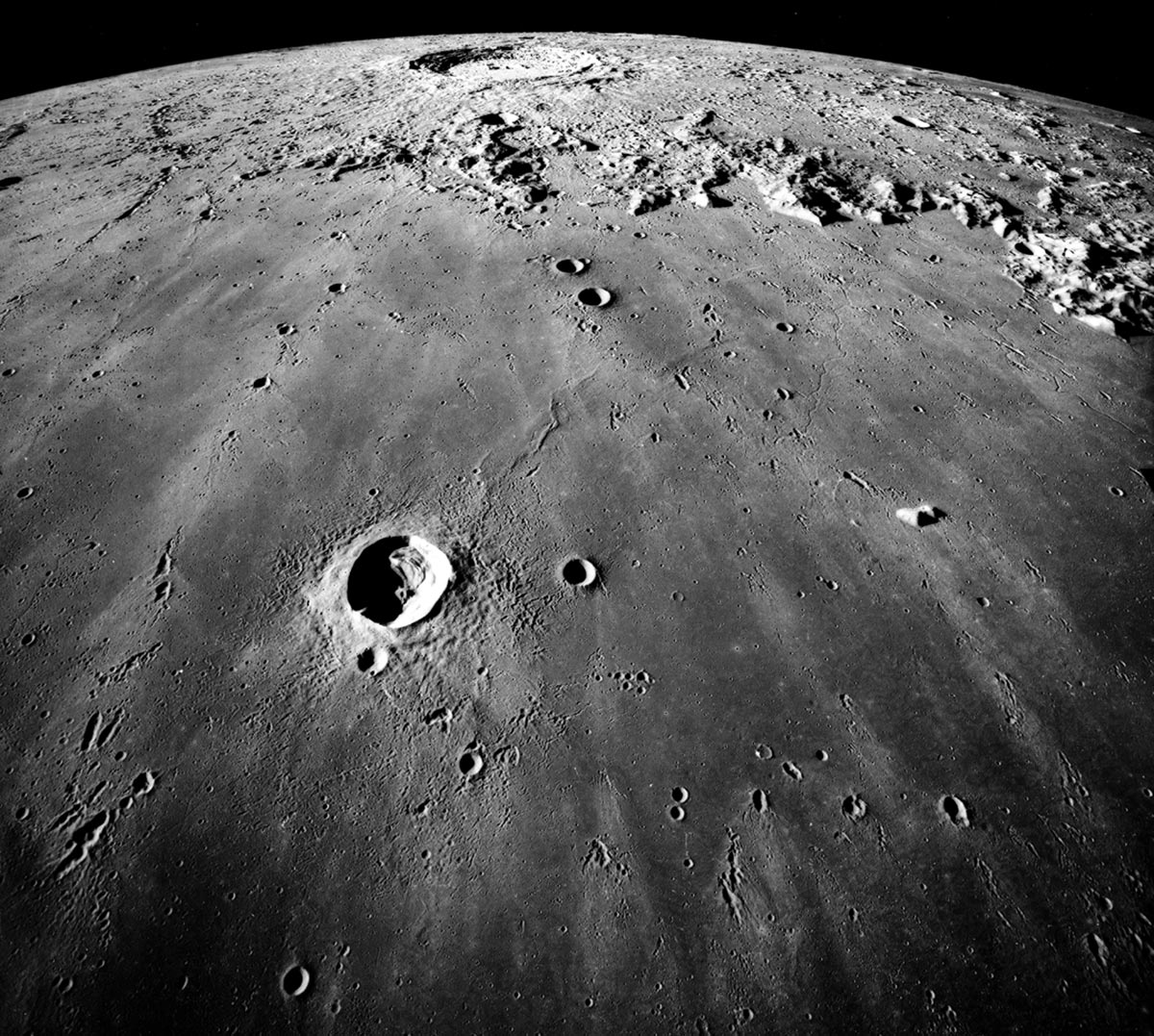
Researchers fhave reconciled conflicting methods of dating the Moon’s surface, revealing that parts of its crust are about 200 million years older than previously thought. The revised dating, achieved by comparing Apollo samples with crater counts and spectroscopy data from various Moon missions, has broad implications for our understanding of lunar and Earth’s early geological history and the origin of life.
Scientists have ‘reset the clock’ for craters on the Moon, meaning that parts of its surface – which characterize the children’s story of the Man in the Moon – are around 200 million years older than had been thought.
Researchers from Norway and France have found a way of coordinating and recalibrating two conflicting systems of dating the surface of the Moon. This new evaluation shows that large parts of the crust of the Moon are around 200 million years older than had been thought and allows the scientists to clarify the sequence of events in the evolution of the Moon’s surface.
The Moon is now geologically pretty inactive, meaning that the craters from asteroids and comets which bombarded the Moon throughout time have not been eroded away; Earth has received a similar barrage throughout time, but the movements on the surface of the Earth will have masked these impacts.
Presenting the work at the Goldschmidt Geochemistry Conference in Lyon, Professor Stephanie Werner (of the Centre for Planetary Habitability, University of Oslo) said:
“Looking at the signs of these impacts on the Moon shows what Earth would be like without the geological churning of plate tectonics which took place here on Earth. What we have done is to show that large portions of the lunar crust are around 200 million years older than had been thought.”
Refining Lunar Dating with Apollo Samples
Researchers have known that the standard way of measuring the age of the surface of the Moon – a process known as crater counting – gave quite different results to that seen when examining rocks from the Apollo missions, especially for the light areas of the moon, the Highlands.
“We decided that we had to reconcile these differences, and that meant correlating individually dated Apollo samples to the number of craters in the sample site surrounding area – in effect, resetting the crater clock. We also correlated them against spectroscopy data from various Moon missions, especially the Indian Chandrayaan-1, to be sure which Apollo sample “belongs” to the surface in which we counted craters. This was a lot of work; we began this project in 2014. We found that by doing this we could resolve the discrepancy and push back the age of the surface of the Moon by up to 200 million years.”
As an example, the age of the Imbrium Basin, filled with the ‘lunar sea’, the Mare Imbrium (visible in the top left of the Moon), which was probably created by the collision of an asteroid impactor around the size of Sicily, goes back from 3.9 billion years ago, to 4.1 billion years ago. The researchers stress that this does not change the estimates of the Moon’s age itself, just the estimate of its surface. The new system of dating changes the age of all areas of the Moon’s surface – not uniformly, but with the oldest surfaces showing greatest changes.
Implications for Early Bombardment of Earth
Professor Werner said “This is an important difference. It allows is to push back in time an intense period of bombardment from space, which we now know took place before extensive volcanic activity that formed the “Man in the Moon” patterns – the mare volcanic plains including Mare Imbrium. As this happened on the Moon, the Earth was almost certain to have also suffered this earlier bombardment too.”
Prof. Audrey Bouvier (University of Bayreuth, Germany) commented “The Moon provides unique records of the early bombardment history. We have had three successful lunar sample return programs (Apollo, Luna, and Chang’e) which have associated rocks with their sampling locations on the Moon. By combining the latest spacecraft observations with impact events recorded by lunar rocks, Prof. Werner and her colleagues have greatly pushed back the records of heavy bombardment onto the terrestrial planets.
Such a heavy bombardment period must have affected the origin and early evolution of life on Earth and potentially other planets such as Mars. Bringing back rock samples from Jezero Crater on Mars will be the next giant leap forward to search for signs of ancient life on another planet in the Solar System, and when.”
This is an independent comment, Professor Bouvier was not involved in this work.
Conference Abstract 15810 Lunar Time Travels – Introduction to a Revised Cratering Chronology Model Stephanie C Werner, Benjamin Bultel, Tobias Rolf
The work on which this presentation is based is in press at the peer-reviewed publication The Planetary Science Journal:
- Bultel, B. S.C. Werner (2023) Sample-Based Spectral Mapping Around Landing Sites on the Moon – Lunar Time Scale Part 1. The Planetary Science Journal, in press.
- Werner, S.C., B. Bultel, T. Rolf (2023) Review and Revision of the Lunar Cratering Chronology – Lunar Time Scale Part 2. The Planetary Science Journal, in press.
Never miss a breakthrough: Join the SciTechDaily newsletter.
Follow us on Google and Google News.