
Close Menu
    Facebook X (Twitter) Instagram
    SciTechDaily
    • Biology
    • Chemistry
    • Earth
    • Health
    • Physics
    • Science
    • Space
    • Technology
    Facebook X (Twitter) Pinterest YouTube RSS
    SciTechDaily
    Home»Science»Materials Scientists Turn Metal Into Glass
    Science

    Materials Scientists Turn Metal Into Glass

    By University of PittsburghAugust 13, 2014No Comments2 Mins Read
    Facebook Twitter Pinterest Telegram LinkedIn WhatsApp Email Reddit
    Share
    Facebook Twitter LinkedIn Pinterest Telegram Email Reddit
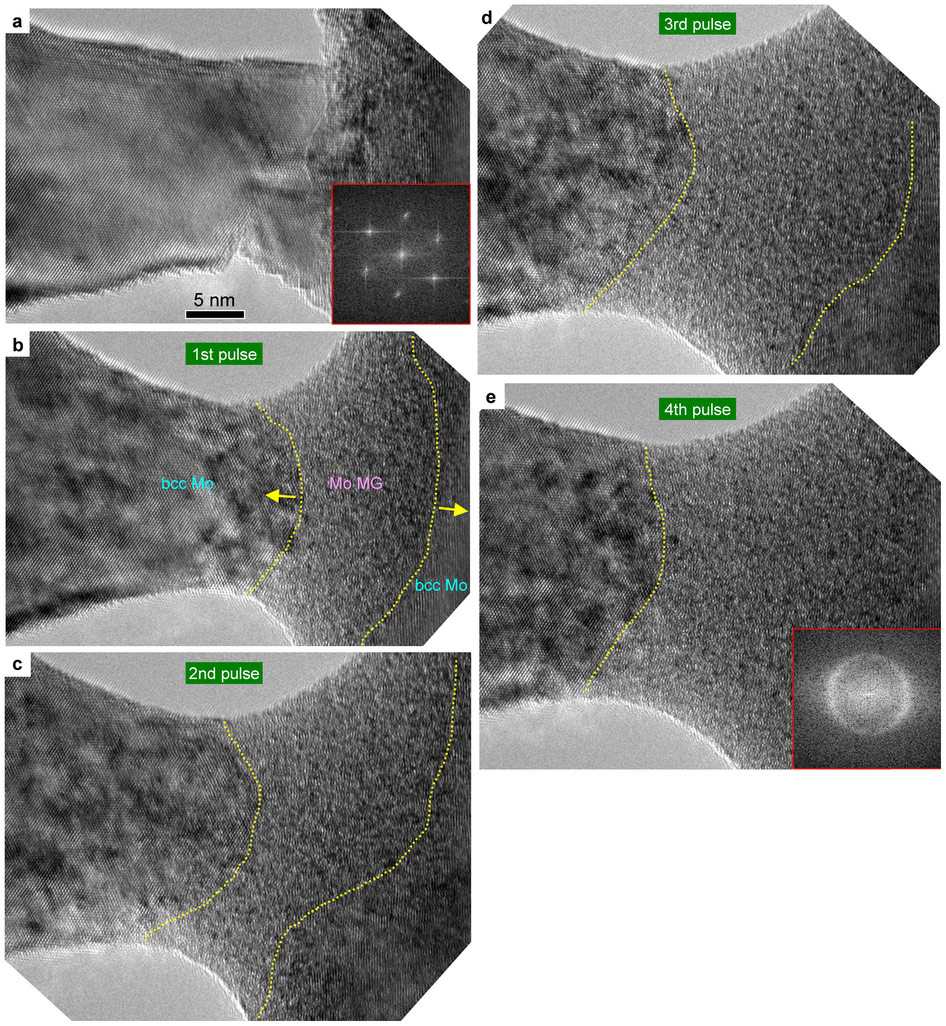
    Formation of Mo MG by Ultrafast Quenching
    a, TEM image of two contacting Mo nano-tips with a well-defined bcc structure viewed along the left fence111right fence zone axis (inset in a). b, Formation of Mo MG under the first vitrification pulse. The GCIs are indicated by yellow dotted curves. c–e, Growth of the Mo MG under subsequent vitrification pulses. The GCIs moved one step away from each other (denoted by two yellow arrows in b) after the second (c), third (d) and fourth (e) pulse, respectively, resulting in the growth of the Mo MG. The amorphous structure is corroborated by the diffuse halos in the fast Fourier transformation (inset in e). Credit: Li Zhong, et al. Nature (2014) doi:10.1038/nature13617

    In a newly published study, University of Pittsburgh researchers report an experimental approach to the formation of monatomic metallic glasses through ultrafast liquid quenching.

    Materials scientists have long sought to form glass from pure, monoatomic metals. Scott X. Mao and colleagues did it.

    Their paper, “Formation of Monoatomic Metallic Glasses Through Ultrafast Liquid Quenching,” was recently published online in Nature, a leading science journal.

    Mao, William, Kepler Whiteford Professor of Mechanical Engineering and Materials Science at the University of Pittsburgh, says, “This is a fundamental issue explored by people in this field for a long time, but nobody could solve the problem. People believed that it could be done, and now we’re able to show that it is possible.”

    Metallic glasses are unique in that their structure is not crystalline (as it is in most metals), but rather is disordered, with the atoms randomly arranged. They are sought for various commercial applications because they are very strong and are easily processed.

    Mao’s novel method of creating metallic glass involved developing and implementing a new technique (a cooling nano-device under in-situ transmission electron microscope) that enabled him and his colleagues to achieve an unprecedentedly high cooling rate that allowed for the transformation of liquefied elemental metals tantalum and vanadium into glass.

    Reference: “Formation of Monoatomic Metallic Glasses Through Ultrafast Liquid Quenching” by Li Zhong, Jiangwei Wang, Hongwei Sheng, Ze Zhang and Scott X. Mao, 6 August 2014, Nature.
    DOI: 10.1038/nature13617


    Never miss a breakthrough: Join the SciTechDaily newsletter.
    Follow us on Google and Google News.

    Materials Science University of Pittsburgh
    Share. Facebook Twitter Pinterest LinkedIn Email Reddit

    Related Articles

    Carbon Nanotubes Show a Love/Hate Relationship With Water

    Microstructures of Plants May Lead to New Bio-Inspired Materials

    Optically Switchable Chiral THz Metamolecules

    Graphite Foam Could Harness Energy from Temperature Gradient in Oceans

    Researchers Uncover Why Lithium Iron Phosphate Works So Well

    Self-Healing Polymer Mechanism Rediscovered After 60 Years

    Scientists Make 3D Objects Invisible to Microwave Wavelengths

    Graphene is Transparent to Water

    Research for High Pressure Materials for DoD Underway

    Leave A Reply Cancel Reply

    • Facebook
    • Twitter
    • Pinterest
    • YouTube

    Don't Miss a Discovery

    Subscribe for the Latest in Science & Tech!

    Trending News

    JWST Finds a “Star” 100 Billion Times Brighter Than Any Star Should Be

    Scientists Find a Hidden Biological Link Across Different Forms of Autism

    Astronomers Discover a Ghostly River of Stars That Could Reveal Dark Matter

    Why Is Colorectal Cancer Rising in People Under 50? New Clues Point to the Environment

    Quantum Fluctuations Break a Crystal’s Symmetry Rules

    Why Does an Irregular Heartbeat Strike 40 Years Early in Some People?

    Scientists Reveal How ADHD Could Fuel Creative Thinking

    Scientists Find Just 3 Minutes of Sprinting Can Transform Blood Chemistry

    Follow SciTechDaily
    • Facebook
    • Twitter
    • YouTube
    • Pinterest
    • Newsletter
    • RSS
    SciTech News
    • Biology News
    • Chemistry News
    • Earth News
    • Health News
    • Physics News
    • Science News
    • Space News
    • Technology News
    Recent Posts
    • Common Plant Chemical Linked to Widespread Organ Damage in Aquatic Animals
    • Scientists Discover a Hidden Baobab Species in Madagascar
    • Dogs and Humans May Share a Surprising Biological Secret to Longevity
    • A 150-Million-Year-Old Dinosaur Flight Mystery May Finally Have an Answer
    • Giant Crocodylians Ruled South America’s Ancient Food Chain
    Copyright © 1998 - 2026 SciTechDaily. All Rights Reserved.
    • Science News
    • About
    • Contact
    • Editorial Board
    • Privacy Policy
    • Terms of Use

    Type above and press Enter to search. Press Esc to cancel.