
Close Menu
    Facebook X (Twitter) Instagram
    SciTechDaily
    • Biology
    • Chemistry
    • Earth
    • Health
    • Physics
    • Science
    • Space
    • Technology
    Facebook X (Twitter) Pinterest YouTube RSS
    SciTechDaily
    Home»Science»Carbon Nanotubes Show a Love/Hate Relationship With Water
    Science

    Carbon Nanotubes Show a Love/Hate Relationship With Water

    By University of PittsburghJanuary 2, 2020No Comments3 Mins Read
    Facebook Twitter Pinterest Telegram LinkedIn WhatsApp Email Reddit
    Share
    Facebook Twitter LinkedIn Pinterest Telegram Email Reddit
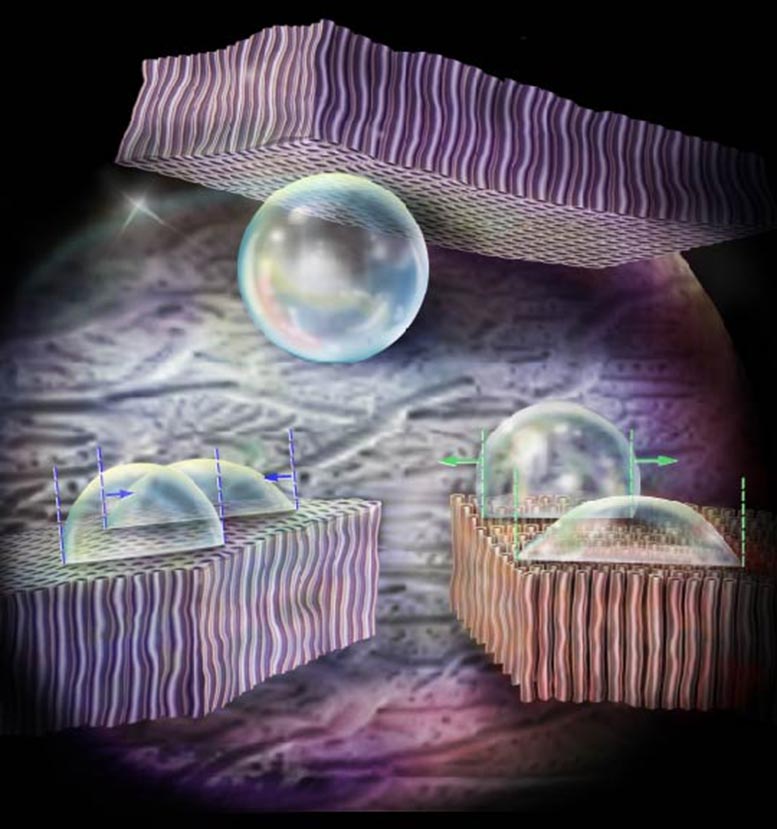
    Carbon Nanotubes and Water Droplets
    An illustration shows the wetting behavior of carbon nanotubes, which both repel water and hold it in place. Credit: University of Pittsburgh

    Carbon nanotubes (CNTs) are valuable for a wide variety of applications. Made of graphene sheets rolled into tubes 10,000 times smaller than a human hair, CNTs have an exceptional strength-to-mass ratio and excellent thermal and electrical properties. These features make them ideal for a range of applications, including supercapacitors, interconnects, adhesives, particle trapping, and structural color.

    New research reveals even more potential for CNTs: as a coating, they can both repel and hold water in place, a useful property for applications like printing, spectroscopy, water transport, or harvesting surfaces. When water is dropped on a CNT forest, the CNTs repel the water, and it forms a sphere. However, when flipped over, the drop does not fall to the ground but rather clings to the surface.
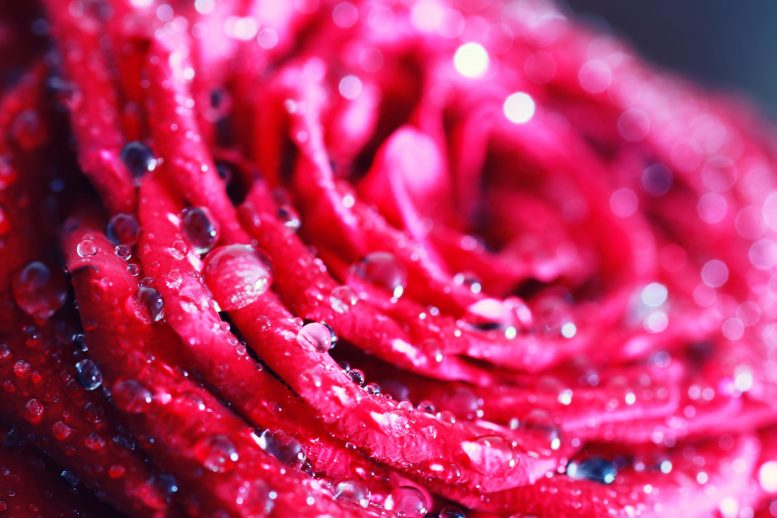
    Wet Red Rose
    Water droplets on a rose petal. Carbon nanotubes as a coating exhibit the same dynamic wetting behaviors as a rose petal.

    “In contrast to superhydrophobic surfaces where droplets roll off easily when tilted, CNTs forests are parahydrophobic, where the droplet is both repelled and attracted to the CNT surface,” explains Ziyu Zhou, lead author of the paper and graduate student in the LAMP Lab.  “It is a love-hate relationship.” 

    The key to this wetting behavior is the use of CNT forests that are densely, vertically packed on the surface, and the inherently hydrophilic CNT surface. The forests are about 100 microns in height and so dense that there are over 100 billion (1011) CNTs in 1 cm2 area.  Some amount of water sinks below the carbon nanotubes and clings to the hydrophilic material, while the rest is repelled into a sphere.

    This research represents the first observation of parahydrophobicity of CNT forests, where the droplet can roll along the surface but does not fall off when turned upside down. Other surfaces in nature such as peach fuzz or rose petals also exhibit this wetting behavior, which may be used for liquid transportation, fabric coating design, membrane selectivity, and even wall-climbing robotics.

    This wetting behavior could also be used as a way to construct CNTs into various arrangements. 

    “Previous research showed CNT forests to be unstable under the application of water, but we show that water droplets are, in fact, stable on these dense CNT forests,” explains Paul Leu, Ph.D., associate professor of industrial engineering at the University of Pittsburgh’s Swanson School of Engineering and author on the paper. “This wetting behavior may be used to assemble CNTs into dense vertical arrays, surface stripes, and other unique shapes that could be used for supercapacitors, interconnects, and other applications.”

    Leu also has appointments in chemical engineering and mechanical engineering and material science. His lab, the Laboratory for Advanced Materials at Pittsburgh (LAMP), conducted the research.

    Reference: “Parahydrophobicity and stick-slip wetting dynamics of vertically aligned carbon nanotube forests” by Ziyu Zhou, Tongchuan Gao, Sean McCarthy, Andrew Kozbial, Susheng Tan, David Pekker, Lei Li and Paul W. Le, 7 June 2019, Carbon.
    DOI: 10.1016/j.carbon.2019.06.012

    Never miss a breakthrough: Join the SciTechDaily newsletter.
    Follow us on Google and Google News.

    Carbon Nanotubes Materials Science University of Pittsburgh Water
    Share. Facebook Twitter Pinterest LinkedIn Email Reddit

    Related Articles

    Defying Limits: Discovery of New Membrane Behavior Could Lead to Unprecedented Separations

    Water-Repellent Plastrons Keep Surfaces Dry for Months Underwater

    Pollution Solution: New Device Can Capture 99.9% of Microplastics in Water Using Wood Dust

    Bathing in Bacteria: The Unexpected Dangers in Your Daily Shower

    99% Efficiency: Princeton Engineers Have Developed a New Way To Remove Microplastics From Water

    Low-Cost Gel Harvests Drinking Water From Dry Desert Air

    Solving a Natural Riddle of Water Filtration to Create Clean Water While Consuming Less Energy

    Purifying Carbon Nanotubes Using Dietary Fiber Is Cheap and Effective

    Materials Scientists Turn Metal Into Glass

    Leave A Reply Cancel Reply

    • Facebook
    • Twitter
    • Pinterest
    • YouTube

    Don't Miss a Discovery

    Subscribe for the Latest in Science & Tech!

    Trending News

    Breakthrough Bowel Cancer Trial Leaves Patients Cancer-Free for Nearly 3 Years

    Natural Compound Shows Powerful Potential Against Rheumatoid Arthritis

    100,000-Year-Old Neanderthal Fossils in Poland Reveal Unexpected Genetic Connections

    Simple “Gut Reset” May Prevent Weight Gain After Ozempic or Wegovy

    2.8 Days to Disaster: Scientists Warn Low Earth Orbit Could Suddenly Collapse

    Common Food Compound Shows Surprising Power Against Superbugs

    5 Simple Ways To Remember More and Forget Less

    The Atomic Gap That Could Cost the Semiconductor Industry Billions

    Follow SciTechDaily
    • Facebook
    • Twitter
    • YouTube
    • Pinterest
    • Newsletter
    • RSS
    SciTech News
    • Biology News
    • Chemistry News
    • Earth News
    • Health News
    • Physics News
    • Science News
    • Space News
    • Technology News
    Recent Posts
    • ADHD Isn’t Just a Deficit: Study Reveals Powerful Hidden Strengths
    • Scientists Uncover “Astonishing” Hidden Property of Light
    • Scientists Discover Stem Cells That Could Regrow Teeth and Bone
    • Scientists Discover Natural Molecule That Stops Alzheimer’s Protein Clumps From Forming
    • Early Cannabis Use May Stall Key Brain Skills in Teens
    Copyright © 1998 - 2026 SciTechDaily. All Rights Reserved.
    • Science News
    • About
    • Contact
    • Editorial Board
    • Privacy Policy
    • Terms of Use

    Type above and press Enter to search. Press Esc to cancel.