
Close Menu
    Facebook X (Twitter) Instagram
    SciTechDaily
    • Biology
    • Chemistry
    • Earth
    • Health
    • Physics
    • Science
    • Space
    • Technology
    Facebook X (Twitter) Pinterest YouTube RSS
    SciTechDaily
    Home»Physics»Aligned “Metallic” Carbon Nanotubes Convert Heat to Electrical Energy With Higher Power Output
    Physics

    Aligned “Metallic” Carbon Nanotubes Convert Heat to Electrical Energy With Higher Power Output

    By Tokyo Metropolitan UniversityDecember 2, 2019No Comments3 Mins Read
    Facebook Twitter Pinterest Telegram LinkedIn WhatsApp Email Reddit
    Share
    Facebook Twitter LinkedIn Pinterest Telegram Email Reddit
    Aligned Metallic Carbon Nanotubes
    This is an illustration of aligned metallic carbon nanotubes in the team’s thermoelectric device. A temperature gradient causes an electrical current to flow. Credit: Tokyo Metropolitan University

    Solving the thermoelectric ‘trade-off’ conundrum in metallic carbon nanotubes with strategy to bypass trade-off between thermoelectric voltage and conductivity.

    Scientists from Tokyo Metropolitan University have used aligned “metallic” carbon nanotubes to create a device which converts heat to electrical energy (a thermoelectric device) with a higher power output than pure semiconducting carbon nanotubes (CNTs) in random networks. The new device bypasses the troublesome trade-off in semiconductors between conductivity and electrical voltage, significantly outperforming its counterpart. High power thermoelectric devices may pave the way for more efficient use of waste heat, like wearable electronics.

    Thermoelectric devices can directly convert heat to electricity. When we think about the amount of wasted heat in our environment like in air conditioning exhausts, vehicle engines or even body heat, it would be revolutionary if we could somehow scavenge this energy back from our surroundings and put it to good use. This goes some way to powering the thought behind wearable electronics and photonics, devices which could be worn on the skin and powered by body heat. Limited applications are already available in the form of body heat powered lights and smartwatches.
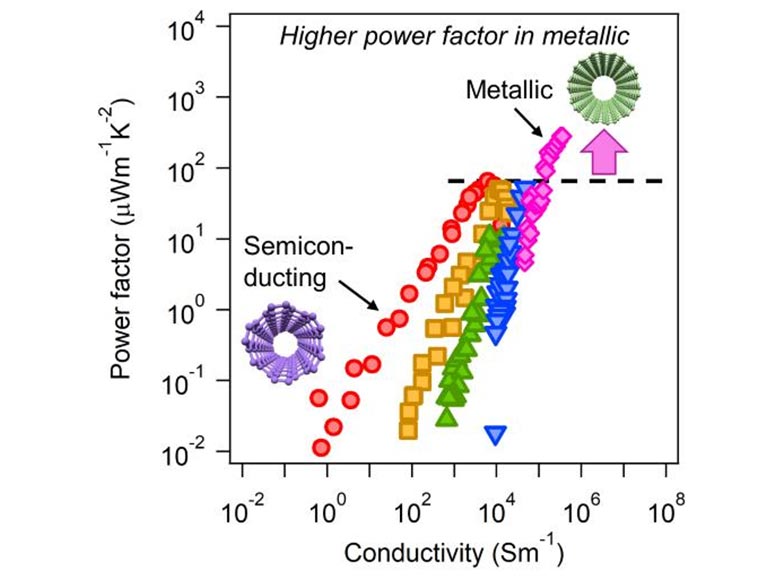
    Power Factor Vs. Conductivity for Purely Semiconducting and Metallic CNT Films
    Power factor vs. conductivity for purely semiconducting and metallic CNT films. The proportion of metallic CNTs increases from left to right. The plot all the way to the right corresponds to aligned metallic CNT films. They exhibit significantly higher power than all the other films. Credit: Tokyo Metropolitan University

    The power extracted from a thermoelectric device when a temperature gradient is formed is affected by the conductivity of the device and the Seebeck coefficient, a number indicating how much electrical voltage is generated with a certain difference in temperature. The problem is that there is a trade-off between the Seebeck coefficient and conductivity: the Seebeck coefficient drops when the device is made more conductive. To generate more power, we ideally want to improve both.

    Semiconducting materials are generally considered superior candidates for high-performance thermoelectric devices. However, a team led by Prof. Kazuhiro Yanagi of Tokyo Metropolitan University met an unlikely hero in the form of “metallic” CNTs. Unlike purely semiconducting CNTs, they found that they could simultaneously enhance both the conductivity and Seebeck coefficient of metallic CNTs, breaking the trade-off between these two key quantities. The team went on to show that these unique characteristics arose from the one-dimensional metallic electronic structure of the material. Furthermore, they were able to align the orientation of the metallic CNTs, achieving an output which was nearly five times that of films of randomly oriented pure semiconducting CNTs.

    Not only will high-performance thermoelectric elements let us use body heat to power our smartphones, the potential biomedical applications will ensure that they play an important role in everyday applications in the future.

    Reference: “Solving the Thermoelectric Trade-Off Problem with Metallic Carbon Nanotubes” by Yota Ichinose, Akari Yoshida, Kanako Horiuchi, Kengo Fukuhara, Natsumi Komatsu, Weilu Gao, Yohei Yomogida, Manaho Matsubara, Takahiro Yamamoto, Junichiro Kono and Kazuhiro Yanagi, 5 September 2019, Nano Letters.
    DOI: 10.1021/acs.nanolett.9b03022

    This work was supported by the JSPS KAKENHI Program through Grant Numbers JP17H06124, JP17H01069, and JP18H01816, and the JST CREST Program through Grant Number JPMJCR17I5.

    Never miss a breakthrough: Join the SciTechDaily newsletter.
    Follow us on Google and Google News.

    Carbon Nanotubes Nanotechnology Semiconductors Tokyo Metropolitan University
    Share. Facebook Twitter Pinterest LinkedIn Email Reddit

    Related Articles

    Better Imperfections: Optically Active Defects Improve Carbon Nanotubes

    Catching Electrons in Action in an Antiferromagnetic Nanowire for Ultrahigh-Density Data Storage

    Switching Nanolight On and Off: A New Way to Program Light on an Ultra-Small Scale

    Solid-State Laser Refrigeration of Nanoscale Sensors Achieved – Could Revolutionize Bio-Imaging and Quantum Communication

    Physics Process Yielding Nanolasers in 2D Semiconductors Could Be Game-Changer for High Speed Communications

    Light Trapped in Nanoresonators for Record Time – Could Enable Night Vision Devices

    Researchers Surprised When Nano-Guitar String Plays Itself – Nano-Electronic Circuit Vibrates Without Any External Force

    Physicists Discover Negative Photoconductivity in Monolayer MoS2

    New Quantum Dots Design for Solotronics

    Leave A Reply Cancel Reply

    • Facebook
    • Twitter
    • Pinterest
    • YouTube

    Don't Miss a Discovery

    Subscribe for the Latest in Science & Tech!

    Trending News

    Enormous Prehistoric Insects Puzzle Scientists

    Scientists Develop Bioengineered Chewing Gum That Could Help Fight Oral Cancer

    After 37 Years, the World’s Longest-Running Soil Warming Experiment Uncovers a Startling Climate Secret

    NASA Satellite Captures First-Ever High-Res View of Massive Pacific Tsunami

    ADHD Isn’t Just a Deficit: Study Reveals Powerful Hidden Strengths

    Scientists Discover Stem Cells That Could Regrow Teeth and Bone

    Early Cannabis Use May Stall Key Brain Skills in Teens

    Popular Vitamin D Supplement Has “Previously Unknown” Negative Effect, Study Finds

    Follow SciTechDaily
    • Facebook
    • Twitter
    • YouTube
    • Pinterest
    • Newsletter
    • RSS
    SciTech News
    • Biology News
    • Chemistry News
    • Earth News
    • Health News
    • Physics News
    • Science News
    • Space News
    • Technology News
    Recent Posts
    • Darwin’s Islands Still Evolving: Giant Daisies Rewrite the Rules of Evolution
    • Ancient Document Confirms “Legendary” African King Actually Existed
    • First-of-Its-Kind Discovery: Homer’s Iliad Found Embedded in a 1,600-Year-Old Egyptian Mummy
    • Beyond Inflammation: Scientists Uncover New Cause of Persistent Rheumatoid Arthritis
    • Cancer-Like Mutations Found in the Brain May Be Driving Alzheimer’s Disease
    Copyright © 1998 - 2026 SciTechDaily. All Rights Reserved.
    • Science News
    • About
    • Contact
    • Editorial Board
    • Privacy Policy
    • Terms of Use

    Type above and press Enter to search. Press Esc to cancel.