
Close Menu
    Facebook X (Twitter) Instagram
    SciTechDaily
    • Biology
    • Chemistry
    • Earth
    • Health
    • Physics
    • Science
    • Space
    • Technology
    Facebook X (Twitter) Pinterest YouTube RSS
    SciTechDaily
    Home»Science»Like Nothing Seen Before – New Type of Wasp Discovered With Mysterious, Cloud-Like Structures at Ends of Antennae
    Science

    Like Nothing Seen Before – New Type of Wasp Discovered With Mysterious, Cloud-Like Structures at Ends of Antennae

    By Oregon State UniversityOctober 9, 20233 Comments3 Mins Read
    Facebook Twitter Pinterest Telegram LinkedIn WhatsApp Email Reddit
    Share
    Facebook Twitter LinkedIn Pinterest Telegram Email Reddit
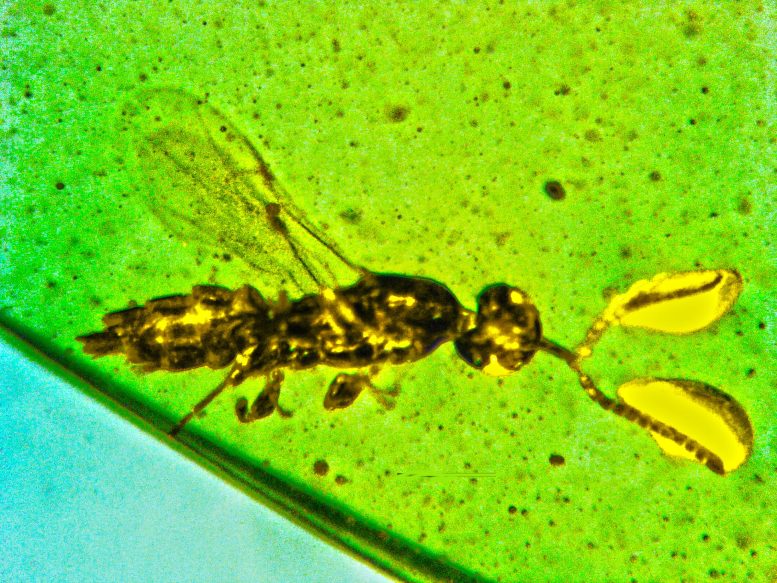
    Caradiophyodus saradae
    Researchers discovered a new genus and species of micro-wasp with unique bulbous structures on its antennae from 100-million-year-old Burmese amber. The origin and purpose of these structures remain a mystery, with no similar features found on any known insect. Credit: Photo provided by George Poinar Jr., OSU College of Science.

    A Unique Discovery in Amber

    Fossil researchers have discovered a novel genus and species of tiny wasp with a mysterious, bulbous structure at the end of each antenna.

    The female micro-wasp was described from 100-million-year-old Burmese amber in a study led by George Poinar Jr., who holds a courtesy appointment at the Oregon State University College of Science.

    Speculating on the Mysterious “Clouds”

    Poinar and Fernando Vega, an independent researcher based in Silver Spring, Maryland, have some ideas about the “clouds” on the antennae, but they don’t know for sure what they are.

    “We could find no fossil or extant insect with such antennal structures,” said Poinar, an international expert in using plant and animal life forms preserved in amber to learn about the biology and ecology of the distant past. “We wondered how it could still fly with that weight.”

    Characteristics of Micro-Wasps

    Micro-wasps are defined as those with an adult body length of less than 2 millimeters. There are thousands of species of these parasitic insects around today, spread among hundreds of genera, Poinar said. Some are useful for controlling scale insects, which can be crop pests, he added.

    “This micro-wasp has a length of only 1.3 millimeters,” Poinar said. “That, as well as its 15-segment antennae, a deep cleft in the center of its head, and characters of the wings distinguish it from all other micro-wasps. The unique, miniature cloudlike structures stuck to the antennae must have certainly been an annoyance to this tiny parasite.”  

    Possible Theories About the Antennal Structures

    Since the researchers could not find such structures on any other insect, current or extinct, they can only make educated guesses as to what they could be.

    “They could be tiny plant seeds, plant secretions, or eggs from a host the wasp was parasitizing,” Poinar said. “There is a good possibility the micro-wasp was parasitizing scale insects since there is a male scale insect embedded in the same piece of amber.  Whatever they are, discovering these is one of the things that makes our work so interesting, and challenging: finding dominant, unique features on extinct organisms.”

    Naming the New Specimen

    The scientists named the new specimen Caradiophyodus saradae. The genus takes its name from the Greek words for head (kara) and cleft (diaphyodus), and the species name is a nod to fellow scientist Sarada Krishnan.

    Reference: “Caradiophyodidae, a New Family of Micro-Wasps (Hymenoptera: Platygastroidea) Based on the Description of Caradiophyodus saradae gen. et sp. nov. in Mid-Cretaceous Burmese Amber” by George Poinar Jr. and Fernando E. Vega, 7 August 2023, Life.
    DOI: 10.3390/life13081698

    Never miss a breakthrough: Join the SciTechDaily newsletter.
    Follow us on Google and Google News.

    Amber Fossils New Species Oregon State University Paleontology Popular Wasp
    Share. Facebook Twitter Pinterest LinkedIn Email Reddit

    Related Articles

    Historic Discovery: Ancient Venomous Reptile Species Discovered in Arizona

    Giant Horned Lokiceratops: Remarkable New Dinosaur Unearthed in the Ancient Swamps of Montana

    Paleontology Plot Twist: New Research Shows Nanotyrannus Is Separate Species, Not “Juvenile T. rex”

    One of the Oldest Ever Found: New Ancient “Marine Crocodile” Discovered

    Fearsome New Species of Stegosaur May Be the Oldest Ever Discovered in the World

    Triassic Archosaur Fossils Excavated in the 1960s Add Missing Link to Crocodile Evolution

    Kyhytysuka: 130-Million-Year-Old Hypercarnivore “Fish Lizard” Discovered

    New Species of Tardigrade (Water Bear) Discovered in 16 Million-Year-Old Dominican Amber

    Giant Waikato Penguin: School Kids in New Zealand Discover New Species

    3 Comments

    1. Mous on October 9, 2023 8:41 pm

      something like a volatile pheromone maybe? Or a biological off gas as it decomposes

      Reply
    2. Matthew Lewis on October 13, 2023 9:02 pm

      Test the tips for anything acidic. Fruit flies bite to.maybe prior to being fossilized that creature was doing a survival routine that was normal.back then.also what kind of gas could have left the antenna after death or during life

      Reply
    3. Matthew Lewis on October 13, 2023 9:03 pm

      God is awesome

      Reply
    Leave A Reply Cancel Reply

    • Facebook
    • Twitter
    • Pinterest
    • YouTube

    Don't Miss a Discovery

    Subscribe for the Latest in Science & Tech!

    Trending News

    “I Couldn’t Do It Anymore” – Antarctic Guides Quit Their Dream Jobs After Witnessing Tourism’s Damage

    Scientists Say Eating Less Protein May Help You Live Longer

    Scientists Solve a Long-Standing Mystery About Bird and Dinosaur Eggs

    Belly Fat and Low Vitamin D May More Than Double the Risk of Early Death

    Lost in Space: Rare Cosmic Flare Exposes a Wandering Black Hole Far From Its Galaxy’s Center

    Dark Matter May Be Leaving a Signal in Earth’s Atmosphere

    Scientists Discover a 300-Million-Year-Old Geological Time Capsule Inside Fossilized Wood

    Oral Weight Loss Pill Helps Patients Lose up to 12% of Body Weight

    Follow SciTechDaily
    • Facebook
    • Twitter
    • YouTube
    • Pinterest
    • Newsletter
    • RSS
    SciTech News
    • Biology News
    • Chemistry News
    • Earth News
    • Health News
    • Physics News
    • Science News
    • Space News
    • Technology News
    Recent Posts
    • Industrial Chicken Farming Is Supercharging the Spread of a Dangerous Foodborne Bacterium
    • Honeybee Queens May Pass Toxic Chemicals to the Next Generation
    • This Common Amino Acid May Help the Body Fight Cancer and Viruses
    • Schizophrenia’s Brain Damage May Start in One Key Region
    • A Simple Treatment Could Save Extremely Premature Babies From Blindness
    Copyright © 1998 - 2026 SciTechDaily. All Rights Reserved.
    • Science News
    • About
    • Contact
    • Editorial Board
    • Privacy Policy
    • Terms of Use

    Type above and press Enter to search. Press Esc to cancel.