

Close Menu
    Facebook X (Twitter) Instagram
    SciTechDaily
    • Biology
    • Chemistry
    • Earth
    • Health
    • Physics
    • Science
    • Space
    • Technology
    Facebook X (Twitter) Pinterest YouTube RSS
    SciTechDaily
    Home»Technology»Redefining Electronics: Ferroelectric Material Is Now Elastic
    Technology

    Redefining Electronics: Ferroelectric Material Is Now Elastic

    By Chinese Academy of SciencesOctober 18, 20231 Comment3 Mins Read
    Facebook Twitter Pinterest Telegram LinkedIn WhatsApp Email Reddit
    Share
    Facebook Twitter LinkedIn Pinterest Telegram Email Reddit
    Advanced Material Technology
    A research team has developed a “slight crosslinking” approach, enhancing the elasticity of ferroelectric materials. This breakthrough, termed “elastic ferroelectrics,” offers potential advancements in wearable electronics and smart healthcare.

    A research group led by Prof. Li Runwei at the Ningbo Institute of Materials Technology and Engineering (NIMTE) of the Chinese Academy of Sciences (CAS) has proposed a “slight crosslinking” method that imparts elastic recovery to ferroelectric materials.

    The study was recently published in the journal Science.

    Importance of Ferroelectric Materials

    Ferroelectric materials are very useful for applications such as data storage and processing, sensing, energy conversion, and optoelectronics, etc., making them highly desirable in mobile phones, tablets, and other electronic devices for everyday use.

    After stress is relieved, however, conventional ferroelectric materials exhibit poor elastic recovery—typically less than 2%, and thus tend to be either brittle (ferroelectric ceramics) or plastic (ferroelectric polymers).
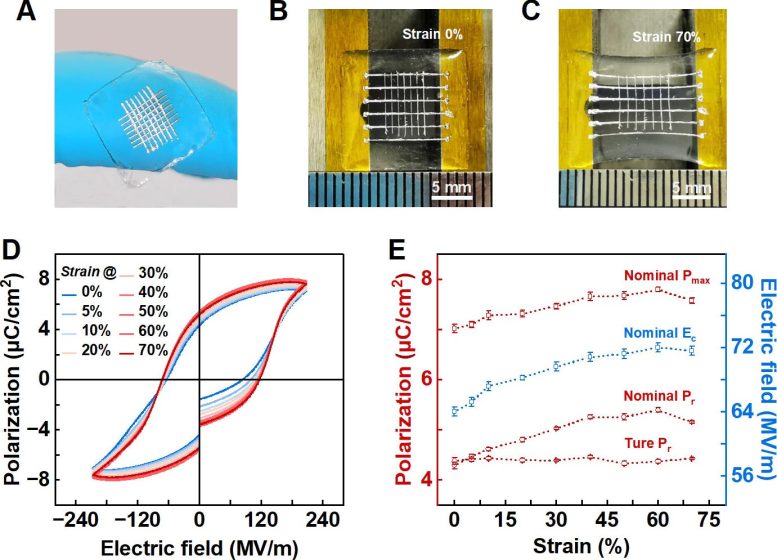
    The Elastic Ferroelectrics Under 70% Strain
    The elastic ferroelectrics under 70% strain. Credit: NIMTE

    The ferroelectric properties of these materials are mainly due to their crystalline regions, which lack intrinsic elasticity.

    The “Slight Crosslinking” Solution

    To solve the dilemma of ferroelectric response and elastic recovery, the researchers developed a precise “slight crosslinking” method.

    By using poly(vinylidene fluoride–trifluoroethylene) as the matrix material and soft-long-chain polyethylene oxide diamine as the crosslinker, the researchers established a network structure in linear ferroelectric polymers.

    By precisely controlling the crosslinking density at 1–2%, the crosslinked ferroelectric film mainly exhibited a β-phase crystalline structure and was uniformly dispersed in the crosslinked polymer network.

    Under stress, the network structure can evenly distribute and bear external forces, thereby mitigating damage to the crystalline regions. Thus, these newly developed ferroelectrics combine elasticity with relatively high crystallinity. Experimental results also showed that the cross-linked film retained a stable ferroelectric response and elastic recovery even under strains up to 70%.

    Expert Insights

    “Based on their study,” said Prof. XIONG Rengen, an internationally renowned expert in ferroelectric materials, “Gao et al. have established a new research direction, elastic ferroelectrics.”

    Elastic ferroelectrics such as these, with excellent resistance to mechanical and ferroelectric fatigue, have broad application prospects in wearable electronics and smart healthcare.

    Reference: “Intrinsically elastic polymer ferroelectric by precise slight cross-linking” by Liang Gao, Ben-Lin Hu, Linping Wang, Jinwei Cao, Ri He, Fengyuan Zhang, Zhiming Wang, Wuhong Xue, Huali Yang and Run-Wei Li, 3 August 2023, Science.
    DOI: 10.1126/science.adh2509

    This work was supported by the National Natural Science Foundation of China, the Zhejiang Province Qianjiang Talent Program, and the K.C. Wong Education Foundation, among others.

    Never miss a breakthrough: Join the SciTechDaily newsletter.
    Follow us on Google and Google News.

    Chinese Academy of Sciences Ferroelectric Materials Materials Science
    Share. Facebook Twitter Pinterest LinkedIn Email Reddit

    Related Articles

    Scientists Develop the World’s First Rechargeable Hydride Ion Battery

    Beyond Graphene: Scientists Create Ultra-Thin 2D Metals for the First Time

    The Hidden Material Breakthrough That Could Supercharge AI and Save Energy

    Atomic Spray Painting Transforms Material Science for Greener Tech

    Chinese Researchers Solve Key Electronics Challenge With Pure Gold Microspheres

    From Lab Curiosity to Industrial Reality: The New Dawn of Transition Metal Telluride Nanosheets

    Ultra-High Energy Absorption Breakthrough: Chinese Researchers Unveil Game-Changing Nanolattice Metamaterials

    Unexpected Behavior – Bending 2D Nanomaterial Could “Switch On” Future Technologies

    Researchers Develop World’s Lightest Material

    1 Comment

    1. Shan on January 1, 2024 9:24 am

      Ummm, this was known and duocumented by citizen scientist Forrest Mimms III in the 1980’s.

      Reply
    Leave A Reply Cancel Reply

    • Facebook
    • Twitter
    • Pinterest
    • YouTube

    Don't Miss a Discovery

    Subscribe for the Latest in Science & Tech!

    Trending News

    A Nutrient Found in Red Meat Could Make Dangerous Inflammation Even Worse

    Scientists Discover How Dead Stars Could Break One of Physics’ Most Famous Limits

    A Natural Compound Found in Everyday Foods Shows Surprising Power Against Lung Cancer

    Do Spiders Dream? Scientists Discover a Mysterious Sleep State

    Eating a Handful of Peanuts Could Change Your Blood in a Surprising Way, Study Finds

    Scientists Create Stunning, Car-Quality Paint Without Using a Single Pigment

    Scientists Challenge a Long-Held Belief About Artificial Sweeteners

    Did Venus Eat Its Own Moon? Scientists Uncover a Shocking Possibility

    Follow SciTechDaily
    • Facebook
    • Twitter
    • YouTube
    • Pinterest
    • Newsletter
    • RSS
    SciTech News
    • Biology News
    • Chemistry News
    • Earth News
    • Health News
    • Physics News
    • Science News
    • Space News
    • Technology News
    Recent Posts
    • Trapped in Amber for 99 Million Years, a Lizard’s Tail Reveals an Ancient Survival Secret
    • 120 Million Years Ago, Something Extraordinary Was Happening in Earth’s Oceans
    • Comets Probably Didn’t Bring Life’s Ingredients to Earth After All, New Study Reveals
    • The Mystery of Hair Growth Patterns May Finally Have a Simple Explanation
    • Human-Elephant Conflict Could Explode Across Southern Africa As Scientists Warn of a Growing Crisis
    Copyright © 1998 - 2026 SciTechDaily. All Rights Reserved.
    • Science News
    • About
    • Contact
    • Editorial Board
    • Privacy Policy
    • Terms of Use

    Type above and press Enter to search. Press Esc to cancel.