
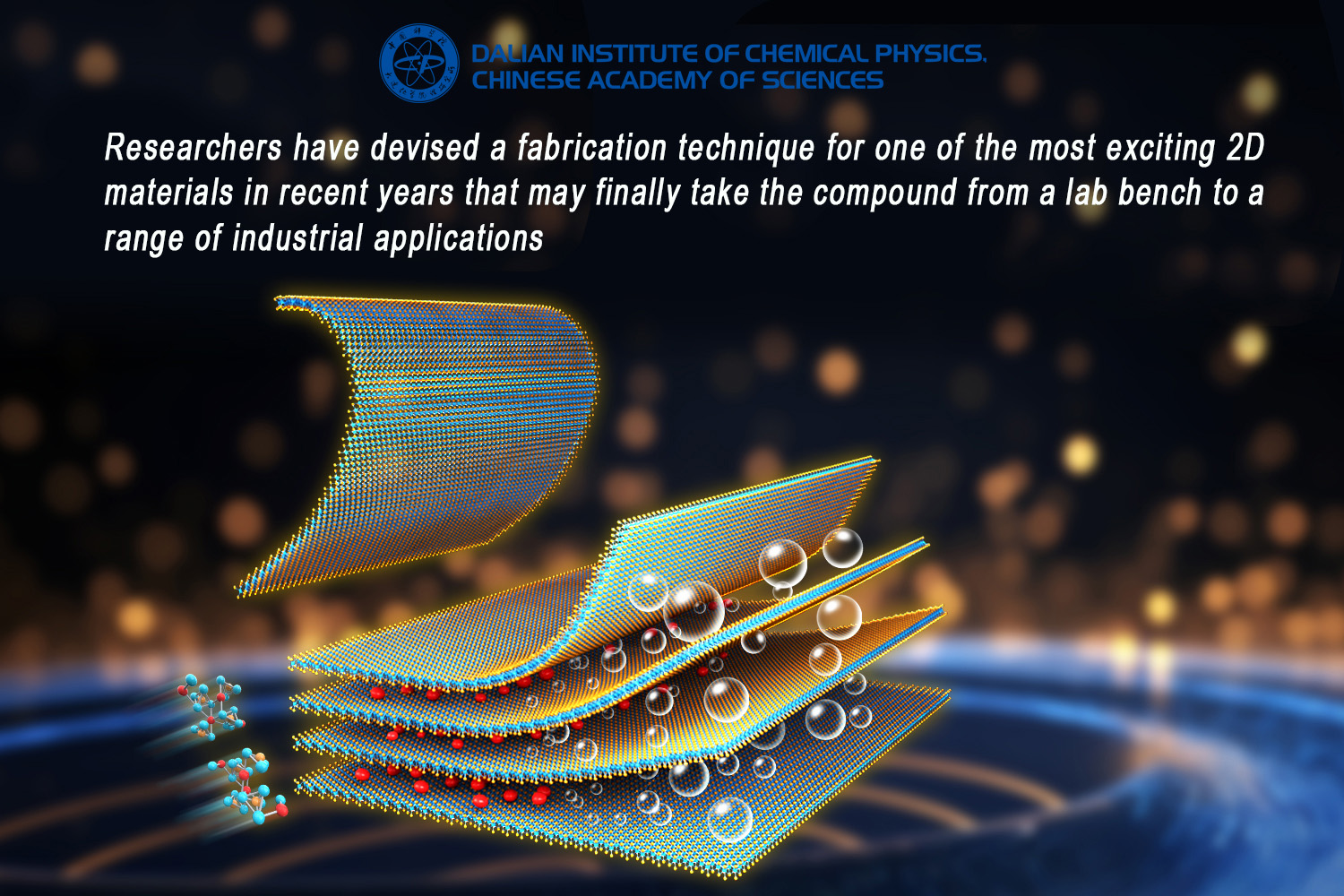
Nanosheets made from transition metal tellurides have demonstrated significant potential for basic research and applications in various fields, yet until recently, their large-scale production has been unattainable, relegating them to the status of a mere laboratory novelty rather than a practical industrial material. But a team of researchers has recently developed a novel fabrication technique—the use of chemical solutions to peel off thin layers from their parent compounds, creating atomically thin sheets—that looks set to finally deliver on the ultra-thin substance’s promise.
The researchers describe their fabrication technique in a study published in Nature on April 3.
In the world of ultra-thin or ‘two-dimensional’ materials—those containing just a single layer of atoms—transition metal telluride (TMT) nanosheets have in recent years caused great excitement amongst chemists and materials scientists for their particularly unusual properties. These compounds, made of tellurium and any of the elements in the ‘middle’ of the periodic table (groups 3-12), enjoy a range of states from semi metallic to semiconducting, insulating, and superconducting, and even more exotic states, as well as magnetic and unique catalytic activity.
These properties offer a range of potential applications across electronics, energy storage, catalysis, and sensing. In particular, TMT nanosheets are being explored as novel electrode materials in batteries and supercapacitors—essential for the clean transition—due to their high conductivity and large surface area.
Potential Applications and Challenges
TMT nanosheets can also be used as electrocatalysts for lithium-oxygen batteries, improving their efficiency and performance. Other potential applications in emerging technologies include photovoltaics and thermoelectrics, hydrogen production, and filtration and separation. They have even been found to display interesting quantum phenomena, such as quantum oscillations and giant magnetoresistance.
“The list of industries that would enjoy significant efficiency improvements from the mass production of TMT nanosheets is extremely long,” said team leader WU Zhong-Shuai, a chemist with the Dalian Institute of Chemical Physics (DICP), Chinese Academy of Sciences. “This is why this 2D material is potentially so exciting.”
Unfortunately, despite various attempts at exfoliation of high-quality TMT nanosheets, preserving high crystallinity while achieving large nanosheet size and ultrathin feature continues to be a significant challenge. The methods devised so far are not scalable due to long processing times. They also often require toxic chemicals. Thus, the properties of TMT nanosheets have remained an interesting laboratory phenomenon that cannot quite make the leap to mass production and industrial application.
Breakthrough in Mass Production
The team finally cracked this problem via a simplified process of lithiation, hydrolysis, and finally the nanosheet exfoliation.
First, a bulk quantity of metal telluride crystals was prepared using chemical vapor transport—a method commonly used in chemistry to transport solid compounds from one location to another using a carrier gas. When the reaction vessel is heated, the transporting agent vaporizes and carries the solid compound with it as a vapor. The vapor travels through the reaction vessel and may encounter a cooler surface, where the compound can deposit and form crystals. This allows for the controlled growth of crystals or very thin films of the desired compound. In this case, the prepared telluride crystals are then mixed with lithium borohydride. This process involves the placing of lithium ions in between the layers of the metal telluride crystals, leading to the formation of an intermediate, ‘lithiated’ compound.
The lithiated intermediate compound is then rapidly drenched with water, which results in “exfoliation,” or stripping of the lithiated metal telluride crystals into nanosheets in seconds.
Finally, the exfoliated metal telluride nanosheets are collected and characterized based on their shape and size, allowing them to be further processed into different forms such as films, inks, and composites, depending on the desired application.
The whole process takes just ten minutes for the lithiation and seconds for the hydrolysis. The technique is capable of producing high-quality TMT nanosheets of varying desired thicknesses with very high yields.
When testing the nanosheets, the researchers found that their charge storage, high-rate capacity, and stability made them promise for applications in lithium batteries and micro-supercapacitors.
They believe that their technique is essentially ready for commercialization, but they also want to conduct further studies to characterize the properties and behavior of their nanosheets, as well as further refine and optimize the lithiation and exfoliation stages.
Reference: “Metal telluride nanosheets by scalable solid lithiation and exfoliation” by Liangzhu Zhang, Zixuan Yang, Shun Feng, Zhuobin Guo, Qingchao Jia, Huidan Zeng, Yajun Ding, Pratteek Das, Zhihong Bi, Jiaxin Ma, Yunqi Fu, Sen Wang, Jinxing Mi, Shuanghao Zheng, Mingrun Li, Dong-Ming Sun, Ning Kang, Zhong-Shuai Wu and Hui-Ming Cheng, 3 April 2024, Nature.
DOI: 10.1038/s41586-024-07209-2
Never miss a breakthrough: Join the SciTechDaily newsletter.
Follow us on Google and Google News.