
Mechanical Metamaterials Fabricated With Ultra-high Energy Absorption Capacity
Researchers have created a nanolattice metamaterial with ultra-high energy absorption capacity using ion track technology, achieving a record low beam diameter of 34 nm and demonstrating excellent energy absorption and compressive strength.
Chinese researchers have successfully fabricated mechanical metamaterials with ultra-high energy absorption capacity using the ion track technology. The results were published in Nature Communications as Editors’ Highlights.
The study was conducted by researchers from the Materials Research Center of the Institute of Modern Physics (IMP) of the Chinese Academy of Sciences (CAS) and their collaborators from Chongqing University.
Mechanical metamaterials refer to a class of composite materials with artificially designed structures, which exhibit extraordinary mechanical properties that traditional materials do not have. Among them, energy absorption mechanical metamaterials can absorb mechanical energy more efficiently, which requires the material itself to equip both high strength and high strain capacity, which, however, hardly co-exist in general.
The Promise of Nanolattice Metamaterials
Nanolattice is a new class of mechanical metamaterials with characteristic sizes on the nanoscale. Due to size effects, geometrical configuration, and material selection, the mechanical properties of this type of porous materials are very different from those of bulk materials. Given its even better mechanical properties with lighter weight, nanolattice is expected to bring revolutionary applications in the field of high-performance functional materials in the future.
Beam-structured nanolattice is the research focus of nanolattice metamaterials. However, it has been so challenging to fabricate metallic beam nanolattice with beam diameter less than 100 nm, and thus its mechanical properties still remain ambiguous.
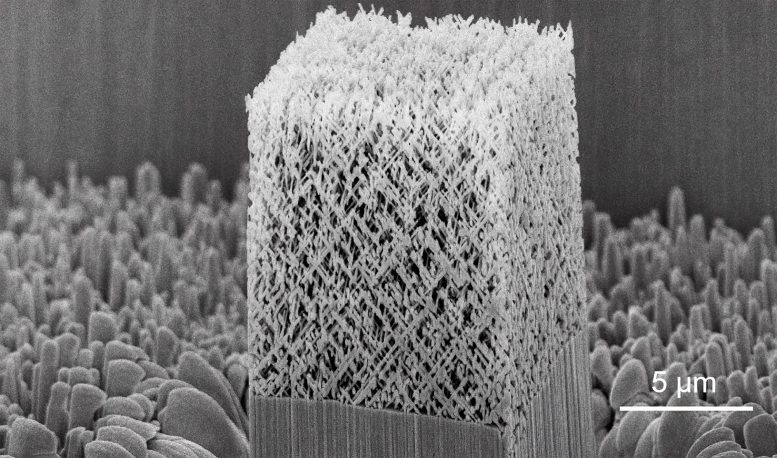
In this work, based on the Heavy Ion Research Facility at Lanzhou (HIRFL), the researchers fabricated a new type of quasi-body centered cubic (quasi-BCC) beam nanolattice mechanical metamaterial with the ion track technology. The beam diameter of the quasi-BCC nanolattice can be as small as 34 nm, a record low beam diameter of mechanical metamaterials.
Extraordinary Mechanical Properties of Quasi-BCC Nanolattices
Besides, the researchers demonstrated that gold and copper quasi-BCC beam nanolattices have excellent energy absorption capacity and compressive strength. The experiments showed that the energy absorption capacity of the copper quasi-BCC beam nanolattice exceeds that of the previously reported beam nanolattice. The yield strength of the gold and copper quasi-BCC beam nanolattices exceeds that of the corresponding bulk materials at less than half the density of the latter.
Furthermore, the researchers revealed that the extraordinary mechanical properties are mainly due to the synergistic effect of size effects, quasi-BCC geometry, and good ductility of metals.
This study sheds light on the mechanical properties of the beam nanolattices, and applies the ion track technology as a new method for the exploration of beam nanolattice with ultra-high energy absorption capacity.
Reference: “Mechanical metamaterials made of freestanding quasi-BCC nanolattices of gold and copper with ultra-high energy absorption capacity” by Hongwei Cheng, Xiaoxia Zhu, Xiaowei Cheng, Pengzhan Cai, Jie Liu, Huijun Yao, Ling Zhang and Jinglai Duan, 4 March 2023, Nature Communications.
DOI: 10.1038/s41467-023-36965-4
Never miss a breakthrough: Join the SciTechDaily newsletter.
Follow us on Google and Google News.
12 Comments
cool
THIS is what can be achieved when we’re not obsessed with capitalism. Way to go China!
THIS is what can be achieved when people aren’t starving to death due to the Great Leap Backward and the Cultural Revolution. Also, when you rapaciously steal intellectual property…
Well put. Probably analyzed and made with western equipment. Such as SEM equipment from the netherlands.
As well as begin a mutually beneficial relationship with the United States some 1980. None of these advancements were recorded in the pre US beneficial relationship period.
What does this mean? What a possible future applications?
The nano suit from Crysis 2 https://youtu.be/1qF_D1QuWGw
It sounds interesting. What does it mean? How can this be used? I’m not a scientist
Don’t think for a second that the Chinese don’t already know how they are going to use it as a weapon itself or to enhance one before allowing this to even see the light of day in such a public forum. Just saying..
In other words the nano suit from Crysis 2….. https://youtu.be/1qF_D1QuWGw
I think this is still satisfying!
If we are so intelligent why can’t we work together for the greater good of our species. It seems all we can do is enslave those who we think is not Worthy of what or who we are for our thoughts and words. We can not achieve a greater society if it is for just a very few of us. Controlling a race of people like sheep because you think your better. If we can’t fix this science won’t be of much help in the end.
May the fiber in the seaweed washing ashore in massive amounts in Mexico and in Gulf of Mexico(Florida etc.) be used to create a useful form of this nanolattice as well as bamboo etc.