
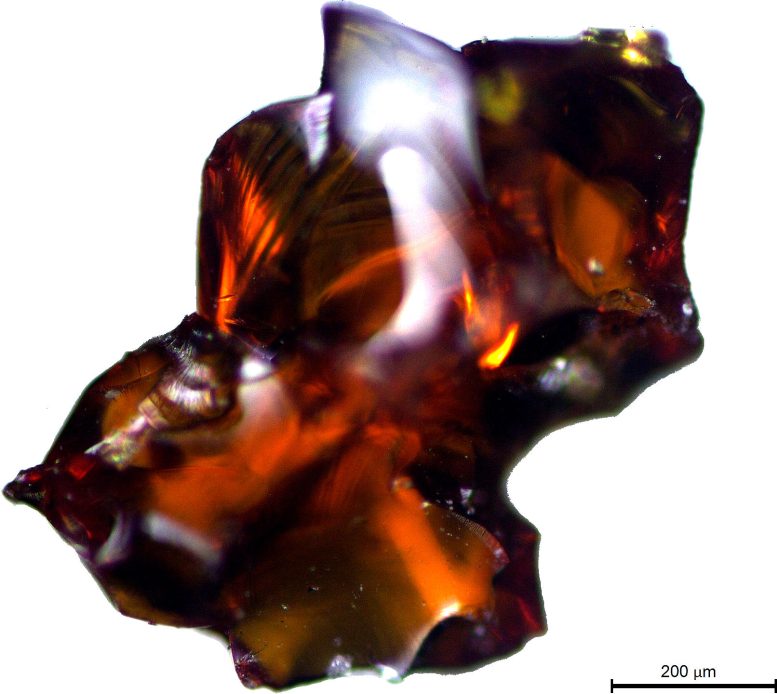
Baltic amber reached Iberia 1,000 years earlier than thought, revealing new Neolithic trade routes.
Scientists from the Universities of Granada and Cambridge, in collaboration with the Government of Catalonia, have discovered the oldest Baltic amber fragments on the Iberian Peninsula. These findings suggest that this luxury material, widely used in global jewelry and crafts, was being traded over 5,000 years ago.
The research was led by UGR lecturer Mercedes Murillo-Barroso and involved the collaboration of Marcos Martinón-Torres of the University of Cambridge and Araceli Martín Cólliga of the Government of Catalonia.
According to Murillo-Barroso, the work “allows us to say with confidence that the arrival of Baltic amber on the Iberian Peninsula occurred at least in the 4th millennium BC, more than a millennium earlier than we thought, and that it was probably part of wider trade networks linked to the south of France.”
The Significance of Trade and Amber in Prehistoric Times
Trade is one of the many mechanisms through which we establish social relations, and often the objects that are exchanged are not necessarily consumer goods needed to live, but rather decorative, luxury, or symbolic objects. Sometimes, especially in adverse conditions, having trade networks means having a network of mutual support, but these trade networks can also generate social inequalities and relations of dependency, especially if not all of the community enjoys equal access to the networks or if the objects exchanged are unequal.
In prehistoric times, amber, a fossil resin, was certainly not a raw material necessary for the development of daily life, but it was highly valued and was exchanged via the extensive trade networks that were established.
The use of the multiple amber deposits on the Iberian Peninsula since the Upper Palaeolithic has been documented and, thanks to research carried out by archaeologists over the years, we know that from the 4th millennium BC onwards Sicilian amber began to reach the Iberian Peninsula through Mediterranean trade networks. However, until now it was believed that Baltic amber did not reach the Peninsula until the 2nd millennium BC, at which point it would become the primary raw material, replacing other types of amber such as Peninsular or Sicilian amber.
Evidence from the Cova del Frare Site
In their research article published in the journal Scientific Reports, Mercedes Murillo-Barroso noted: “We present the standard infrared spectroscopy analysis of an amber bead of Baltic origin found at the Cova del Frare site in a context dated between 3634-3363 cal BC.”
“The site, which is truly exceptional, illustrates the transition between the Middle Neolithic of the ‘Sepulcrand the Late Neolithic of Véraza”, explains Araceli Martín Cólliga, director of the excavations at the site.
“As there are no written documents from prehistoric times, the only way to study human activity is through archaeological remains. To study the transport and exchange of materials, we use very precise analytical techniques, such as infrared spectroscopy, which give us a kind of fingerprint of the amber deposits and objects,” says Mercedes Murillo-Barroso.
Based on a large amount of data and this type of analysis, combined with other bodies of archaeological information, the study confirms that Baltic amber arrived in the northeastern Iberian Peninsula as early as the Neolithic, which is “something that must be understood in the context of trade during this period of transition and change, either by agents of a declining ‘Sepulcres de Fossa’ culture, or by those who would set new cultural trends at the end of the Neolithic, led by the Véraza groups of Catalonia and southern France, and not necessarily as direct contact with northern Europe.”
In fact, there is currently no evidence of Baltic amber crossing the Ebro at such an early date into the southern Iberian Peninsula, where the use of Sicilian amber was predominant as a result of the Mediterranean networks.
The Global Value of Baltic Amber
The Baltic region is home to what is perhaps the best amber in the world for use in jewelry. Indeed, it was highly sought after in classical Rome and now sustains a whole industry, for example in Poland. We now know that it began to arrive in Iberia as early as the 4th millennium BC, and that it gradually replaced Peninsular and Sicilian amber.
“This finding undoubtedly has important implications for our understanding of early exchange networks of exotic materials and their influence on social structures,” explains University of Cambridge professor Marcos Martinón-Torres.
Reference: “The earliest Baltic amber in Western Europe” by M. Murillo-Barroso, A. Martín Cólliga and M. Martinón-Torres, 31 August 2023, Scientific Reports.
DOI: 10.1038/s41598-023-41293-0
Never miss a breakthrough: Join the SciTechDaily newsletter.
Follow us on Google and Google News.