
Close Menu
    Facebook X (Twitter) Instagram
    SciTechDaily
    • Biology
    • Chemistry
    • Earth
    • Health
    • Physics
    • Science
    • Space
    • Technology
    Facebook X (Twitter) Pinterest YouTube RSS
    SciTechDaily
    Home»Science»Unlike People, Capuchin Monkeys Aren’t Fooled by Expensive Brands
    Science

    Unlike People, Capuchin Monkeys Aren’t Fooled by Expensive Brands

    By Bill Hathaway, Yale UniversityDecember 3, 2014No Comments3 Mins Read
    Facebook Twitter Pinterest Telegram LinkedIn WhatsApp Email Reddit
    Share
    Facebook Twitter LinkedIn Pinterest Telegram Email Reddit
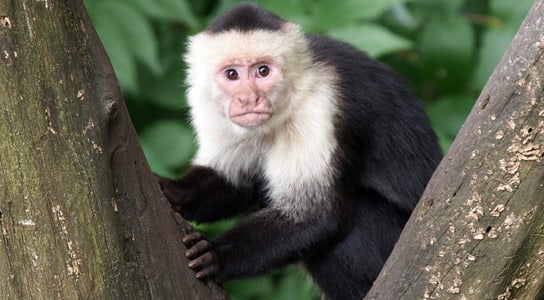
    Monkeys Aren’t Fooled by Expensive Brands
    Capuchin monkeys don’t assume a higher price tag means better quality, according to a new Yale study

    A newly published study from Yale University shows that although Capuchin monkeys exhibit a number of irrational behaviors similar to humans, the monkeys aren’t fooled by expensive brands.

    In at least one respect, Capuchin monkeys are smarter than humans — they don’t assume a higher price tag means better quality, according to a new Yale study appearing in the open-access journal Frontiers in Psychology.

    People consistently tend to confuse the price of a good with its quality. For instance, one study showed that people think a wine labeled with an expensive price tag tastes better than the same wine labeled with a cheaper price tag. In other studies, people thought a painkiller worked better when they paid a higher price for it.

    The Yale study shows that monkeys don’t buy that premise, although they share other irrational behaviors with their human relatives.

    “We know that capuchin monkeys share a number of our own economic biases. Our previous work has shown that monkeys are loss-averse, irrational when it comes to dealing with risk, and even prone to rationalizing their own decisions, just like humans,” said Laurie Santos, a psychologist at Yale University and senior author of the study. “But this is one of the first domains we’ve tested in which monkeys show more rational behavior than humans do.”

    Rhia Catapano, a former Yale undergraduate who ran the study as part of her senior honors thesis, along with Santos and colleagues designed a series of four experiments to test whether capuchins would prefer higher-priced but equivalent items. They taught monkeys to make choices in an experimental market and to buy novel foods at different prices. Control studies showed that monkeys understood the differences in price between the foods. But when the researchers tested whether monkeys preferred the taste of the higher-priced goods, they were surprised to find that the monkeys didn’t show the same bias as humans.

    Santos and colleagues think that differences in the response of humans and capuchins could stem from the different experiences that monkeys and people have with markets and how they behave.

    “For humans, higher price tags often signal that other people like a particular good,” Santos noted. “Our richer social experiences with markets might be the very thing that leads us — and not monkeys — astray in this case.”

    Reference: “Capuchin monkeys do not show human-like pricing effects” by Rhia Catapano, Nicholas Buttrick, Jane Widness, Robin Goldstein and Laurie R. Santos, 2 December 2014, Frontiers in Psychology.
    DOI: 10.3389/fpsyg.2014.01330

    Never miss a breakthrough: Join the SciTechDaily newsletter.
    Follow us on Google and Google News.

    Monkey Popular Psychology Yale University
    Share. Facebook Twitter Pinterest LinkedIn Email Reddit

    Related Articles

    Ingenious Experiments Show Monkeys Consciously Experience the Visual World the Same Way People Do

    Yale Engineers Develop New Colors for Solar Energy

    New Study Traces the Impact of Volcanic Activity on Climate Change

    Yale Study: Climate Science Communication and the Measurement Problem

    Targeted Computer Games Improve Neurobiological Dysfunctions of Psychopaths

    Drug-Loaded Nanoparticles Offer New Approach to Treating Brain Cancer

    Researchers Identify Mutations Responsible for USC Tumors

    Controversial Psychiatry Change Could See Bereavement as a Disease

    Puzzle Play With Children Results in Better Spatial Skills

    Leave A Reply Cancel Reply

    • Facebook
    • Twitter
    • Pinterest
    • YouTube

    Don't Miss a Discovery

    Subscribe for the Latest in Science & Tech!

    Trending News

    JWST Finds a “Star” 100 Billion Times Brighter Than Any Star Should Be

    Scientists Find a Hidden Biological Link Across Different Forms of Autism

    Astronomers Discover a Ghostly River of Stars That Could Reveal Dark Matter

    Why Is Colorectal Cancer Rising in People Under 50? New Clues Point to the Environment

    Quantum Fluctuations Break a Crystal’s Symmetry Rules

    Why Does an Irregular Heartbeat Strike 40 Years Early in Some People?

    Scientists Reveal How ADHD Could Fuel Creative Thinking

    Scientists Find Just 3 Minutes of Sprinting Can Transform Blood Chemistry

    Follow SciTechDaily
    • Facebook
    • Twitter
    • YouTube
    • Pinterest
    • Newsletter
    • RSS
    SciTech News
    • Biology News
    • Chemistry News
    • Earth News
    • Health News
    • Physics News
    • Science News
    • Space News
    • Technology News
    Recent Posts
    • A Vast Clean Energy Source May Be Hiding Beneath Australia’s Red Soil
    • Scientists Uncover Signs of an Ancient Climate “Tipping Point”
    • Cleaner Cars May Be Hiding a New Pollution Problem
    • Common Plant Chemical Linked to Widespread Organ Damage in Aquatic Animals
    • Scientists Discover a Hidden Baobab Species in Madagascar
    Copyright © 1998 - 2026 SciTechDaily. All Rights Reserved.
    • Science News
    • About
    • Contact
    • Editorial Board
    • Privacy Policy
    • Terms of Use

    Type above and press Enter to search. Press Esc to cancel.