
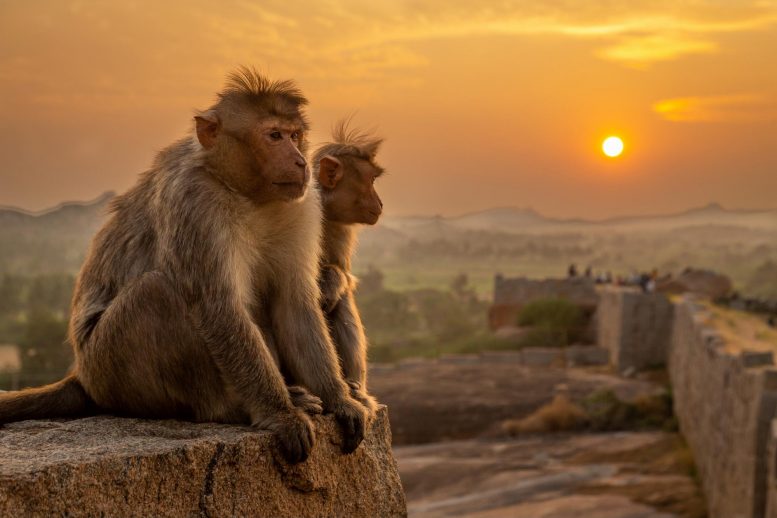
Monkeys process visual stimuli on conscious and unconscious levels, mirroring human behavior and suggesting shared visual awareness.
When humans look out at a visual landscape like a sunset or a beautiful overlook, we experience something — we have a conscious awareness of what that scene looks like. This awareness of the visual world around us is central to our everyday existence, but are humans the only species that experiences the world consciously? Or do other non-human animals have the same sort of conscious experience we do?
Scientists and philosophers have asked versions of this question for millennia, yet finding answers — or even appropriate ways to ask the question — has proved elusive. But a team of Yale researchers recently devised an ingenious way to try to solve this riddle.
Writing on March 29, 2021, in the Proceedings of the National Academy of Sciences, they make the case that one non-human species — the rhesus macaque — also has a conscious awareness of the world around it.
“People have wondered for a long time whether animals experience the world the way we do, but it’s been difficult to figure out a good way to test this question empirically,” said Moshe Shay Ben-Haim, a postdoctoral fellow at Yale and first author of the paper.
Unconscious Versus Conscious Learning Patterns
Researchers have known for a long time that people can be influenced by unconscious subliminal cues — visual stimuli presented just outside of our threshold for conscious awareness, said Laurie Santos, a professor of psychology at Yale who is co-senior author of the study along with her colleague Steve Chang, associate professor of psychology and of neuroscience, and Ran Hassin of Hebrew University.
“We tend to show different patterns of learning when presented with subliminal stimuli than we do for consciously experienced, or supraliminal stimuli,” she said.
If monkeys show the same “double dissociation” pattern that humans do, it would mean that monkeys probably experience the supraliminally presented stimuli in the same way as people do — as a conscious visual experience.
Ben-Haim, Santos, and their team thought of a novel way to explore whether macaques also exhibit a difference in learning when stimuli are experienced consciously versus non-consciously.
In a series of experiments, they had monkeys and humans guess whether a target image would appear on the left or right side of a screen. Before the target appeared, participants received a visual cue — a small star— on the side opposite of where the target would subsequently appear. The researchers varied whether the cue was presented supraliminally or subliminally. When the cue was presented for a few seconds, human participants successfully learned that the target would appear in the opposite location from the cue. But when the cue was presented subliminally — quickly enough that it escaped people’s conscious perception — participants showed a different pattern of performance; they continued to choose the side that was subliminally cued, failing to learn the rule that the cue predicted the opposite side.
Monkeys Mirror Human Consciousness Patterns
Surprisingly, the researchers found that monkeys showed exactly the same response patterns as the people did: like humans, macaques were able to successfully look to the target location when the cues were presented consciously, but showed the reverse pattern for subliminal cues. This striking result suggests that monkeys have two levels of processing just as humans do, one of which must be conscious.
“These results show that at least one non-human animal exhibits both non-conscious perception as well as human-like conscious visual awareness,” said Ben-Haim. “We now have a new non-verbal method for assessing whether other non-human creatures experience visual awareness in the same way as humans.”
Reference: “Disentangling perceptual awareness from nonconscious processing in rhesus monkeys (Macaca mulatta)” by Moshe Shay Ben-Haim, Olga Dal Monte, Nicholas A. Fagan, Yarrow Dunham, Ran R. Hassin, Steve W. C. Chang and Laurie R. Santos 30 March 2021, Proceedings of the National Academy of Sciences.
DOI: 10.1073/pnas.2017543118
Other authors of the paper are Yarrow Dunham, Olga Dal-monte, and Nicholas Fagan of Yale.
Never miss a breakthrough: Join the SciTechDaily newsletter.
Follow us on Google and Google News.
4 Comments
… there was no judge to weight the humans perspective on other creatures, … and when verdicts started to poor in, we might find our selves into a denial at firs, but the change is needed…
BS. A too vague analysis by lazy researchers. This experiment is moot.
The fact this question of mammals perception of the world is entirely the product of arrogance coupled with chosen ignorance. I certainly didn’t need a scientific study to confirm what I can easily see when I look into the eyes of another mammal. A reflection of my own soul.
All animal look the same but the process of creation is different in each one