
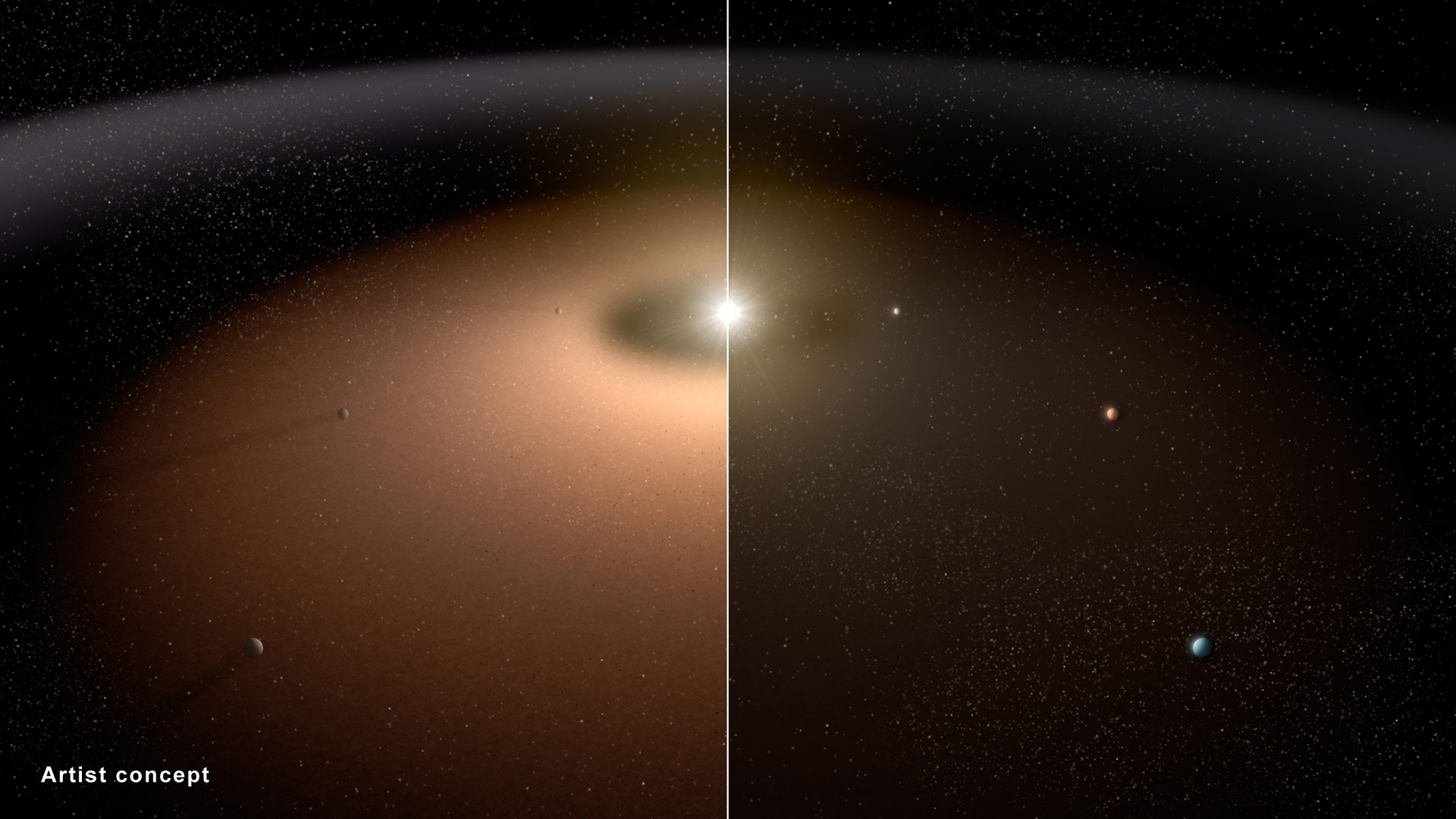
Using the Keck Interferometer, new research shows that mature, sun-like stars appear to be, on average, not all that dusty. This is good news for future space missions wanting to take detailed pictures of planets like Earth and seek out possible signs of life.
Planet hunters received some good news recently. A new study concluded that, on average, sun-like stars aren’t all that dusty. Less dust means better odds of snapping clear pictures of the stars’ planets in the future.
These results come from surveying nearly 50 stars from 2008 to 2011 using the Keck Interferometer, a former NASA key science project that combined the power of the twin W. M. Keck Observatory telescopes atop Mauna Kea, Hawaii.
“Dust is a double-edged sword when it comes to imaging distant planets,” explained Bertrand Mennesson of NASA’s Jet Propulsion Laboratory, Pasadena, California, lead author of an Astrophysical Journal report to be published online December 8. “The presence of dust is a signpost for planets, but too much dust can block our view.” Mennesson has been involved in the Keck Interferometer project since its inception more than 10 years ago, both as a scientist and as the optics lead for one of its instruments.
Ground- and space-based telescopes have already captured images of exoplanets — planets orbiting stars beyond our sun. These early images, which show giant planets in cool orbits far from the glow of their stars, represent a huge technological leap. The glare from stars can overwhelm the light of planets, like a firefly buzzing across the sun. So, researchers have developed complex instruments to block the starlight, allowing information about the planet to shine through.
The next challenge is to image smaller planets in the “habitable” zone around stars where possible life-bearing “exo-Earths” — Earth-like planets outside the solar system — could reside. Such a lofty goal may take decades, but researchers are already on the path to getting there, developing new instrument designs and analyzing the dust kicked up around stars to better understand how to snap crisp planetary portraits. Scientists want to find out which stars have the most dust, and how dusty the habitable zones of sun-like stars are.
The Keck Interferometer was built to seek out this dust, and to ultimately help in the design and target selection of future NASA exo-Earth missions. Like planets around other stars, dust near a star is also hard to detect. Interferometry is a high-resolution imaging technique that can be used to block out a star’s light, making the region nearby easier to observe. Light waves from the precise location of a star, collected separately by the twin 10-meter Keck Observatory telescopes, are combined and canceled out in a process called nulling.
“If you don’t turn off the star, you are blinded and can’t see dust or planets,” said co-author Rafael Millan-Gabet of NASA’s Exoplanet Science Institute at the California Institute of Technology in Pasadena, who led the Keck Interferometer’s science operations system.
In the latest study, mature, sun-like stars were analyzed with high precision to search for warm, room-temperature dust in their habitable zones. Roughly half of the stars selected for the study had previously shown no signs of cool dust circling in their outer reaches. This outer dust is easier to see than the inner, warm dust due to its greater distance from the star. Of this first group of stars, none were found to host the warm dust, making them good targets for planet imaging, and a good indication that other, relatively dust-free stars are out there.
The other stars in the study were already known to have significant amounts of distant, cold dust orbiting them. In this group, many of the stars were found to also have the room-temperature dust. This is the first time a direct link between the cold and warm dust has been established. In other words, if a star is observed to have a cold belt of dust, astronomers now can make an educated guess that its warm habitable zone is also riddled with dust, making it a poor target for imaging exo-Earths.
“We want to avoid planets that are buried in dust,” said Mennesson. “The dust glows in the infrared and reflects starlight in the visible, both of which can outshine the planet’s light.”
Like a busy construction site, the process of building planets is messy. It is common for young, developing star systems to be covered in dust. Proto-planets collide, scattering dust. But eventually, the chaos settles and the dust clears — except around some older stars. Why are these mature stars still laden with warm dust in their habitable zones?
The newfound link between cold and warm dust belts helps answer this question.
“The outer belt is somehow feeding material into the inner, warm belt,” said Geoff Bryden of JPL, a co-author of the study. “This transport of material could be accomplished as dust smoothly flows inward, or there could be larger comets thrown directly into the inner system.”
Upcoming, more-sensitive measurements by NASA’s Large Binocular Telescope Interferometer on Mount Graham in Arizona will further improve these measurements of dust in star systems, narrowing in on its quantity, origin, and whereabouts. With these early efforts to sift through the murk around stars, astronomers are making their way down the path to one-day finding planets similar to our own.
Reference: “Exo-zodi modelling for the Large Binocular Telescope Interferometer” by Grant M. Kennedy, Mark C. Wyatt, Vanessa Bailey, Geoffrey Bryden, William C. Danchi, Denis Defrère, Chris Haniff, Philip M. Hinz, Jèrèmy Lebreton, Bertrand Mennesson, Rafael Millan-Gabet, Farisa Morales, Olja Panić, George H. Rieke, Aki Roberge, Eugene Serabyn, Andrew Shannon, Andrew J. Skemer, Karl R. Stapelfeldt, Katherine Y. L. Su and Alycia J. Weinberger, 27 January 2015, The Astrophysical Journal.
DOI: 10.1088/0067-0049/216/2/23
The Keck Interferometer completed its NASA prime mission in 2012. It was funded by NASA and managed by JPL. JPL is managed by Caltech for NASA.
The W. M. Keck Observatory operates the largest, most scientifically productive telescopes on Earth. The two, 10-meter optical/infrared telescopes near the summit of Mauna Kea on the Island of Hawaii feature a suite of advanced instruments including imagers, multi-object spectrographs, high-resolution spectrographs, integral-field spectrographs and world-leading laser guide star adaptive optics systems.
Keck Observatory is a private 501(c) 3 non-profit organization and a scientific partnership of Caltech, the University of California System and NASA.
Never miss a breakthrough: Join the SciTechDaily newsletter.
Follow us on Google and Google News.
1 Comment
this is really cool