
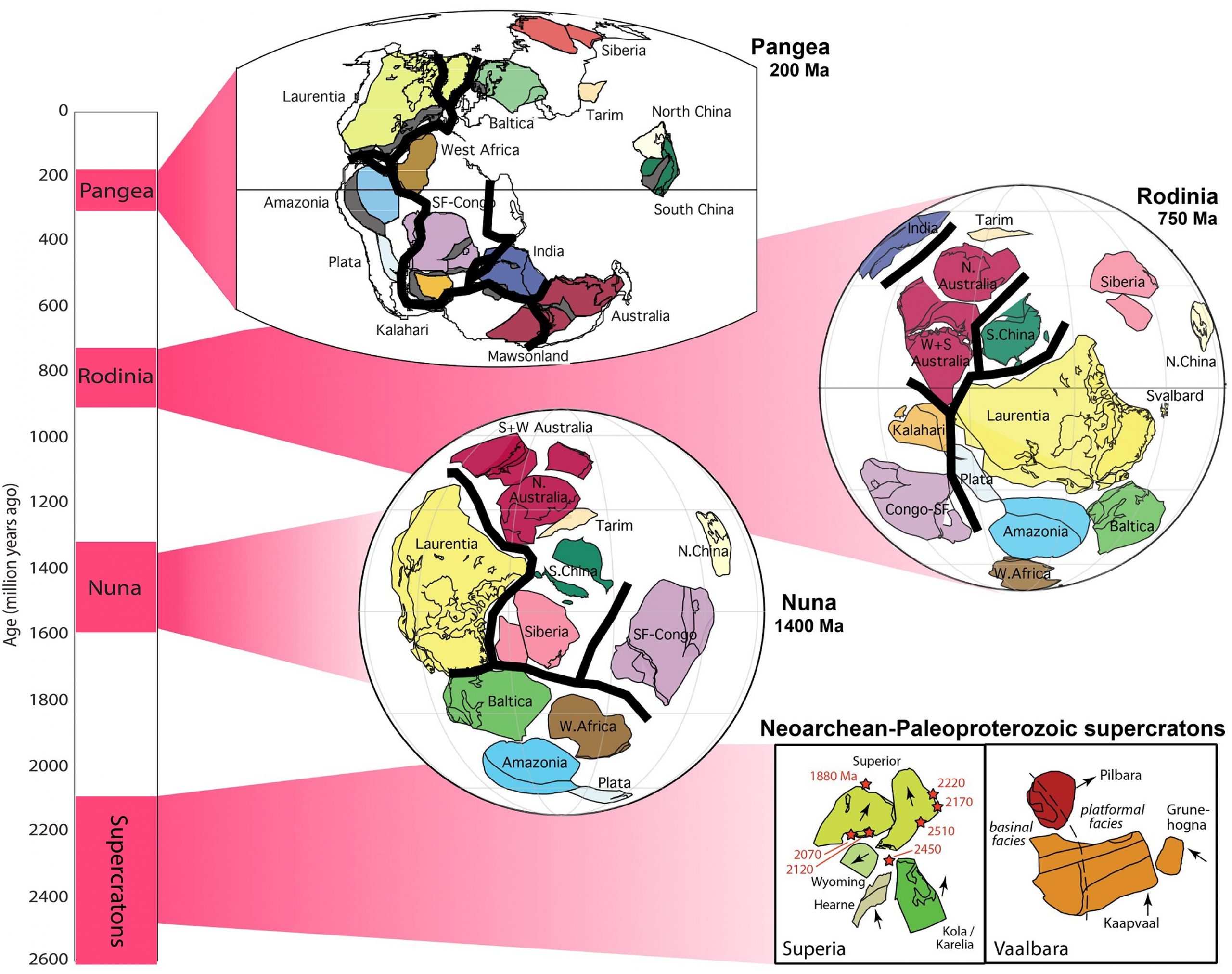
Curtin University research has uncovered the first solid clues about the very beginning of the supercontinent cycle of Earth, finding it was kick-started two billion years ago.
Detailed in a paper published in Geology, a team of researchers from Curtin’s Earth Dynamics Research Group found that plate tectonics operated differently before two billion years ago, and the 600 million years supercontinent cycle likely only started during the second half of Earth’s life.
Lead researcher Dr. Yebo Liu from Curtin’s School of Earth and Planetary Sciences said that the shift in plate tectonics marked a regime change in the Earth System.
“This regime change impacted on the eventual emergence of complex life and even how Earth resources are formed and preserved,” Dr. Liu said.
“Pangea was the first supercontinent scientists discovered early last century that existed some 300 million years ago and lasted until the age of the dinosaurs. Geologists realized more recently that at least two older supercontinents existed before Pangea in the past two billion years (Ga) in a 600 million year cycle. But what happened in the first 2.5 billion years of Earth’s history is anybody’s guess.”
“Our research was essentially testing two hypotheses – one is that the supercontinent cycle started prior to two billion years ago. Alternatively, the ancient continents (called cratons) only managed to get together in multiple clusters called supercratons, instead of forming a singular supercontinent.”
To conduct their tests, the Curtin researchers ventured into the hills east of Perth, Western Australia, an area known as the Yilgarn craton.
Paleomagnetism Reveals Earth’s Ancient Geography
Dr Liu said Yilgarn was a critical piece of the puzzle not only because it is old, but also because there are a series of dark rocks or dolerite dykes that recorded Earth’s ancient magnetic field at the time that the rocks formed.
“By precisely dating the rocks and measuring the samples’ magnetic record, using a technique called paleomagnetism, we are able to reconstruct where those rocks were (relative to the magnetic North pole) when they formed,” Dr. Liu said.
Co-author John Curtin Distinguished Professor Zheng-Xiang Li, from Curtin’s School of Earth and Planetary Sciences, said by analyzing their new data from Yilgarn, and comparing it with data available globally for other cratons, one thing became clear.
“It was clear that we can almost rule out the existence of a long-lived single supercontinent before two billion years ago (2 Ga), although transient supercontinents may have existed,” Professor Li said.
Supercratons, Not Supercontinents
“More likely, there could have been two long-lived clusters of cratons, or supercratons, before 2 Ga that were geographically isolated from each other, never forming a singular supercontinent.”
Professor Ross Mitchell of the Chinese Academy of Sciences, who was previously a member of Curtin’s Earth Dynamics Research Group, said the research goes some way to solving a long-standing mystery.
“The idea of an even older supercontinent has been speculated about for years. But while it has been difficult to prove, it has also been difficult to disprove,” Professor Mitchell said.
Dr. Liu said more studies now need to be done.
“This study surely isn’t the final word on the debate, but it’s certainly a step in the right direction and we need to collect data from a lot more similar rocks to further test the hypotheses,” Dr. Liu said.
Reference: “Archean geodynamics: Ephemeral supercontinents or long-lived supercratons” by Yebo Liu, Ross N. Mitchell, Zheng-Xiang Li, Uwe Kirscher, Sergei A. Pisarevsky and Chong Wang, 22 March 2021, Geology.
DOI: 10.1130/G48575.1
Never miss a breakthrough: Join the SciTechDaily newsletter.
Follow us on Google and Google News.
2 Comments
“This study surely isn’t the final word on the debate, but it’s certainly a step in the right direction and we need to collect data from a lot more similar rocks to further test the hypotheses,”
Would it were that climatologists were as humble and objective.
I think it is done a good job from scientists. If we refer to Pangea supercontinent, I may say that it is positioned at the western hemisphere, from North to South. This is right. Of course, it is not the right map as it has been before 300 million years ago. I have discovered physical evidence that shows the real map of supercontinent Pangea as well other details included world ocean Panthalassa. If you are in concern to cooperate , I am willing.