
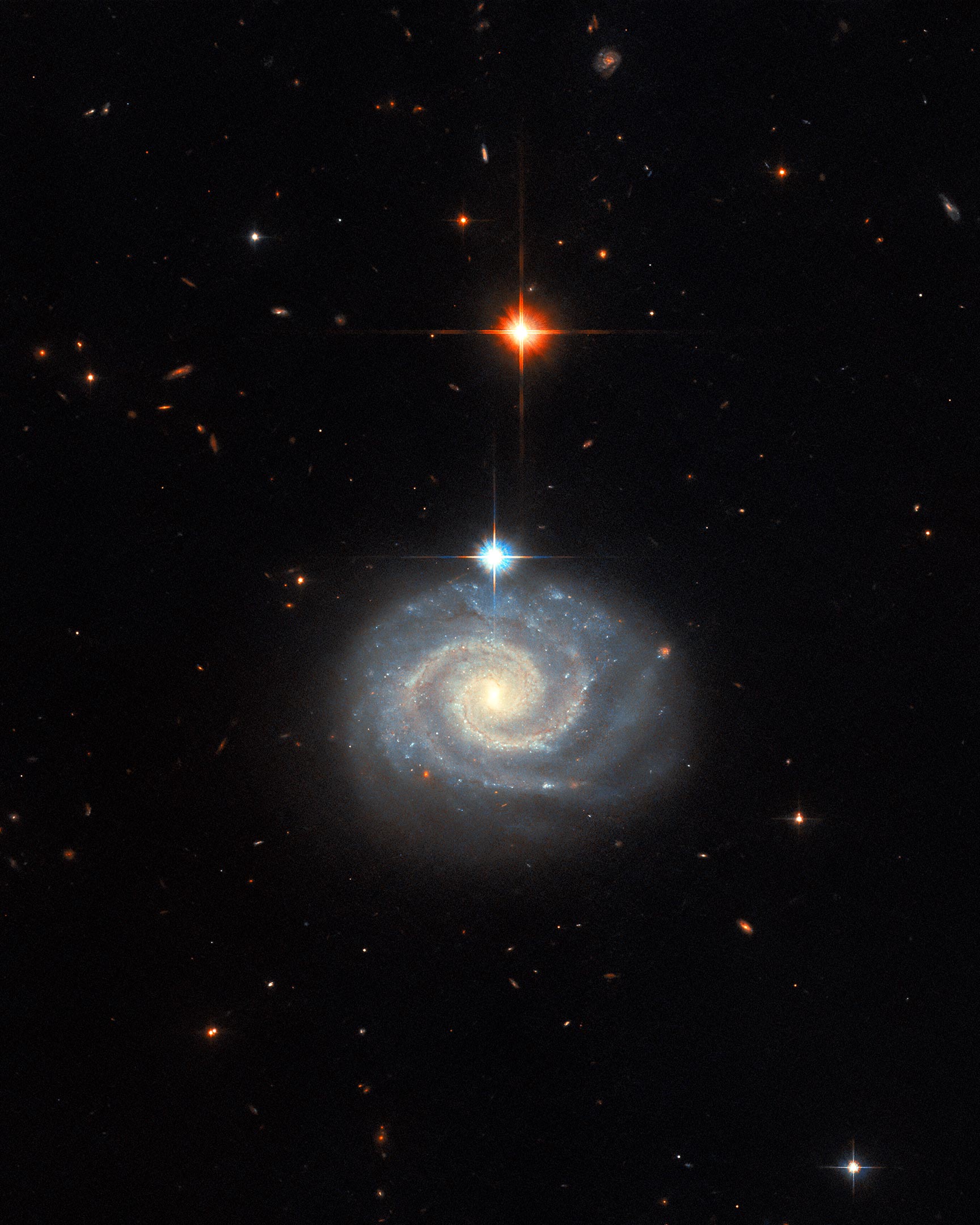
This whirling Hubble Space Telescope image features a bright spiral galaxy known as MCG-01-24-014, which is located about 275 million light-years from Earth. In addition to being a well-defined spiral galaxy, MCG-01-24-014 has an extremely energetic core, known as an active galactic nucleus (AGN), so it is referred to as an active galaxy.
Even more specifically, it is categorized as a Type-2 Seyfert galaxy. Seyfert galaxies host one of the most common subclasses of AGN, alongside quasars. Whilst the precise categorization of AGNs is nuanced, Seyfert galaxies tend to be relatively nearby ones where the host galaxy remains plainly detectable alongside its central AGN, while quasars are invariably very distant AGNs whose incredible luminosities outshine their host galaxies.
Understanding Seyfert Galaxies and Their Spectra
There are further subclasses of both Seyfert galaxies and quasars. In the case of Seyfert galaxies, the predominant subcategories are Type-1 and Type-2. These are differentiated from one another by their spectra — the pattern that results when light is split into its constituent wavelengths — where the spectral lines that Type-2 Seyfert galaxies emit are particularly associated with specific so-called ‘forbidden’ emission.
To understand why emitted light from a galaxy could be considered forbidden, it helps to understand why spectra exist in the first place. Spectra look the way they do because certain atoms and molecules will absorb and emit light very reliably at very specific wavelengths.
The reason for this is quantum physics: electrons (the tiny particles that orbit the nuclei of atoms and molecules) can only exist at very specific energies, and therefore electrons can only lose or gain very specific amounts of energy. These very specific amounts of energy correspond to certain light wavelengths being absorbed or emitted.
The Phenomenon of Forbidden Emissions
Forbidden emission lines, therefore, are spectral emission lines that should not exist according to certain rules of quantum physics. But quantum physics is complex, and some of the rules used to predict it use assumptions that suit laboratory conditions here on Earth.
Under those rules, this emission is ‘forbidden’ — so improbable that it’s disregarded. But in space, in the midst of an incredibly energetic galactic core, those assumptions don’t hold anymore, and the ‘forbidden’ light gets a chance to shine out towards us.
Never miss a breakthrough: Join the SciTechDaily newsletter.
Follow us on Google and Google News.
4 Comments
“To understand why emitted light from a galaxy could be considered forbidden, it helps to understand why spectra exist in the first place. Spectra look the way they do because certain atoms and molecules will absorb and emit light very reliably at very specific wavelengths.
The reason for this is quantum physics: electrons (the tiny particles that orbit the nuclei of atoms and molecules) can only exist at very specific energies, and therefore electrons can only lose or gain very specific amounts of energy. These very specific amounts of energy correspond to certain light wavelengths being absorbed or emitted.”
Not understanding the focus on elementary school science except as a way to frame the readership as ignorant.
What did Wolfgang Pauli say?
“It’s not even wrong.”
Was the author deliberately trying to blather on about nonsense because it involved an eye-catching term ‘forbidden’, or were they just to lazy to bother learning anything useful about it?
Seeing that the distant galaxy is 275 million light years away from our observation on earth it could be showing a phase of evolution it has not been categorized in growth of any phased numbered process. Could it be a early phase of a heavy metal rich galaxy or developing to a type of galaxy of distinction.
If only slamming superhot random ions together at various relativistic speeds for the MIC was also forbidden. Taxpayers would save a fortune otherwise stolen by HEP rent-seekers, except maybe that hoped-for Muon collider will be able to project massive destructive atmospheric down-blasts from all the way across an ocean, I mean you just never know how greatly it could pay off.