

Close Menu
    Facebook X (Twitter) Instagram
    SciTechDaily
    • Biology
    • Chemistry
    • Earth
    • Health
    • Physics
    • Science
    • Space
    • Technology
    Facebook X (Twitter) Pinterest YouTube RSS
    SciTechDaily
    Home»Space»Reimagining Planetary Genesis: Young Disk Observations Challenge Formation Theories
    Space

    Reimagining Planetary Genesis: Young Disk Observations Challenge Formation Theories

    By National Radio Astronomy ObservatoryJanuary 9, 20242 Comments3 Mins Read
    Facebook Twitter Pinterest Telegram LinkedIn WhatsApp Email Reddit
    Share
    Facebook Twitter LinkedIn Pinterest Telegram Email Reddit
    Circumstellar Protoplanetary Disc Art Concept
    Astronomers have found early ring and spiral structures in young planetary disks, indicating that planet formation begins much earlier than previously thought. This groundbreaking discovery, revealed through ALMA data, challenges existing models of planet formation and suggests a much faster timeline for the emergence of planetary structures. (Artist’s concept.) Credit: SciTechDaily.com

    Early Evolution of Planetary Disk Structures Seen for the First Time

    Planet formation may occur much more rapidly than previously thought.

    An international team of astronomers has found ring and spiral structures in very young planetary disks, demonstrating that planet formation may begin much earlier than once thought. The results were presented on Monday at the 243rd Meeting of the American Astronomical Society.

    Using data from the National Radio Astronomy Observatory’s (NRAO) Atacama Large Millimeter/submillimeter Array (ALMA) the team captured images of Class 0 and Class I planetary disks, which are much younger than the Class II disks observed by earlier disk surveys. Class II disks are known to have gaps and ring structures, indicating that planetary formation is well underway. “ALMA’s early observations of young protoplanetary disks have revealed many beautiful rings and gaps, possible formation sites of planets,” said Cheng-Han Hsieh, PhD Candidate at Yale University, “I wondered when these rings and gaps started to appear in the disks.”
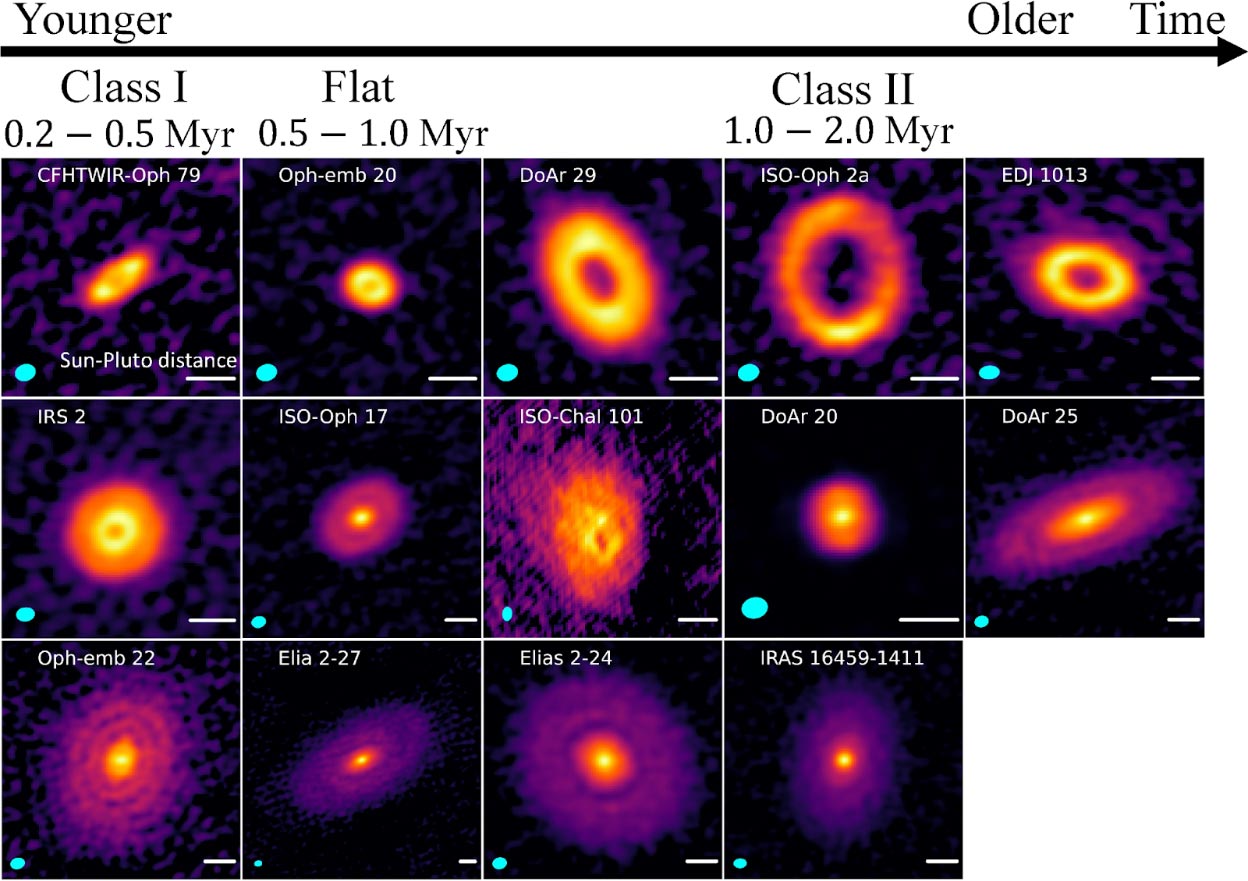
    Evolutionary Sequence of Protoplanetary Disks
    The evolutionary sequence of protoplanetary disks with substructures, from the ALMA CAMPOS survey. These wide varieties of planetary disk structures are possible formation sites for young protoplanets. Credit: Hsieh et al. in prep.

    This new study shows that structure begins to form when the disks are about 300,000 years old, which is incredibly fast. Young disks can have multiple rings, and spiral structures, or evolve into a ring with a central cavity. These observations challenge our understanding of how planets form, particularly large Jupiter-like planets. “It is difficult to form giant planets within a million years from the core accretion model,” said Cheng-Han Hsieh. Future studies will pinpoint the exact time when the disk substructure appears and how that connects to early planet formation.
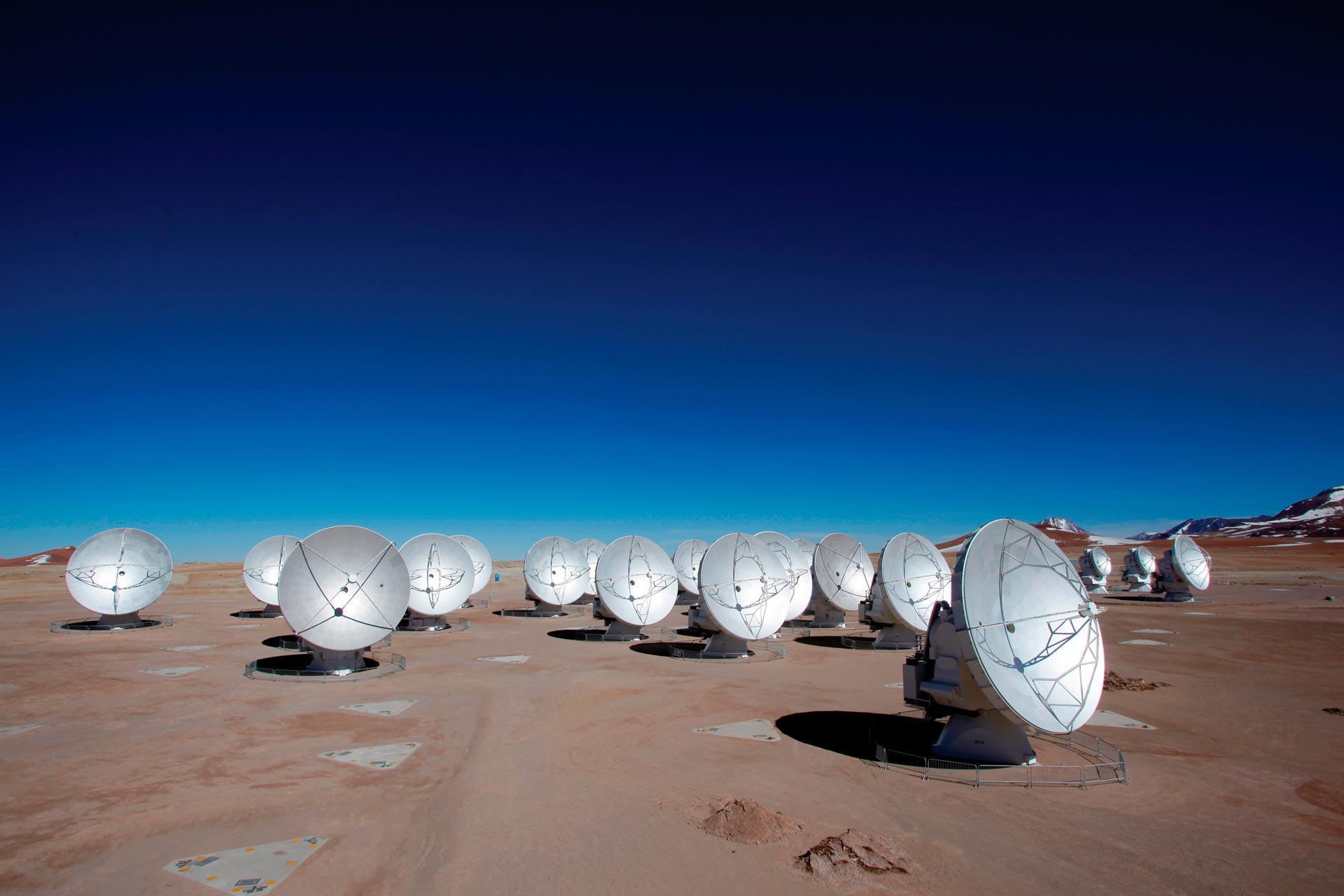
    ALMA’s Central Array on the Chajnantor Plains
    The Atacama Large Millimeter/submillimeter Array (ALMA) sits on the Chajnantor plains nearly 5,000 m above sea level and currently has 66 high-precision antennas working together at millimeter and submillimeter wavelengths. Credit: C. Padilla, NRAO/AUI/NSF

    The Atacama Large Millimeter/submillimeter Array (ALMA) is a state-of-the-art telescope situated in the Atacama Desert of northern Chile. Operated by a partnership between Europe, North America, East Asia, and the host country Chile, ALMA specializes in studying light from some of the coldest objects in the Universe.

    It operates at millimeter and submillimeter wavelengths, filling a crucial gap between infrared light and radio waves. This allows ALMA to observe phenomena such as the formation of stars, planetary systems, and the detailed chemistry of the universe, which are often obscured at other wavelengths.

    ALMA’s high altitude and dry location provide an almost unparalleled view of the universe in these unique wavelengths, making it one of the most powerful and versatile observatories in the world for studying molecular gas and dust.

    Never miss a breakthrough: Join the SciTechDaily newsletter.
    Follow us on Google and Google News.

    ALMA Astronomy Astrophysics National Radio Astronomy Observatory
    Share. Facebook Twitter Pinterest LinkedIn Email Reddit

    Related Articles

    Water – A Requirement for Life As We Know It – Detected in a Galaxy Far, Far Away

    Scientists Uncover the Mystery of Early Massive Galaxies That Strangely Ran Out of Fuel

    Magnetic Structures Observed Near Supermassive Black Hole

    Extensive Chemical Composition Mapping Reveals Carbon-Rich, Organic Birth Environments of Planets

    Gas Re-Accretion Observed in Dying Galaxies for the First Time

    Surprising Insights Into Star Formation From Unprecedented Survey of the “Nurseries” Where Stars Are Born

    Mind the Gap: Direct Link Uncovered Between Protoplanetary Disk Structures and Giant Exoplanets

    Young Chaotic Star System Reveals Secrets of Planet Formation

    Map of the Nearby Universe Created by Cosmic Cartographers Reveals the Diversity of Star-Forming Galaxies

    2 Comments

    1. Robert Norton on January 13, 2024 5:09 pm

      Thank You For The Updated Respectfully

      Reply
    2. Robert Norton on January 13, 2024 5:11 pm

      Planetary Observation Abilities
      Like (ALMA) JWST,LIGO,ESO,All Are Welcome Too Send Me Anything,And I Will Show Respects There Way

      Reply
    Leave A Reply Cancel Reply

    • Facebook
    • Twitter
    • Pinterest
    • YouTube

    Don't Miss a Discovery

    Subscribe for the Latest in Science & Tech!

    Trending News

    Textbooks May Need Rewriting After Researchers Debunk a Core Chemistry Concept

    Alzheimer’s May Start With a Surprising Symptom – Not Memory Loss

    The “Hobbits” Mysteriously Disappeared 50,000 Years Ago – Scientists Have Revealed What Happened to Their Home

    One Sugar Tells Your Brain You’re Full. Another Barely Does

    One of Arizona’s Largest Reservoirs Is Less Than 1% Full After Snowpack Collapse

    This 400-Year-Old Shark May Hold the Secret to Preserving Human Vision

    Your Daily Orange Juice Could Have an Unexpected Health Benefit

    Black Hole Shredded a Massive Star in the Most Powerful Stellar Explosion Ever Seen

    Follow SciTechDaily
    • Facebook
    • Twitter
    • YouTube
    • Pinterest
    • Newsletter
    • RSS
    SciTech News
    • Biology News
    • Chemistry News
    • Earth News
    • Health News
    • Physics News
    • Science News
    • Space News
    • Technology News
    Recent Posts
    • 567-Million-Year-Old Fossils Suggest Animals Evolved Earlier Than We Thought
    • Scientists Discover a 5-Million-Year-Old Whale Graveyard Deep Beneath the Indian Ocean
    • Ancient DNA Reveals the Hidden Origins of China’s Mysterious Shimao Civilization
    • Scientists Finally Solve a 50-Year Mystery Hidden in Solid Nitrogen
    • Saturn’s Largest Moon May Hold the Resources for a Space Colony
    Copyright © 1998 - 2026 SciTechDaily. All Rights Reserved.
    • Science News
    • About
    • Contact
    • Editorial Board
    • Privacy Policy
    • Terms of Use

    Type above and press Enter to search. Press Esc to cancel.