

Close Menu
    Facebook X (Twitter) Instagram
    SciTechDaily
    • Biology
    • Chemistry
    • Earth
    • Health
    • Physics
    • Science
    • Space
    • Technology
    Facebook X (Twitter) Pinterest YouTube RSS
    SciTechDaily
    Home»Space»Unlocking the Secrets of Mars: Atmospheric Pressure and the Mystery of Methane Pulses
    Space

    Unlocking the Secrets of Mars: Atmospheric Pressure and the Mystery of Methane Pulses

    By Los Alamos National LaboratoryJanuary 27, 20241 Comment3 Mins Read
    Facebook Twitter Pinterest Telegram LinkedIn WhatsApp Email Reddit
    Share
    Facebook Twitter LinkedIn Pinterest Telegram Email Reddit
    Methane on Mars
    Research suggests that atmospheric pressure changes on Mars may release underground methane into the atmosphere, aiding the Curiosity rover in its quest for life signs. (Artist’s concept.) Credit: SciTechDaily.com

    Simulations will help Curiosity search for signs of past or present life on the Red Planet.

    New research shows that atmospheric pressure fluctuations that pull gases up from underground could be responsible for releasing subsurface methane into Mars’ atmosphere; knowing when and where to look for methane can help the Curiosity rover search for signs of life.

    “Understanding Mars’ methane variations has been highlighted by NASA’s Curiosity team as the next key step towards figuring out where it comes from,” said John Ortiz, a graduate student at Los Alamos National Laboratory who led the research team. “There are several challenges associated with meeting that goal, and a big one is knowing what time of a given sol (Martian day) is best for Curiosity to perform an atmospheric sampling experiment.”

    The paper was published in January 22 in the Journal of Geophysical Research: Planets.
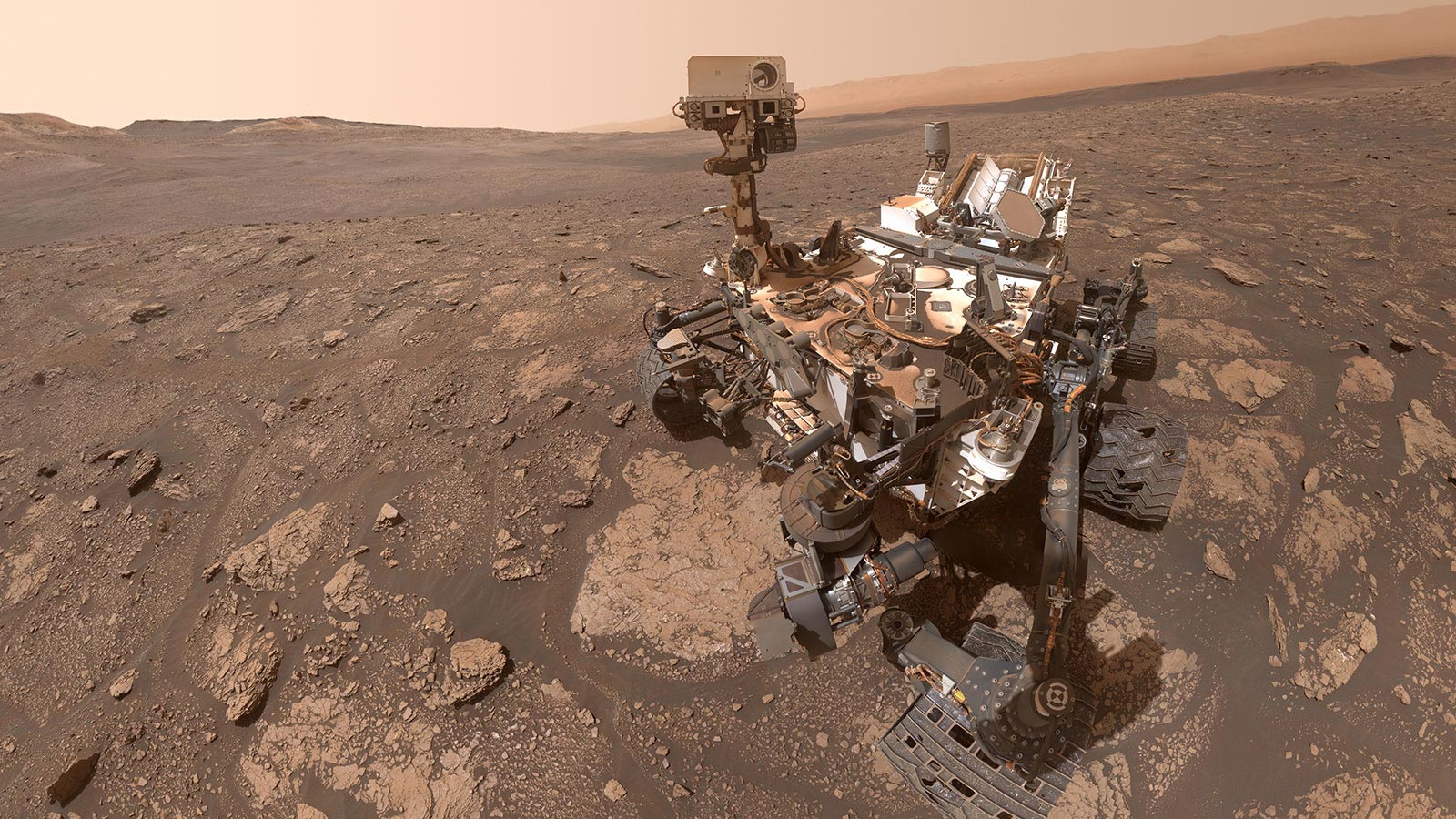
    Mary Anning Mars Curiosity Selfie
    New simulations are helping inform the Curiosity rover’s ongoing sampling campaign. Credit: NASA/JPL-Caltech/MSSS

    A primary focus of NASA’s Mars missions, including Curiosity and Perseverance, is to detect and understand past or present signs of life, such as methane. However, with the source of methane on Mars likely being underground, short-term variations in atmospheric methane levels have posed a research challenge.

    To better understand Mars’ methane levels, Ortiz and his team used high-performance computing clusters to simulate how methane travels through networks of underground fractures and is released into the atmosphere, where it then mixes within the atmospheric column. They also modeled how methane is adsorbed onto the pores of rocks, which is a temperature-dependent process that may contribute to the methane level fluctuations.

    Their simulations predicted methane pulses from the ground surface into the atmosphere just before the Martian sunrise in the planet’s northern summer season, which just recently ended. This corroborates previous rover data suggesting that methane levels fluctuated not only seasonally, but also daily.

    This valuable data is helping inform the Curiosity rover’s ongoing sampling campaign.

    “Our work suggests several key time windows for Curiosity to collect data. We think these offer the best chance of constraining the timing of methane fluctuations, and (hopefully) down the line bringing us closer to understanding where it comes from on Mars,” Ortiz said.

    Reference: “Sub-Diurnal Methane Variations on Mars Driven by Barometric Pumping and Planetary Boundary Layer Evolution” by J. P. Ortiz, H. Rajaram, P. H. Stauffer, K. W. Lewis, R. C. Wiens and D. R. Harp, 22 January 2024, Journal of Geophysical Research: Planets.
    DOI: 10.1029/2023JE008043

    This research was supported by a Student Fellowship grant through the Center for Space and Earth Science, which is funded by the Laboratory Directed Research and Development program under project number 20210528CR.

    Never miss a breakthrough: Join the SciTechDaily newsletter.
    Follow us on Google and Google News.

    Curiosity Rover DOE Los Alamos National Laboratory Mars Planets Popular
    Share. Facebook Twitter Pinterest LinkedIn Email Reddit

    Related Articles

    Tantalizing Science and Dangerous Hazards: NASA’s Curiosity Mars Rover Reaches Long-Awaited Salty Region

    NASA’s Curiosity Rover Spots a “Doorway” on Mars

    NASA’s Curiosity Rover Reports Back on “Most Chemically Diverse Part” of Gale Crater on Mars

    Curiosity Rover Finds a Bizarre Rock on Mars That Looks Like a Flower

    Newly Discovered Carbon on Mars: Origin May Be Biologically Produced Methane

    NASA’s Curiosity Mars Rover Explores a Changing Landscape – Video Tour of Martian Mountain

    See NASA’s Curiosity Rover’s Stunning 360-Degree View Atop “Mont Mercou” on Mars

    Curiosity Rover Finds That Mars Did Not Dry Up All at Once

    Mars Didn’t Dry Up in One Go – Martian Climate Cycled Between Dry and Wet Periods

    1 Comment

    1. a member under the cloack of anonimity on January 27, 2024 10:41 am

      The methane is, in all likelihood, waste from some alien and martian life-form. It’s amazing how martian beings have outsmarted and evaded those science nerds, who claim to have probes on the planet…open this link for more…

      Reply
    Leave A Reply Cancel Reply

    • Facebook
    • Twitter
    • Pinterest
    • YouTube

    Don't Miss a Discovery

    Subscribe for the Latest in Science & Tech!

    Trending News

    Giant Crocodylians Ruled South America’s Ancient Food Chain

    Breakthrough in a Bizarre Galaxy Could Help Unlock the Mystery of Dark Matter

    Just 4 Minutes of Daily Strength Training Can Quadruple Fitness in Older Adults

    Almost All Plant-Based Meat Alternatives Contain Mycotoxins, Study Finds

    Astronomers Detect a Record-Breaking “Cosmic Laser” From 8 Billion Light-Years Away

    A 47-Year-Old Scientist Tracked Himself for Months – His Biological Age Fell to 32

    Construction Crew Uncovers Giant 20-Meter Dinosaur in Brazil

    30 Years of Hurricane Data Reveal 4 Warning Signs Before Storms Strengthen

    Follow SciTechDaily
    • Facebook
    • Twitter
    • YouTube
    • Pinterest
    • Newsletter
    • RSS
    SciTech News
    • Biology News
    • Chemistry News
    • Earth News
    • Health News
    • Physics News
    • Science News
    • Space News
    • Technology News
    Recent Posts
    • A 20-Year Study Finds Preschool Can Influence Success for Years
    • 55-Million-Year-Old Penguin Fossils Preserve Clues to a Warmer Antarctica
    • A 35,000-Year-Old Neanderthal Pelvis May Explain Why Men and Women Walk Differently
    • Hidden Brain Wiring May Help Preserve Thinking As Gray Matter Shrinks
    • Dual Stem Cell Treatment Restores Vision in First Human Trial
    Copyright © 1998 - 2026 SciTechDaily. All Rights Reserved.
    • Science News
    • About
    • Contact
    • Editorial Board
    • Privacy Policy
    • Terms of Use

    Type above and press Enter to search. Press Esc to cancel.