
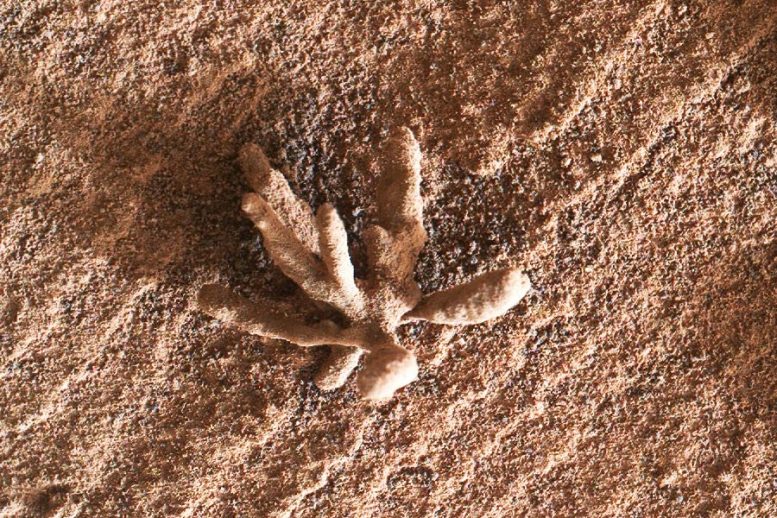
The Curiosity rover took a picture of something pretty enticing this week on the surface of Mars. While the object in question looks like a tiny little flower or maybe even some type of organic feature, the rover team confirmed this object is a mineral formation, with delicate structures that formed by minerals precipitating from water.
Curiosity has actually seen these types of features before, which are called diagenetic crystal clusters. Diagenetic means the recombination or rearrangement of minerals, and these features consist of three-dimensional crystal clusters, likely made of a combination of minerals. Curiosity deputy project scientist Abigail Fraeman said on Twitter that these features that were seen previously were made of salts called sulfates.
(1/3) Your Friday moment of zen: A beautiful new microscopic image from @MarsCuriosity shows teeny, tiny delicate structures that formed by mineral precipitating from water.
(Penny approximately for scale added me)https://t.co/cs7t11BWAj pic.twitter.com/AU20LjY5pQ
— Abigail Fraeman (@abbyfrae) February 26, 2022
From studies of previous features like this found on Mars (you can read a paper on them here), originally the feature was embedded within a rock, which eroded away over time. These mineral clusters, however, appear to be resistant to erosion.
Another name for these features is concretion, which you may remember from the Opportunity rover, who saw features that were nicknamed ‘blueberries,’ since they were small and round. You can see round concretions next to the flower-like feature in this image.
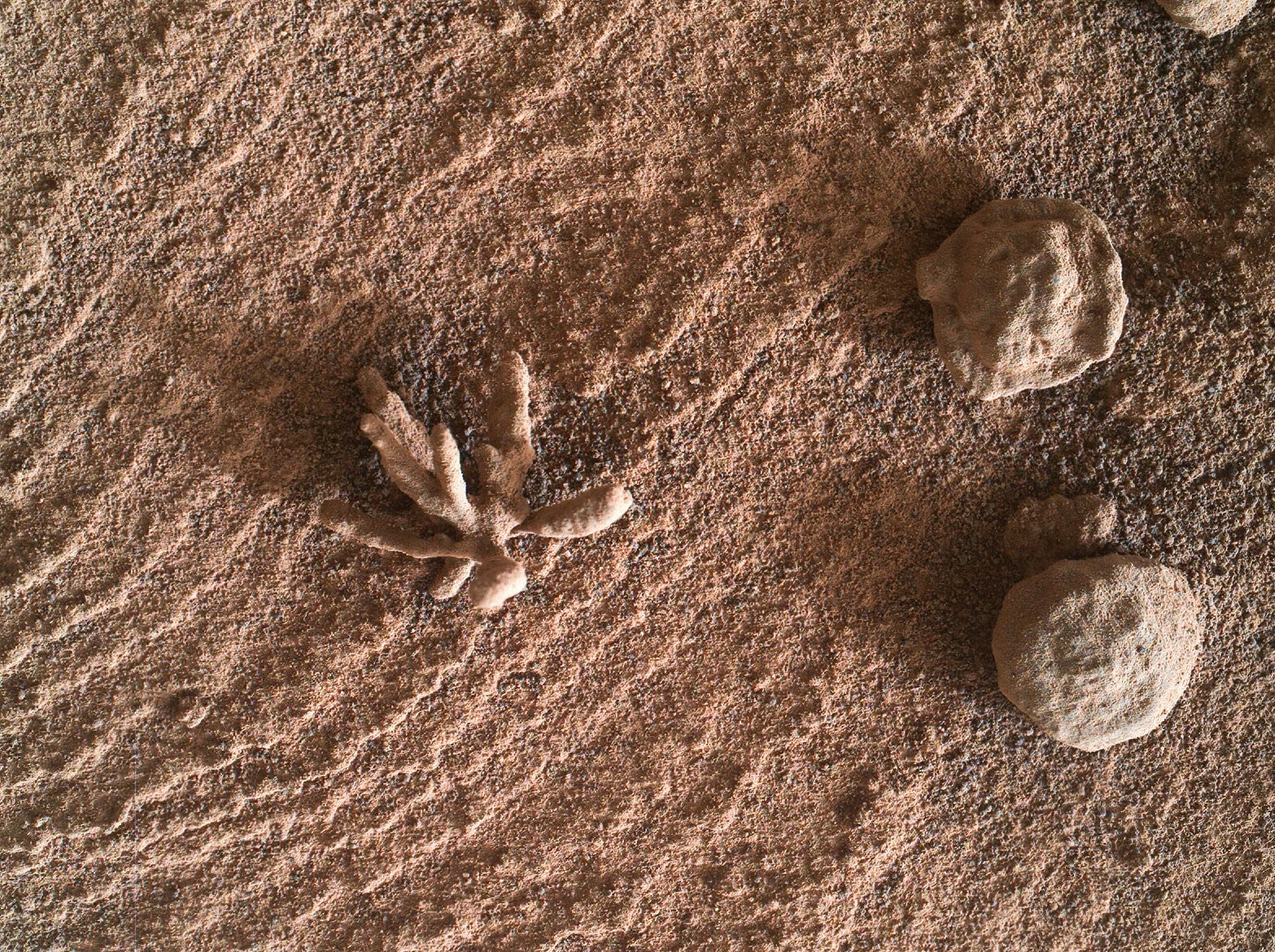
The rover science team saw this feature earlier this week and named it ‘Blackthorn Salt’. They used the rover’s Mars Hand Lens Imager, called MAHLI, to take these close-up images. This camera is the rover’s version of the magnifying hand lens that geologists usually carry with them into the field. MAHLI’s close-up images reveal the minerals and textures in rock surfaces.
Here you can see a 3-D model of the object, thanks to Simeon Schmauss:
Curiosity found another flower-like feature back in 2013, and the Spirit rover found similar-looking rocks that were nicknamed ‘cauliflower’ features because of their knobby protuberances.
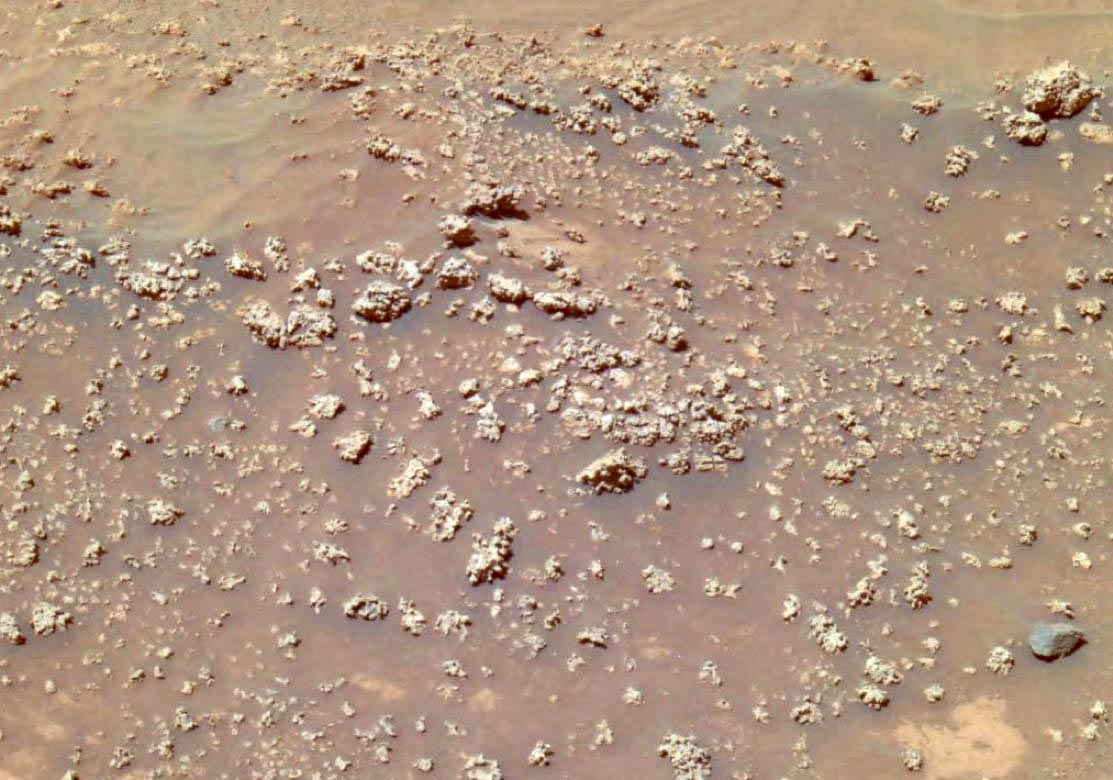
Our thanks to Kevin Gill who processed the images, taken on Sol 3397. See more great Curiosity images processed by Kevin at his Flickr page.
Adapted from an article originally published on Universe Today.
Never miss a breakthrough: Join the SciTechDaily newsletter.
Follow us on Google and Google News.
18 Comments
Imagine coming to the earth after it dries out. No life anywhere. But, everything that lived and died would be right on the surface. NASA is fuking about. Squeezing as much cash as they can from the Mars cow. Remember that a test for life on the Viking lander was positive. Think about that.
We have thought about the one test among the negatives that were positive, and few but the experiment scientist himself have been excited. Even before we found the perchlorate oxidizers in the soil that explains the observations from known ingredients.
By your own account it is interesting research, which the researchers agree on, and NASA is not idly spending money as you suggest. Read about the research on Mars and the many results, as well as the many other interested parties like Europe, Russia and China, and think about that.
I’m not a fan of the “water on Mars” theory. We’ve seen the solar system’s largest electric dust storms, electrical dust devils a mile high, hematite nodules everyone, each in its own little tiny crater just like the ones we can reproduce with arc point anodes above a bed of hematite in a laboratory.
Don’t get me wrong-I’m not saying Mars never had water. I can’t prove that any more than I can do a marathon these days. What I’m saying is that these features are easily reproducible with electric currents and dry, semi-conductive substrates right in a laboratory. That is literally inarguable.
It boils down to what you would rather believe…unless you’re a scientist. Then, it’s supposed to be about what you can *disprove* empirically. So, as you can see by a lot of the comments of scientists doing exogeology and exohydrology, some people are letting their beliefs and desires cloud their thinking.
Reminds me of Chico from Duck Soup: “Who ya gonna believe-me, or your own eyes?” Clarity of thought is what makes for the most elucidatory analyses of observations. Word.
Scientific Consensus > whatever you’re going on about.
Cue Scott C Waring saying it’s a form of alien vegetable proving that Martians exist and are peaceful farmers and that NASA is hiding that fact from us
Don’t suggest new ideas for them.
No seriously: it has been shown in research that describing conspiracy theories – even when criticizing them – makes people believe in them more.
I just couldn’t resist Torbjörn LOL.
Waring has come out with some really silly comments it just seems to ‘fit’ you know?
That’s coral!
Is no one going to address the standing water in the crater photo at the end of this article?
It’s a nice find. I particularly enjoy the way it is just a few inches from a stone with a natural sculpture of an ape skull graven into it.
Which I find a little more interesting… Louis Leakey might also..
Hey…! That looks like the last neuron I have left. After this week’s news cycle, my mind was blown… Could this neuron be mine?
A sea coral
Ewige Blumenkraft.
Thats coral and maybe some sponges, but Nasa would never admit it, but as everyone knows, NASA, stands for Never A Strait Answer!!!
Looks like a psychedelic cactus. I reckon if you ate it, you would trip for weeks, and then slowly die from radiation poisoning.
Keep breeding people, there’s room on Mars!
The one that looks like a flower reminds me of a sea anenome(sp?)!
Babu G. Ranganathan*
(B.A. Bible/Biology)
POSSIBLY MILLIONS OF TONS OF VOLCANIC EARTH SOIL REACHED MARS (Newsweek)
A Newsweek article of September 21, 1998, p.12 mentions the high possibility of Earth life on Mars because of millions of tons of Earth soil ejected into space from ancient volcanic explosions. “We think there’s about 7 million tons of earth soil sitting on Mars”, says USC scientist Kenneth Nealson. “You have to consider the possibility that if we find life on Mars, it could have come from the Earth” [Weingarten, T., Newsweek, September 21, 1998, p.12]. This may also explain why life forms may exist on Venus, again because they originated from Earth.
In the Earth’s past there was powerful volcanic activity which could have easily spewed dirt and rocks containing microbes and life into outer space which not only could have eventually reached Mars but also ended up traveling in orbit through space that we now know as meteors, comets, and asteroids. This would mean life forms found in meteorites originated from Earth in the first place.
Secular scientists have a different explanation from creationist scientists on the volcanic eruptions of the Earth’s past. Creation scientists believe, as Genesis teaches, that as the fountains of the deep were opened to release water for the world-wide flood the force of the eruptions could have indeed spewed great amounts of earth soil into space.
Life could not have evolved. A partially evolved cell would quickly disintegrate under the effects of random forces of the environment, especially without the protection of a complete and fully functioning cell membrane. A partially evolved cell cannot wait millions of years for chance to make it complete and living! In fact, it couldn’t have even reached the partially evolved state.
Having the right conditions and raw material for life do not mean that life can originate or arise by chance. Stanley Miller, in his famous experiment in 1953, showed that individual amino acids (the building blocks of life) could come into existence by chance. But, it’s not enough just to have amino acids. The various amino acids that make-up life must link together in a precise sequence, just like the letters in a sentence, to form functioning protein molecules. If they’re not in the right sequence the protein molecules won’t work. It has never been shown that various amino acids can bind together into a sequence by chance to form protein molecules. Even the simplest cell is made up of many millions of various protein molecules.
The probability of just an average size protein molecule arising by chance is 10 to the 65th power. Mathematicians have said any event in the universe with odds of 10 to 50th power or greater is impossible! The late great British scientist Sir Frederick Hoyle calculated that the odds of even the simplest cell coming into existence by chance is 10 to the 40,000th power! How large is this? Consider that the total number of atoms in our universe is 10 to the 82nd power.
Also, what many don’t realize is that Miller had a laboratory apparatus that shielded and protected the individual amino acids the moment they were formed, otherwise the amino acids would have quickly disintegrated and been destroyed in the mix of random energy and forces involved in Miller’s experiment.
Miller’s experiment produced equally both left-handed and right-handed amino acids, but all living things strictly require only left-handed amino acids. If a right-handed amino acid gets into the chain the protein won’t work.
There is no innate chemical tendency for the various amino acids to bond with one another in a sequence. Any one amino acid can just as easily bond with any other. The only reason at all for why the various amino acids bond with one another in a precise sequence in the cells of our bodies is because they’re directed to do so by an already existing sequence of molecules found in our genetic code.
Of course, once you have a complete and living cell then the genetic code and biological machinery exist to direct the formation of more cells, but how could life or the cell have naturally originated when no directing code and mechanisms existed in nature? Read my Internet article: HOW FORENSIC SCIENCE REFUTES ATHEISM.
Visit my newest Internet site: THE SCIENCE SUPPORTING CREATION
Author of popular Internet article, TRADITIONAL DOCTRINE OF HELL EVOLVED FROM GREEK ROOTS
* I have had the privilege of being recognized in the 24th edition of Marquis “Who’s Who In The East” for my writings on religion and science, and I have given successful lectures (with question and answer time afterwards) defending creation from science before evolutionist science faculty and students at various colleges and universities.
From the outlook of a Geologist, it looks most like a burrow cast. On earth there are several types of animals that burrow into sand or soil and their burrows can fill with sediment and eventually form burrow casts in a variety of sizes. On earth these concretions are common. The organisms that dig these burrows can range in size from small worms to ground squirrels to Prairie dogs. There are even paleo burrow casts that are even larger in scale. I’m not claiming that Mars had prairie dogs, but some of the worms that leave casts on earth developed far back into earth’s past and were some of the earliest organisms that developed here.