
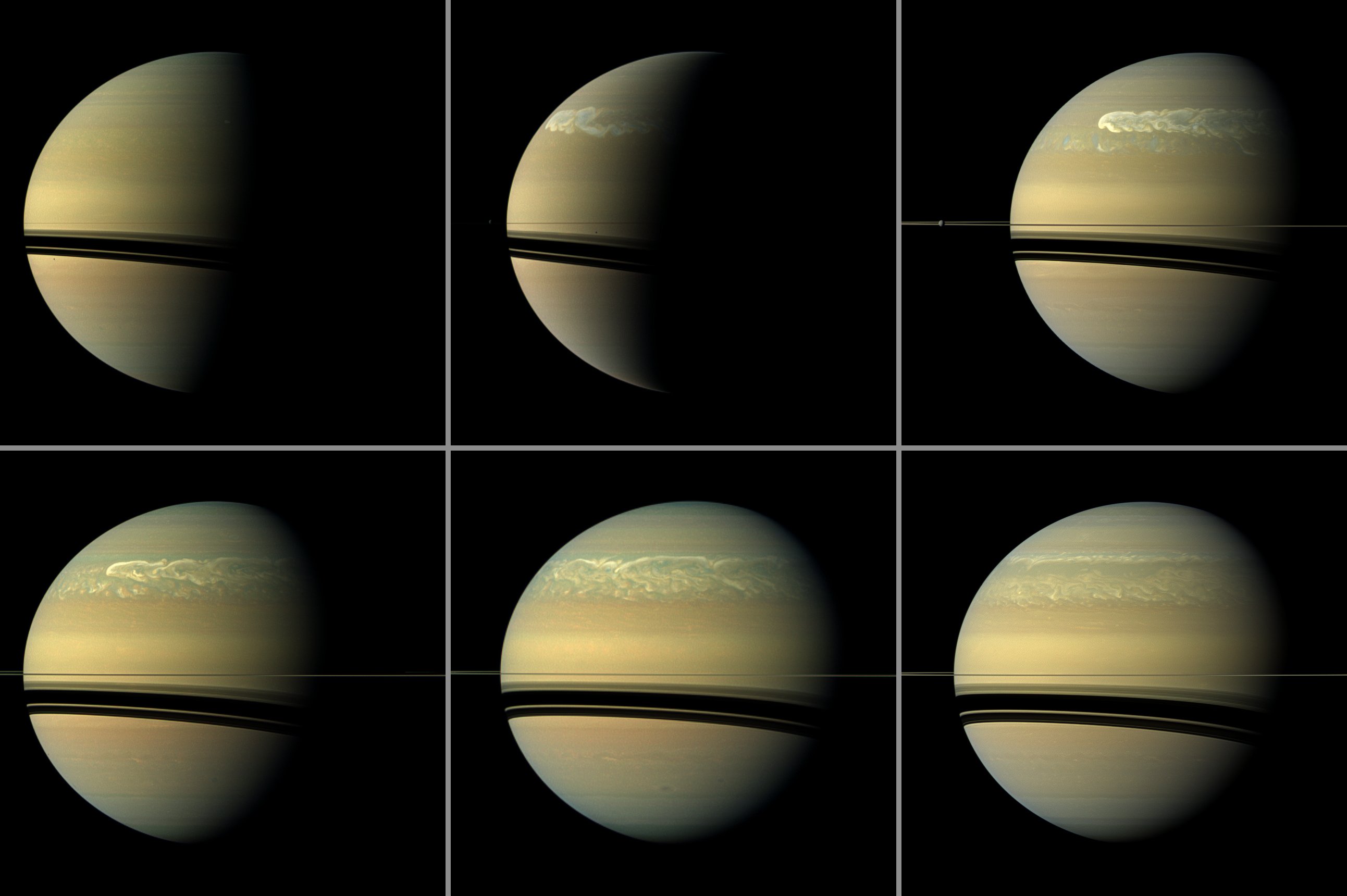
New research describes the effect responsible for the development of a huge storm that erupts about every 30 years on Saturn.
The long-standing mystery of why Saturn seethes with enormous storms every 30 years may have been solved by scientists working with data from NASA’s Cassini mission. The tempests, which can grow into bright bands that encircle the entire planet, are on a natural timer that is reset by each subsequent storm, the researchers report.
In 140 years of telescope observations, great storms have erupted on Saturn six times. Cassini and observers on Earth tracked the most recent of these storms from December 2010 to August 2011. During that time, the storm exploded through the clouds, eventually winding its way around Saturn.
In a paper published in the journal Nature Geoscience, scientists describe the effect they believe is responsible for the periodic outbursts. The basic idea is that water vapor is heavier than the hydrogen and helium that make up the bulk of Saturn’s atmosphere, so once each giant storm dumps its huge mass of rain, the air within the clouds is left lighter than the atmosphere below. For a time, this situation shuts off the process of convection — in which warm, moist air rises, and cool, dense air sinks — that creates new clouds and storms.
“For decades after one of these storms, the warm air in Saturn’s deep atmosphere is too wet, and too dense, to rise,” said Cheng Li, a graduate student at the California Institute of Technology in Pasadena, who led the study. “The air above has to cool off, radiating its heat to space, before its density is greater than that of the hot, wet air below. This cooling process takes about 30 years, and then come the storms.”
Li thinks the episodic nature of the storms indicates Saturn’s deep atmosphere contains more water, relative to the other atmospheric constituents, than Jupiter. The researchers suggest Saturn’s extra-wet interior might explain why the planet has such epic tantrums, whereas Jupiter does not. If Saturn’s deep atmosphere were drier, scientists would expect continuous, smaller storms, as observed on Jupiter, Li said. Instead, Saturn’s outbursts are episodic and quite explosive.
Other observations by ground and space-based telescopes have hinted at a wet interior for Saturn. “Previous studies using spectroscopy have shown that Saturn’s interior is enriched in methane and other volatiles, by two or three times, compared to Jupiter. From there, it’s a short leap to expect that Saturn is also rich in oxygen, which is also a volatile and a big part of every H2O molecule,” said Andrew Ingersoll, a member of the Cassini science team, also at Caltech, who co-authored the paper with Li. Volatiles are elements and chemical compounds that change from solid to liquid or gas at relatively low temperatures.
Scientists are interested in understanding the amount of oxygen and other volatile ingredients in Saturn and Jupiter. These ingredients provide important clues about the formation of the two planets — which are thought to have formed before all the others — and conditions in the early solar system.
The Cassini-Huygens mission is a cooperative project of NASA, ESA (European Space Agency), and the Italian Space Agency. JPL, a division of Caltech, manages the mission for NASA’s Science Mission Directorate in Washington.
Reference: “Moist convection in hydrogen atmospheres and the frequency of Saturn’s giant storms” by Cheng Li and Andrew P. Ingersoll, 13 April 2015, Nature Geoscience.
DOI: 10.1038/ngeo2405
Never miss a breakthrough: Join the SciTechDaily newsletter.
Follow us on Google and Google News.
1 Comment
RBL would like to note that I have previously presented a continuum spinrevorbital motion that proposes a gravitomagnetic bonding between nuclei that may be used in the atmosphere of Saturn at its cold temperatures to predict novel binding hydrogen atoms and novel diamond liquid crystalline structures at the huge gravity and high pressures and low temperatures within the interior of Saturn. As Saturn has only a trace of water I doubt that the great white spots during Saturn’s superstorms are from water and rain and ice from water. I think the storms are either from methane transformed to diamond as I originally proposed on Wikipedia {See “A Different Belief and Theory” section} (http://en.wikipedia.org/wiki/Diamonds_on_Jupiter_and_Saturn ) or the great white spots of Saturn are explained by a gravitomagnetic chemistry involving hydrogen and helium atoms and novel gravitomagnetic binding of hydrogen and helium atoms into solids of greater densities or liquid crystalline hydrogen helium as explained on page 11 and 12 {of “A Theory of the Relativistic Fermionic Spinrevorbital”} [http://www.academicjournals.org/journal/IJPS/article-abstract/592BAB049585 ] and even throughout this long article. But such gravitomagnetic binding and spinrevorbitals thereof I proposed for transforming thermal, mechanical pressure, macro electric, gravity and macro magnetic energies and they bind fermions for explaining high temperature superconductivity and superfluidity as I think occurs within Saturn! I proposed that such spinrevorbital states can bind and glue electrons and nuclei of elements like H and He at lower temperatures as in Saturn as the nuclei of H and He and the surrounding electrons use the thermal energy, pressures and gravity within Saturn to form the unparticles or spinrevorbital continuum of mass energy, momenta for glueing their superconducting fermions at the prevailing temperatures. The great white spots may be the condensation of gravitomagnetically bound H and He structures which with greater mass and magnetism rotate and fall in an orbit for a superfluid orbit of the storm which explains the lateral rotation of the storm as the great storm encircles Saturn. But I applied and document such models to the mechanism of superconductivity and in so noted that heat and relative moving thermal energy relative to fermion can be transformed to gravito-magnetism for nondissipation of motion of fermions for superconductivity and superfluidity! See the short article at this website : http://arxiv.org/abs/1412.4012 .
RBL (in a second longer article “A Theory of the Relativisitic Fermionic Spinrevorbital”) also considered in more details (a lot of details) how heat and relative thermal motions are transformed to gravity and gravity to magnetism by magnetic processes for forming continuum spinrevorbitals (unparticles) in stellar objects and such would apply to cold objects like within Saturn for novel gravitomagnetic binding and chemistry at the low temperatures rather than fusion as in the stellar objects. I show in this article how such heat to gravity to magnetism is further intrinsically coupled to fermions for binding fermions at higher temperatures for novel magnetogravimetric molecules and superfluidity and superconductivity below current critical temperatures. By this I first proposed in 2005 via sci-print archive and in 2012 via vixra archive and now in Jan 2015 via IJPS that quarks are held by a glue that is magnetic revolutionary (unparticle) for a gravitomagnetic basis of chemical bonding for holding the superfluidic hydrogen and heliun in nuclei together. In analog, I realized such weaker magnetic spinrevorbital hold electrons in atoms and molecules for superconductivity and superfluidity in orbitals and in continuum (forbidden states). I thereby realized that such continuum spinrevorbitals in many atoms making up macro-objects can form by macroscopic heat, pressure, macro-electric, gravity, macromagnetic energies to form continuum states of varying mass, momenta and energies for binding macroobjects that constitute these great white spots and internal storms at low temperatures in Saturn with low temperature superconductivity and superfluidity of the storm as it encircles Saturn until the storm descends and liquefies wherein it can reevaporate to restart the cycle in the 30 year period. This is very beautiful!!! See a long article that ties everything together at this website : http://www.academicjournals.org/journal/IJPS/article-abstract/592BAB049585 . You can see the abstract at this website and you can also access the whole publication free of charge by clicking on ‘full text pdf’.