
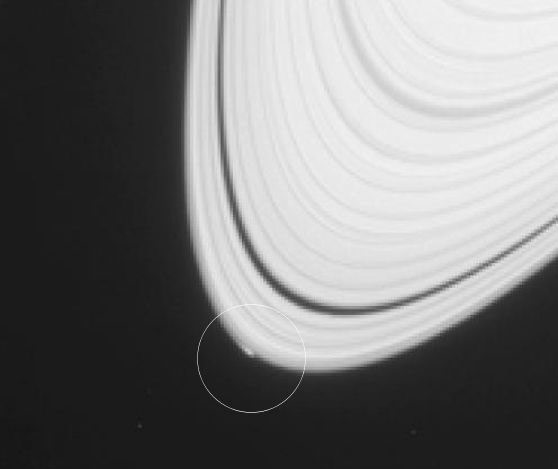
Using data from the Cassini spacecraft, astronomers believe they have discovered the possible formation of a new tiny moon within the rings of Saturn.
NASA’s Cassini spacecraft has documented the formation of a small icy object within the rings of Saturn. Informally named “Peggy,” the object may be a new moon. Details of the observations were published online today by the journal Icarus.
“We have not seen anything like this before,” said Carl Murray of Queen Mary University of London, and the report’s lead author. “We may be looking at the act of birth, where this object is just leaving the rings and heading off to be a moon in its own right.”
Images taken with Cassini’s narrow angle camera on April 15, 2013, show disturbances at the very edge of Saturn’s A ring – the outermost of the planet’s large, bright rings. One of these disturbances is an arc about 20 percent brighter than its surroundings, 750 miles (1,200 kilometers) long and 6 miles (10 kilometers) wide. Scientists also found unusual protuberances in the usually smooth profile at the ring’s edge. Scientists believe the arc and protuberances are caused by the gravitational effects of a nearby object.
The object is not expected to grow any larger, and may even be falling apart. But the process of its formation and outward movement aids in our understanding of how Saturn’s icy moons, including the cloud-wrapped Titan and ocean-holding Enceladus, may have formed in more massive rings long ago. It also provides insight into how Earth and other planets in our solar system may have formed and migrated away from our star, the Sun.
“Witnessing the possible birth of a tiny moon is an exciting, unexpected event,” said Cassini Project Scientist Linda Spilker, of NASA’s Jet Propulsion Laboratory (JPL) in Pasadena, California. According to Spilker, Cassini’s orbit will move closer to the outer edge of the A ring in late 2016 and provide an opportunity to study Peggy in more detail and perhaps even image it.
Peggy is too small to see in images so far. Scientists estimate it is probably no more than about a half mile in diameter. Saturn’s icy moons range in size depending on their proximity to the planet – the farther from the planet, the larger. And many of Saturn’s moons are comprised primarily of ice, as are the particles that form Saturn’s rings. Based on these facts, and other indicators, researchers recently proposed that the icy moons formed from ring particles and then moved outward, away from the planet, merging with other moons on the way.
“The theory holds that Saturn long ago had a much more massive ring system capable of giving birth to larger moons,” Murray said. “As the moons formed near the edge, they depleted the rings.”
It is possible the process of moon formation in Saturn’s rings has ended with Peggy, as Saturn’s rings now are, in all likelihood, too depleted to make more moons. Because they may not observe this process again, Murray and his colleagues are wringing from the observations all they can learn.
Reference: “A survey of low-velocity collisional features in Saturn’s F ring” by Nicholas O. Attree, Carl D. Murray, Gareth A. Williams and Nicholas J. Cooper, 19 September 2013, Icarus.
DOI: 10.1016/j.icarus.2013.09.008
arXiv: 1309.3119
Never miss a breakthrough: Join the SciTechDaily newsletter.
Follow us on Google and Google News.
1 Comment
To me this seems to show that indeed the planets are growing (i know measurements say otherwise, I?) and this new moon may reach the ‘tipping’ point where some amount of objects are ejected from the belt, most often going to the asteroid belts or to the Oort cloud or even to rain down on us. Enceladus spewing water, is that excess created by absorbing incoming energy, creating hydrogen and oxygen internally and with dynamic pressures of heating are forced out and help to add to the rings. The Saturnian clouds of gases must somehow have a route out to the rings.. anything in that??