

Close Menu
    Facebook X (Twitter) Instagram
    SciTechDaily
    • Biology
    • Chemistry
    • Earth
    • Health
    • Physics
    • Science
    • Space
    • Technology
    Facebook X (Twitter) Pinterest YouTube RSS
    SciTechDaily
    Home»Chemistry»Harnessing Nature’s Blueprint for Solar Energy Innovation
    Chemistry

    Harnessing Nature’s Blueprint for Solar Energy Innovation

    By University of GothenburgFebruary 17, 2024No Comments3 Mins Read
    Facebook Twitter Pinterest Telegram LinkedIn WhatsApp Email Reddit
    Share
    Facebook Twitter LinkedIn Pinterest Telegram Email Reddit
    Abstract Photosynthesis Electricity Art
    Research reveals the crucial role of proteins in converting solar energy for biological processes, such as photosynthesis and DNA repair in plants and fruit flies, respectively. By studying the deformation of proteins and the precise movement of electrons within, scientists aim to harness these insights for technological advancements. Credit: SciTechDaily.com

    Cells need energy to function. Researchers at the University of Gothenburg can now explain how energy is guided in the cell by small atomic movements to reach its destination in the protein. Imitating these structural changes of the proteins could lead to more efficient solar cells in the future.

    The sun’s rays are the basis for all the energy that creates life on Earth. Photosynthesis in plants is a prime example, where solar energy is needed for the plant to grow. Special proteins absorb the sun’s rays, and the energy is transported as electrons inside the protein, in a process called charge transfer. In a new study, researchers show how proteins deform to create efficient transport routes for the charges.

    Discovery in Protein Structure

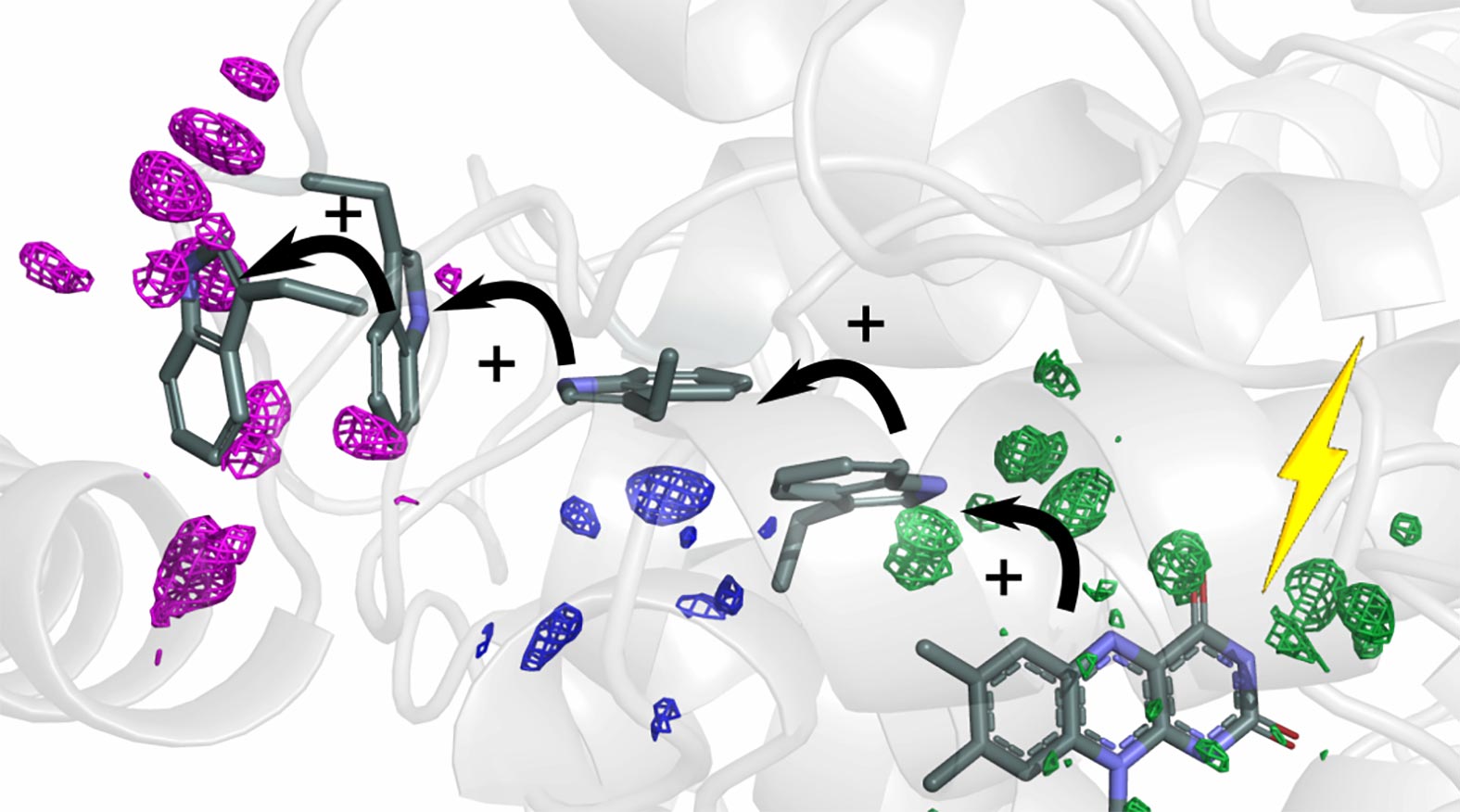
    “We studied a protein, photolyase, in the fruit fly, whose function is to repair damaged DNA. The DNA repair is powered by solar energy, which is transported in the form of electrons along a chain of four tryptophans (amino acids). The interesting discovery is that the surrounding protein structure was reshaped in a very specific way to guide the electrons along the chain,” explains Sebastian Westenhoff, Professor of Biophysical Chemistry.
    Charge Transfer in Cells Illustration
    The charge moves along a pathway in the protein that guides it to the right place in the protein. Credit: Sebastian Westenhoff

    The researchers noted how the changes in the structure followed precise timings in line with the transfer of the charge – important knowledge that could be used to design better solar panels, batteries or other applications that require energy transport.

    Insights for Future Technology

    “Evolution is nature’s material development and it is always the best. What we have done is basic research. The more we understand about what happens when proteins absorb sunlight, the better we can imitate this conversion of solar energy into electricity,” says Sebastian Westenhoff.

    Sebastian Westenhoff
    Sebastian Westenhoff, professor of Biophysical Chemistry. Credit: Sebastian Westenhoff

    The study, published in Nature Chemistry, is a clear step forward in the research on charge transfer in proteins. Studying the process in the fruit fly, using the Serial Femtosecond Crystallography (SFX) technique, can give researchers an insight into the dynamic interaction of the protein as the electrons move.

    “This is going to open up new chapters in our understanding of life’s mysteries at the molecular level,” concludes Sebastian Westenhoff.

    Reference: “Directed ultrafast conformational changes accompany electron transfer in a photolyase as resolved by serial crystallography” by Andrea Cellini, Madan Kumar Shankar, Amke Nimmrich, Leigh Anna Hunt, Leonardo Monrroy, Jennifer Mutisya, Antonia Furrer, Emma V. Beale, Melissa Carrillo, Tek Narsingh Malla, Piotr Maj, Lidija Vrhovac, Florian Dworkowski, Claudio Cirelli, Philip J. M. Johnson, Dmitry Ozerov, Emina A. Stojković, Leif Hammarström, Camila Bacellar, Jörg Standfuss, Michał Maj, Marius Schmidt, Tobias Weinert, Janne A. Ihalainen, Weixiao Yuan Wahlgren and Sebastian Westenhoff, 15 January 2024, Nature Chemistry.
    DOI: 10.1038/s41557-023-01413-9

    Never miss a breakthrough: Join the SciTechDaily newsletter.
    Follow us on Google and Google News.

    Photosynthesis Photovoltaics University of Gothenburg
    Share. Facebook Twitter Pinterest LinkedIn Email Reddit

    Related Articles

    Artificial Photosynthesis Breakthrough – Researchers Produce Hybrid Solid Catalysts

    More Efficient Than Natural Photosynthesis – New Photocatalytic System Converts Carbon Dioxide Into Valuable Fuel

    Previously Unknown Material Could Revolutionize Cancer Treatment

    Harnessing Bacteria and Sunlight: A Revolutionary Path to Sustainable Energy

    Nature’s Chaos That Powers Life: MIT Chemists Discover Why Photosynthetic Light-Harvesting Is So Efficient

    Harnessing Quantum Physics: New Visualization Technique Gives Insight Into Photosynthesis

    Feeding the Future: Artificial Photosynthesis Transforms CO2 Into Food

    Simplifying the Future of Solar Energy: A Single-Step Solution-Coating Process for Perovskite Solar Cells

    Revolutionizing Recycling: Transforming Industrial Waste Into Eco-Friendly Plastic Through Artificial Photosynthesis

    Leave A Reply Cancel Reply

    • Facebook
    • Twitter
    • Pinterest
    • YouTube

    Don't Miss a Discovery

    Subscribe for the Latest in Science & Tech!

    Trending News

    The Secret to Healthy Aging May Be More Protein and More Exercise

    These 567-Million-Year-Old Fossils Are Rewriting the Story of Life on Earth

    The Spider-Like Creatures Helping Scientists Decode the Origins of Fatherhood

    Scientists Baffled by a Sudden Reversal Deep Inside Earth’s Core

    This Strange Sea Creature Can Survive Five Years Without Food – Scientists Finally Know Why

    New Quantum Sensor Opens a Window Into the Invisible Universe

    Stanford Scientists Reverse Age-Related Memory Loss by Targeting the Gut

    James Webb Uncovers the Atmosphere of a Hellish Lava World 41 Light-Years Away

    Follow SciTechDaily
    • Facebook
    • Twitter
    • YouTube
    • Pinterest
    • Newsletter
    • RSS
    SciTech News
    • Biology News
    • Chemistry News
    • Earth News
    • Health News
    • Physics News
    • Science News
    • Space News
    • Technology News
    Recent Posts
    • One of Arizona’s Largest Reservoirs Is Less Than 1% Full After Snowpack Collapse
    • Scientists Detect Hundreds of Iceberg Earthquakes at Antarctica’s Crumbling Doomsday Glacier
    • This 400-Year-Old Shark May Hold the Secret to Preserving Human Vision
    • Hip Replacements Are Lasting Far Longer Than Doctors Once Thought
    • Why Swallowing a Fish Bone Can Become a Life-Threatening Medical Emergency
    Copyright © 1998 - 2026 SciTechDaily. All Rights Reserved.
    • Science News
    • About
    • Contact
    • Editorial Board
    • Privacy Policy
    • Terms of Use

    Type above and press Enter to search. Press Esc to cancel.