
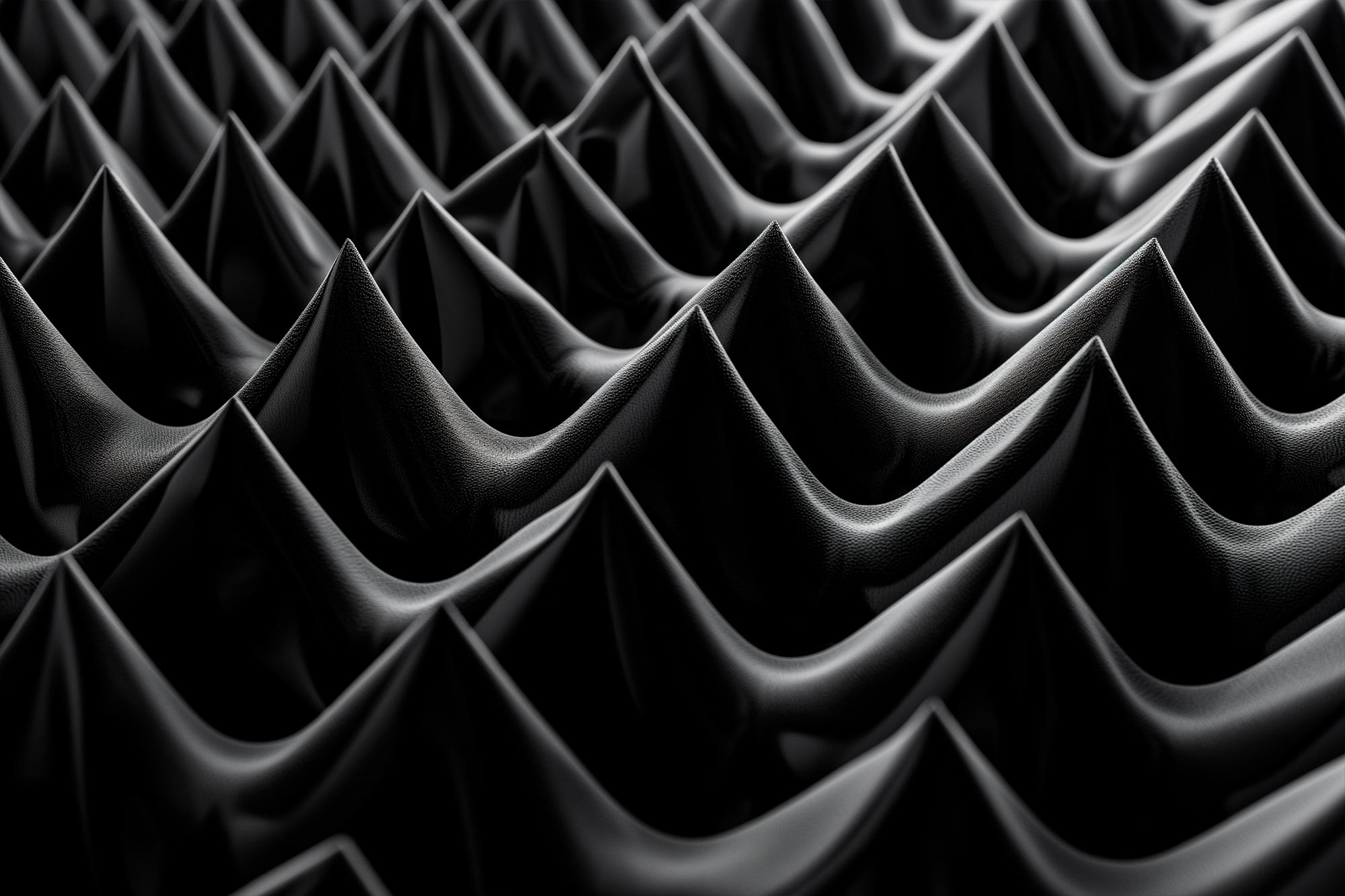
A new model from PPPL researchers explains the production of black silicon using fluorine gas, enhancing its application in solar cells and marking a new direction in quantum chemistry research.
Researchers at the U.S. Department of Energy’s Princeton Plasma Physics Laboratory (PPPL) have developed a new theoretical model explaining one way to make black silicon, an important material used in solar cells, light sensors, antibacterial surfaces, and many other applications.
Black silicon is made when the surface of regular silicon is etched to produce tiny nanoscale pits on the surface. These pits change the color of the silicon from gray to black and, critically, trap more light, an essential feature of efficient solar cells.
While there are many ways to make black silicon, including some that use the charged, fourth state of matter known as plasma (see video below), the new model focuses on a process that uses only fluorine gas. PPPL Postdoctoral Research Associate Yuri Barsukov said the choice to focus on fluorine was intentional: The team at PPPL wanted to fill a gap in publicly available research. While some papers have been published about the role of charged particles called ions in the production of black silicon, not much has been published about the role of neutral substances, such as fluorine gas.
“We now know — with great specificity — the mechanisms that cause these pits to form when fluorine gas is used,” said Barsukov, one of the authors of a new paper about the work. “This kind of information, published publicly and openly available, benefits us all, whether we pursue further knowledge into the basic knowledge that underlines such processes or we seek to improve manufacturing processes.”
Model Reveals Bonds Break Based on Atom Orientation at the Surface
The new etching model precisely explains how fluorine gas breaks certain bonds in the silicon more often than others, depending on the orientation of the bond at the surface. As silicon is a crystalline material, atoms bond in a rigid pattern. These bonds can be characterized based on the way they are oriented in the pattern, with each type of orientation, or plane, identified by a bracketed number, such as (100), (110), or (111).

“If you etch silicon using fluorine gas, the etching proceeds along (100) and (110) crystal planes but does not etch (111), resulting in a rough surface after the etching,” explained Barsukov. As the gas etches away at the silicon unevenly, pits are created on the surface of the silicon. The rougher the surface, the more light it can absorb, making rough black silicon ideal for solar cells. Smooth silicon, in contrast, is an ideal surface for creating the atomic-scale patterns necessary for computer chips.
“If you want to etch silicon while leaving a smooth surface, you should use another reactant than fluorine. It should be a reactant that etches uniformly all crystalline planes,” Barsukov said.
PPPL Expands Its Expertise Into Quantum Chemistry
The research is also notable because it represents an early success in one of PPPL’s newest research areas.
“The Lab is diversifying,” said Igor Kaganovich, principal research physicist and co-author of the paper, which was published in the Journal of Vacuum Science & Technology A. “This is a first for PPPL to do this kind of quantum chemistry work.”
Reference: “Orientation-dependent etching of silicon by fluorine molecules: A quantum chemistry computational study” by Omesh Dhar Dwivedi, Yuri Barsukov, Sierra Jubin; Joseph R. Vella and Igor Kaganovich, 29 August 2023, Journal of Vacuum Science & Technology A Vacuum Surfaces and Films.
DOI: 10.1116/6.0002841
Quantum chemistry is a branch of science investigating the structure and reactivity of molecules using quantum mechanics: the laws of physics governing very small and very light objects, such as electrons and nuclei.
Other researchers who contributed to the paper include Joseph Vella, associate research physicist; Sierra Jubin, a graduate student at Princeton University; and former research assistant at PPPL Omesh Dhar Dwivedi.
This research was supported by the PPPL Laboratory Directed Research and Development funding for novel, innovative processes for highly selective and self-limiting etching relevant to nanofabrication of microelectronics and quantum device materials.
Never miss a breakthrough: Join the SciTechDaily newsletter.
Follow us on Google and Google News.