
Close Menu
    Facebook X (Twitter) Instagram
    SciTechDaily
    • Biology
    • Chemistry
    • Earth
    • Health
    • Physics
    • Science
    • Space
    • Technology
    Facebook X (Twitter) Pinterest YouTube RSS
    SciTechDaily
    Home»Chemistry»Organic Photovoltaic Material Offers Great Promise for Solar Energy
    Chemistry

    Organic Photovoltaic Material Offers Great Promise for Solar Energy

    By Department of Chemistry, MITOctober 2, 2015No Comments3 Mins Read
    Facebook Twitter Pinterest Telegram LinkedIn WhatsApp Email Reddit
    Share
    Facebook Twitter LinkedIn Pinterest Telegram Email Reddit
    Modeling Electron Excitation in Organic Photovoltaic Materials
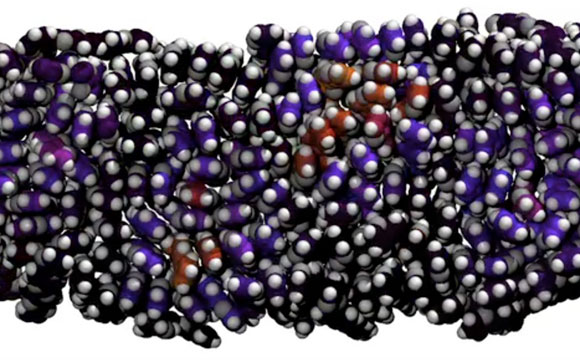
    A top-down view of a photo-excited disordered molecular film. In this film the excited electron tends to spread out across multiple individual molecules in a non-uniform pattern that depends on the underlying disorder. Here, shape and size of the delocalized excitation is indicated by the shading of each molecular core; in this case the excitation is distributed into four non-overlapping regions of the material.

    Scientists at MIT believe modeling electron excitation in organic photovoltaic material could change the future of solar energy.

    The semi-conducting plastic is lightweight, flexible, relatively inexpensive, and easy to make. The problem is that, unlike inorganic photovoltaic material, it is not very efficient or stable. But work by Adam Willard, an assistant professor in the Department of Chemistry at MIT, has the potential to change that.

    Willard is a theoretical chemist who uses modeling and simulation to study molecular systems. The goal of his research group is to explore and understand the fundamentals and consequences of molecular disorder — which lies at the heart of the challenge posed by organic photovoltaic material.

    While organic photovoltaic films may appear smooth and homogeneous to the naked eye, they are extremely disordered at the molecular scale, where they appear as a giant tangle of unaligned molecules. That tangle makes it difficult to understand how electrons, when excited by photons, could more easily travel through the structure and reach an external electrode. Even understanding the behavior of a single electron is a challenge.

    “The position and shape of the excited electron are dynamic and affected by extremely subtle changes in nuclear motion,” Willard explains. “You can imagine the difficulty of understanding millions of subtle nuclear motions and their impact on millions of electrons.”

    Until recently, researchers were unable to even consider this kind of problem.

    “Computers have become so fast and efficient that we can explore a whole class of problems computationally that we couldn’t touch 50 years ago,” Willard says. “For years, the solution to many theoretical chemical problems had to be found analytically by pencil and paper, which meant that many approximations had to be made in order to make the solution analytically tractable. Now, the technology can do the legwork. We’re able to explore the molecular consequences of approximations that have been made and that have shown up in textbooks, and to address where some of these approximations break down or fail to predict behavior.”

    Willard is using computers available to MIT faculty at the Massachusetts Green High Performance Center (MGHPCC). The MGHPCC provides world-class computational infrastructure, indispensable in the increasingly sensor and data-rich environments of modern science and engineering discovery.

    Even with today’s high-performance computers, modeling the behavior of excited electrons on a single large molecule is close to the limit of what is currently feasible, and ensembles of hundreds of molecules are out of reach. To get around this limit, Willard is taking a multi-level approach, simulating the behavior of excited electrons in individual molecules, then applying what he has learned to models consisting of many simplified molecules. This transforms the problem from one that requires a single prohibitively large computation to one that requires many relatively simple computations. The latter can be distributed across platforms that contain many individual processors.

    “Understanding how electrons make their way from deep inside photovoltaic material to where they can be collected, and used to power our fans and light bulbs, is a challenging problem, but one that needs to be addressed for this material to cross over into the realm where it can be useful at the global scale,” Willard says.

    Never miss a breakthrough: Join the SciTechDaily newsletter.
    Follow us on Google and Google News.

    Green Technology Materials Science MIT Photovoltaics Solar Energy
    Share. Facebook Twitter Pinterest LinkedIn Email Reddit

    Related Articles

    New Technique Allows for Rapid Solar Cell Screening

    New Catalyst Promotes Carbon Dioxide Conversion into Fuels

    New Material Can Store Solar Energy During the Day and Release it Later as Heat

    New “Tandem” Solar Cell to Harnesses More Sunlight

    Engineers Develop New System to Harness the Full Spectrum of Available Solar Radiation

    MIT Engineers Recycle Old Batteries Into Solar Cells

    New Efficiency Record for Quantum-Dot Photovoltaics

    Researchers Demonstrate a New Paradigm for Solar Cell Construction

    Aluminum Studs Improve Solar Panel Efficiency

    Leave A Reply Cancel Reply

    • Facebook
    • Twitter
    • Pinterest
    • YouTube

    Don't Miss a Discovery

    Subscribe for the Latest in Science & Tech!

    Trending News

    Artificial Sweeteners May Harm Future Generations, Study Suggests

    Splashdown! NASA Artemis II Returns From Record-Breaking Moon Mission

    What If Consciousness Exists Beyond Your Brain

    Scientists Finally Crack the 100-Million-Year Evolutionary Mystery of Squid and Cuttlefish

    Beyond “Safe Levels”: Study Challenges What We Know About Pesticides and Cancer

    Researchers Have Found a Dietary Compound That Increases Longevity

    Scientists Baffled by Bizarre “Living Fossil” From 275 Million Years Ago

    Your IQ at 23 Could Predict Your Wealth at 27, Study Finds

    Follow SciTechDaily
    • Facebook
    • Twitter
    • YouTube
    • Pinterest
    • Newsletter
    • RSS
    SciTech News
    • Biology News
    • Chemistry News
    • Earth News
    • Health News
    • Physics News
    • Science News
    • Space News
    • Technology News
    Recent Posts
    • This Metal Melts in Your Hand – and Scientists Just Discovered Something Strange
    • Why Losing Too Much Fat Can Be Just As Dangerous as Obesity
    • Beef vs. Chicken: Surprising Results From New Prediabetes Study
    • Alzheimer’s Breakthrough: Scientists Discover Key Protein May Prevent Toxic Protein Clumps in the Brain
    • Scientists Discover New Way To Make Protein Shakes Taste Better
    Copyright © 1998 - 2026 SciTechDaily. All Rights Reserved.
    • Science News
    • About
    • Contact
    • Editorial Board
    • Privacy Policy
    • Terms of Use

    Type above and press Enter to search. Press Esc to cancel.