
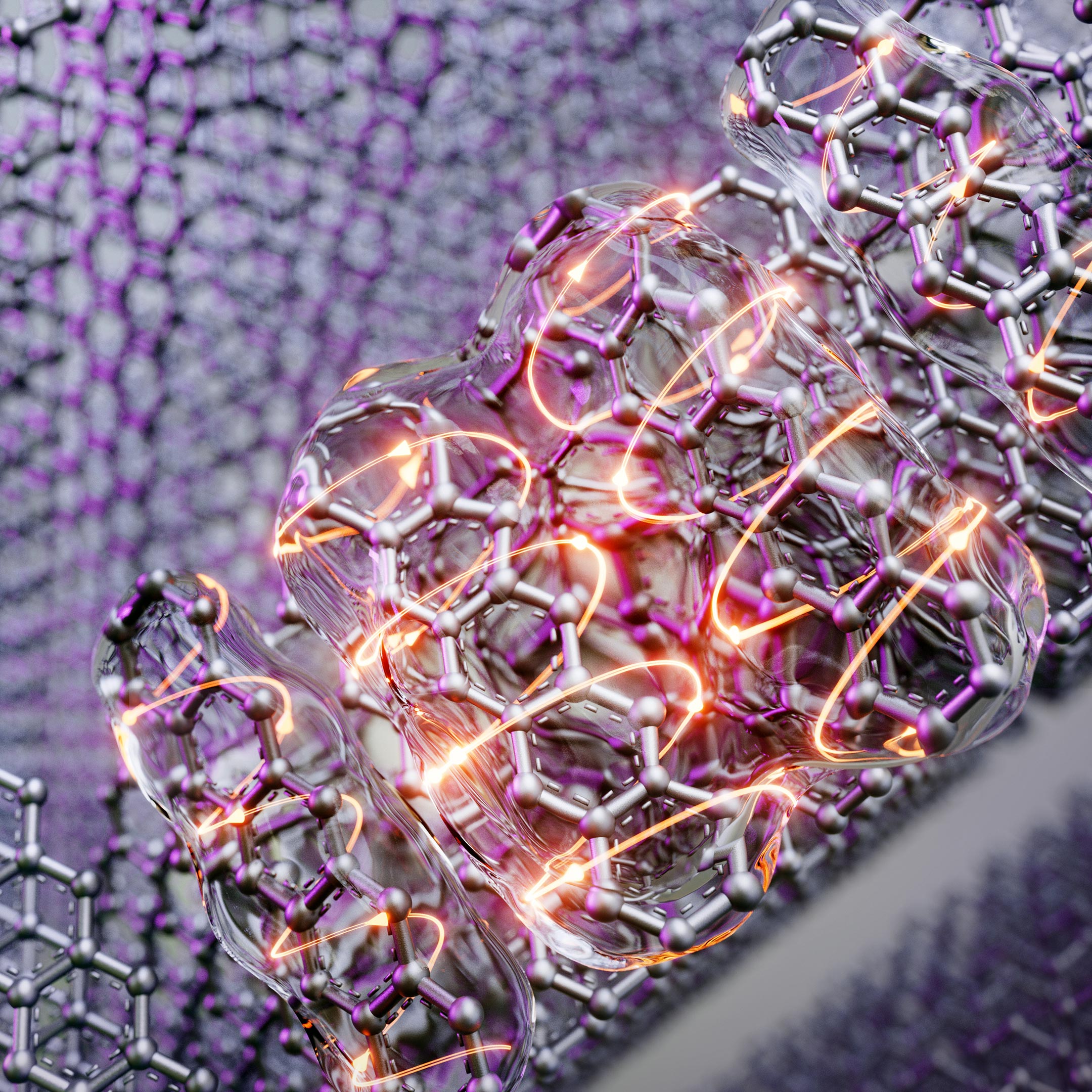
Researchers have resolved the mechanism of exciton fission, which could increase solar-to-electricity efficiency by one-third, potentially revolutionizing photovoltaic technology.
Photovoltaics, the conversion of light to electricity, is a key technology for sustainable energy. Since the days of Max Planck and Albert Einstein, we know that light as well as electricity are quantized, meaning they come in tiny packets called photons and electrons. In a solar cell, the energy of a single photon is transferred to a single electron of the material, but no more than one. Only a few molecular materials like pentacene are an exception, where one photon is converted to two electrons instead. This excitation doubling, which is called exciton fission, could be extremely useful for high-efficiency photovoltaics, specifically to upgrade the dominant technology based on silicon. A team of researchers at the Fritz Haber Institute of the Max Planck Society, the Technical University of Berlin, and the Julius-Maximilians-Universität of Würzburg have now deciphered the first step of this process by recording an ultrafast movie of the photon-to-electricity conversion process, resolving a decades-old debate about the mechanism of the process.
”When pentacene is excited by light, the electrons in the material rapidly react,” explains Prof. Ralph Ernstorfer, a senior author of the study. “It was an open and very disputed question whether a photon excites two electrons directly or initially one electron, which subsequently shares its energy with another electron.”
To unravel this mystery the researchers used time- and angle-resolved photoemission spectroscopy, a cutting-edge technique to observe the dynamics of electrons on the femtosecond time scale, which is a billionth of a millionth of a second. This ultrafast electron movie camera enabled them to capture images of the fleeting excited electrons for the first time.
Deciphering Electron Orbital Patterns
“Seeing these electrons was crucial to decipher the process,” says Alexander Neef, from the Fritz Haber Institute and the first author of the study. “An excited electron not only has a specific energy but also moves in distinct patterns, which are called orbitals. It is much easier to tell the electron apart if we can see their orbital shapes and how these change over time.”
With the images from the ultrafast electron movie at hand, the researchers decomposed the dynamics of the excited electrons for the first time based on their orbital characteristics. “We can now say with certainty that only one electron is excited directly and identified the mechanism of the excitation-doubling process,” adds Alexander Neef.
Knowing the mechanism of exciton fission is essential to using it for photovoltaic applications. A silicon solar cell enhanced with an excitation-doubling material could boost the solar-to-electricity efficiency by one-third. Such an advance could have enormous impacts since solar energy will be the dominant power source of the future. Already today large investments are flowing into the construction of these third-generation solar cells.
Reference: “Orbital-resolved observation of singlet fission” by Alexander Neef, Samuel Beaulieu, Sebastian Hammer, Shuo Dong, Julian Maklar, Tommaso Pincelli, R. Patrick Xian, Martin Wolf, Laurenz Rettig, Jens Pflaum and Ralph Ernstorfer, 12 April 2023, Nature.
DOI: 10.1038/s41586-023-05814-1
Never miss a breakthrough: Join the SciTechDaily newsletter.
Follow us on Google and Google News.
5 Comments
Stupid move to call it fission…..
Why do you lay out your pages so we see a large paragraph on the left that we have to scroll past EVERY TIME FOR EVERY SECTION to see the articles? That is just stupid. Move it or get rid of it. Nobody reads that bs. Let us see the articles. What usability studies did your web developers consult? Oh, I know… NONE.
Could this work with non-silicon based PV, such as perovskite and/or organic?
Was this written by an AI? It’s full of poor writing and bad science. This is my favourite:
“..one photon is converted to two electrons..”
I think you’ll find an educated human would write “one photon has its energy transferred to two electrons”
If this was written by a human and not AI, then you have my apologies, and my sympathy.
This article reads like the “Rockwell Retro Encabulator” presentation.