
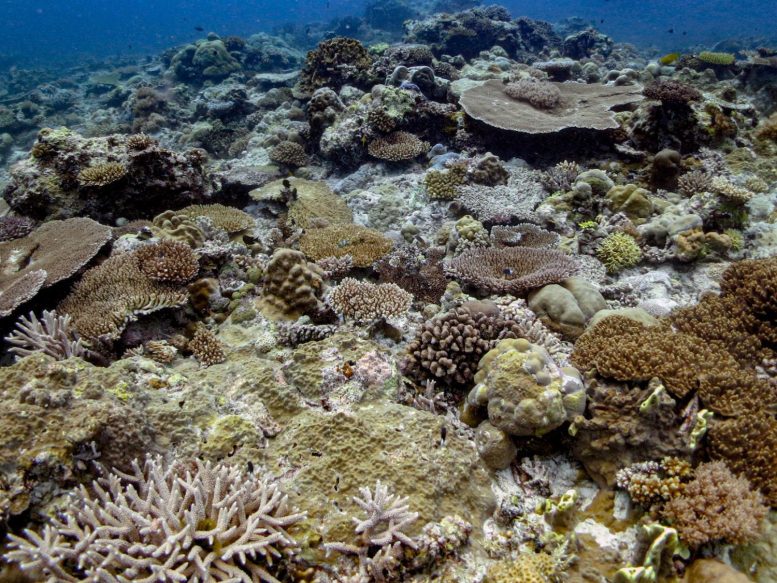
In a study exploring the various species of algal symbionts associated with reef corals throughout the Indo-Pacific region, researchers discovered a high degree of flexibility in these relationships. This flexibility may enhance these coral systems’ long-term resilience to climate change’s impacts.
Facing the effects of global warming and other environmental shifts, corals in the Atlantic Ocean have experienced a sharp decline in recent years. On the other hand, corals in the Pacific and Indian Oceans are faring better. An international team, led by Penn State, has found that the mutualistic relationships between corals and several species of symbiotic algae in the Indo-Pacific may be more adaptable and able to withstand rising ocean temperatures better than those in the Atlantic.
Coral reefs are vast geological structures made of calcium carbonate produced by coral animals whose colonies possess dense populations of photosynthetic algae from the family Symbiodiniaceae — herein referred to as “symbionts” — within their tissues. When environmental factors such as increased ocean temperatures disrupt the relationship between the algae and the coral, coral bleaching occurs, causing the colony to turn white. Although corals can recover from bleaching, it may lead to their death, depending on the severity and length of the stress..
“Coral bleaching not only affects the corals themselves but also entire ecosystems of organisms — from invertebrates, like sea urchins and spiny lobsters, to vertebrates, like fish and sea turtles,” said Todd LaJeunesse, professor of biology, Penn State. “It’s important to study the biology of corals and their symbionts so we can predict how they will respond to future environmental changes, especially ocean warming.”
Regional Differences in Coral-Symbiont Relationships
But, LaJeunesse said, not all corals and symbionts will respond in the same way. That’s because the world’s oceans contain thousands of species of corals, each with their own unique attributes. And, until recently, he said, no one really appreciated the vast diversity of symbiont species and their importance to coral survival.
“Scientists previously lumped all the symbionts into a few broad groups,” said LaJeunesse. “My lab’s work over the past several years has been to describe individual species of symbiont so we know what we’re dealing with. Without this information, you really can’t adequately study the ecology, physiology, and biogeography of corals.”
As LaJeunesse and his colleagues began to describe symbiont species, they learned that some are specialists — meaning they can only associate with one or a few species of coral hosts — whereas others are generalists — meaning they can associate with many species of coral hosts. In addition, they found that some corals, especially from the Caribbean, rely on specialist symbionts, whereas corals from the Indo-Pacific associate with generalists. The lack of flexibility among Caribbean corals may make them more sensitive to environmental changes while Indo-Pacific corals with more flexible partnerships may withstand greater environmental change.
Implications of Thermally Tolerant Symbionts
Indeed, according to LaJeunesse, the symbiont species that the team described are important to reef ecosystems because of their ecological dominance and their importance to so many coral species over huge geographic areas.
He said, “It’s possible that these species may come to dominate coral communities as Earth’s oceans warm and more sensitive symbionts die out.”
The team’s new research, which was recently published in the Journal of Phycology, provides formal descriptions for several host-generalist symbiont species in the Indo-Pacific region. To conduct their study, the researchers collected samples of coral from across the Indo-Pacific, including the reefs of Palau, Thailand, Zanzibar of Tanzania, the Phoenix Islands, the Great Barrier Reef of Australia, and New Caledonia. Next, they extracted the symbiotic algae from these samples and sequenced their DNA. They then identified and described five species of symbionts that are able to associate with a variety of host coral species.
“It’s difficult to communicate about things we do not know about, or even have a name for,” said Caleb Butler, a graduate student in biology at Penn State, and first author on the paper. “When we formally describe a species, we are putting a name to these organisms, helping build an identity we can talk about and allow us to connect previous studies with future research. The organisms that we described are widespread, and as oceans warm, these thermally tolerant generalists are likely to expand to new coral communities. Recognizing these distinct species enables informed research into their ecology, and the ability to accurately communicate about the implications of our findings.”
Specifically, the symbionts that the team described are in the genus Cladocopium.
“Cladocopium are exceptionally biodiverse relative to other coral symbionts; yet very few species from this genus have been successfully cultured,” said Matthew Nitschke, a research scientist from the Australian Institute of Marine Science (AIMS). “One of the species the team described, C. proliferum, can be cultured in a test tube which enables significant progress towards understanding the mechanisms underpinning coral-algal symbiosis, and it has become a model species for such research in Australia. Our Australian team, led by Professor Madeleine van Oppen, are currently using C. proliferum cultures in reef restoration research and development, with a focus on how these algal symbionts contribute to the heat-tolerance of corals.”
Reference: “Formal recognition of host-generalist species of dinoflagellate (Cladocopium, Symbiodiniaceae) mutualistic with Indo-Pacific reef corals” by Caleb C. Butler, Kira E. Turnham, Allison M. Lewis, Matthew R. Nitschke, Mark E. Warner, Dustin W. Kemp, Ove Hoegh-Guldberg, William K. Fitt, Madeleine J. H. van Oppen and Todd C. LaJeunesse, 1 May 2023, Journal of Phycology.
DOI: 10.1111/jpy.13340
Other authors on the paper include Kira Turnham, Penn State; Allison Lewis, Lawrence Berkeley National Laboratory; Mark Warner, University of Delaware; Dustin Kemp, University of Alabama at Birmingham; Ove Hoegh-Guldberg, University of Queensland; Bill Fitt, University of Georgia; and Madeleine van Oppen, Australian Institute of Marine Science and University of Melbourne.
The study was funded by the National Science Foundation, IOC-UNESCO-World Bank and Eberly College at Penn State.
Never miss a breakthrough: Join the SciTechDaily newsletter.
Follow us on Google and Google News.