
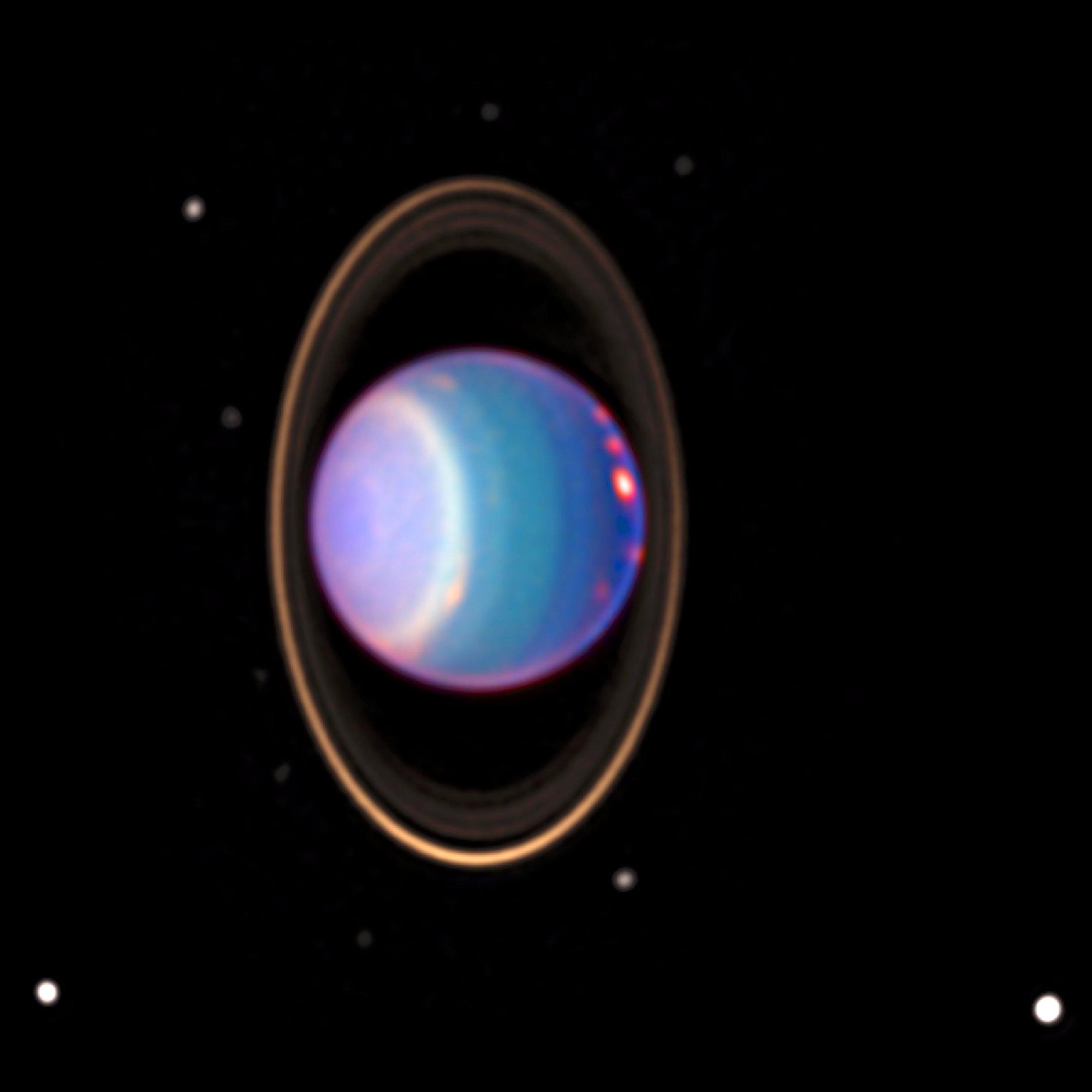
The work is based on new modeling and explores how oceans could exist in unlikely places in our solar system.
New computer modeling and re-analysis of Voyager data suggest that four of Uranus’ largest moons likely have ocean layers between their cores and icy crusts. Insulation and potential heat sources in the moons’ mantles may contribute to maintaining ocean warmth, while antifreeze substances like chlorides, ammonia, and salts are likely abundant in their oceans.
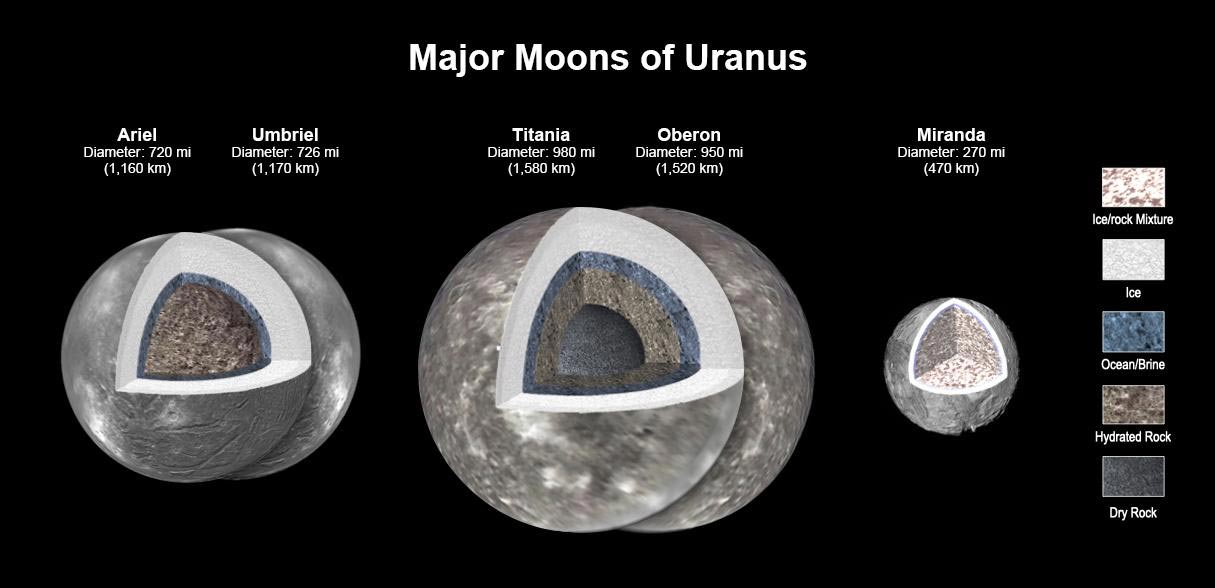
Re-analysis of data from NASA’s Voyager spacecraft, along with new computer modeling, has led NASA scientists to conclude that four of Uranus’ largest moons likely contain an ocean layer between their cores and icy crusts. Their study is the first to detail the evolution of the interior makeup and structure of all five large moons: Ariel, Umbriel, Titania, Oberon, and Miranda. The work suggests four of the moons hold oceans that could be dozens of miles deep.
In all, at least 27 moons circle Uranus, with the four largest ranging from Ariel, at 720 miles (1,160 kilometers) across, to Titania, which is 980 miles (1,580 kilometers) across. Scientists have long thought that Titania, given its size, would be most likely to retain internal heat, caused by radioactive decay. The other moons had previously been widely considered too small to retain the heat necessary to keep an internal ocean from freezing, especially because heating created by the gravitational pull of Uranus is only a minor source of heat.
The National Academies’ 2023 Planetary Science and Astrobiology Decadal Survey prioritized exploring Uranus. In preparation for such a mission, planetary scientists are focusing on the ice giant to bolster their knowledge about the mysterious Uranus system. Published in the Journal of Geophysical Research: Planets, the new work could inform how a future mission might investigate the moons, but the paper also has implications that go beyond Uranus, said lead author Julie Castillo-Rogez of NASA’s Jet Propulsion Laboratory in Southern California.
Credit: NASA/JPL-Caltech
“When it comes to small bodies – dwarf planets and moons – planetary scientists previously have found evidence of oceans in several unlikely places, including the dwarf planets Ceres and Pluto, and Saturn’s moon Mimas,” she said. “So there are mechanisms at play that we don’t fully understand. This paper investigates what those could be and how they are relevant to the many bodies in the solar system that could be rich in water but have limited internal heat.”
The study revisited findings from NASA’s Voyager 2 flybys of Uranus in the 1980s and from ground-based observations. The authors built computer models infused with additional findings from NASA’s Galileo, Cassini, Dawn, and New Horizons (each of which discovered ocean worlds), including insights into the chemistry and the geology of Saturn’s moon Enceladus, Pluto and its moon Charon, and Ceres – all icy bodies around the same size as the Uranian moons.
What Lies Above and Beneath
The researchers used that modeling to gauge how porous the Uranian moons’ surfaces are, finding that they’re likely insulated enough to retain the internal heat that would be needed to host an ocean. In addition, they found what could be a potential heat source in the moons’ rocky mantles, which release hot liquid, and would help an ocean maintain a warm environment – a scenario that is especially likely for Titania and Oberon, where the oceans may even be warm enough to potentially support habitability.
By investigating the composition of the oceans, scientists can learn about materials that might be found on the moons’ icy surfaces as well, depending on whether substances underneath were pushed up from below by geological activity. There is evidence from telescopes that at least one of the moons, Ariel, has material that flowed onto its surface, perhaps from icy volcanoes, relatively recently.
In fact, Miranda, the innermost and fifth largest moon, also hosts surface features that appear to be of recent origin, suggesting it may have held enough heat to maintain an ocean at some point. The recent thermal modeling found that Miranda is unlikely to have hosted water for long: It loses heat too quickly and is probably frozen now.
But internal heat wouldn’t be the only factor contributing to a moon’s subsurface ocean. A key finding in the study suggests that chlorides, as well as ammonia, are likely abundant in the oceans of the icy giant’s largest moons. Ammonia has been long known to act as antifreeze. In addition, the modeling suggests that salts likely present in the water would be another source of antifreeze, maintaining the bodies’ internal oceans.
Of course, there still are a lot of questions about the large moons of Uranus, Castillo-Rogez said, adding that there is plenty more work to be done: “We need to develop new models for different assumptions on the origin of the moons in order to guide planning for future observations.”
Digging into what lies beneath and on the surfaces of these moons will help scientists and engineers choose the best science instruments to survey them. For instance, determining that ammonia and chlorides may be present means that spectrometers, which detect compounds by their reflected light, would need to use a wavelength range that covers both kinds of compounds.
Likewise, they can use that knowledge to design instruments that can probe the deep interior for liquid. Searching for electrical currents that contribute to a moon’s magnetic field is generally the best way to find a deep ocean, as Galileo mission scientists did at Jupiter’s moon Europa. However, the cold water in the interior oceans of moons such as Ariel and Umbriel could make the oceans less able to carry these electrical currents and would present a new kind of challenge for scientists working to figure out what lies beneath.
Reference: “Compositions and Interior Structures of the Large Moons of Uranus and Implications for Future Spacecraft Observations” by Julie Castillo-Rogez, Benjamin Weiss, Chloe Beddingfield, John Biersteker, Richard Cartwright, Allison Goode, Mohit Melwani Daswani and Marc Neveu, 14 December 2022, Journal of Geophysical Research: Planets.
DOI: 10.1029/2022JE007432
Never miss a breakthrough: Join the SciTechDaily newsletter.
Follow us on Google and Google News.