
Webb’s Infrared Image Highlights the Planet’s Dramatic Rings and Dynamic Atmosphere
The planet Uranus is an oddball in our solar system, tilted on its side as it orbits the sun, causing extreme seasons. While the planet’s atmosphere appeared nearly featureless when visited by the Voyager 2 spacecraft in 1986, subsequent observations from the ground and in space have shown turbulent storms.
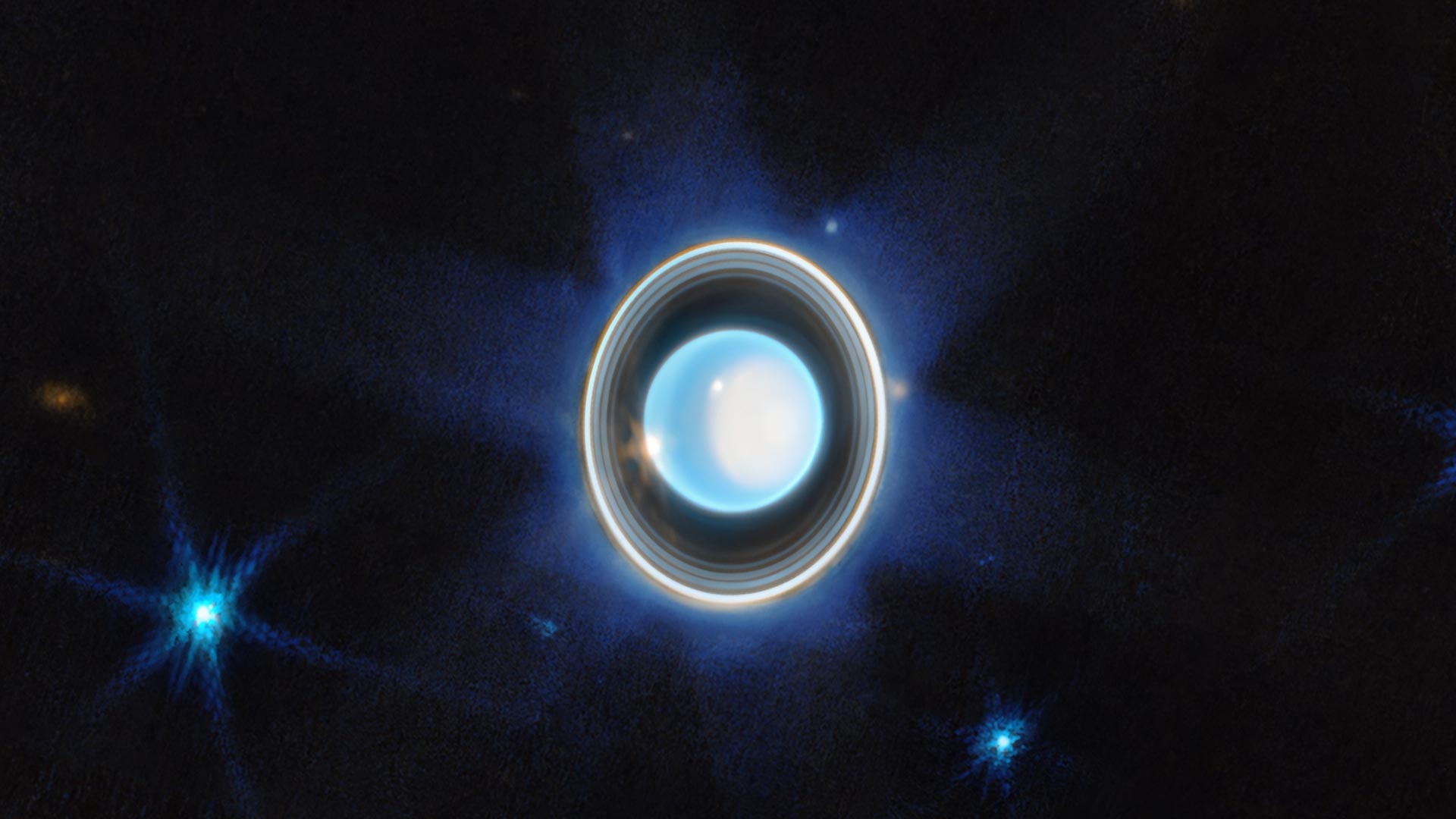
NASA’s James Webb Space Telescope recently observed Uranus, and the resulting image highlights a complex system of rings as well as a bright polar cap and likely storm clouds.

Webb Space Telescope Scores Another Ringed World with New Image of Uranus
Following in the footsteps of the Neptune image released in 2022, NASA’s James Webb Space Telescope has taken a stunning image of the solar system’s other ice giant, the planet Uranus. The new image features dramatic rings as well as bright features in the planet’s atmosphere. The Webb data demonstrates the observatory’s unprecedented sensitivity for the faintest dusty rings, which have only ever been imaged by two other facilities: the Voyager 2 spacecraft as it flew past the planet in 1986, and the Keck Observatory with advanced adaptive optics.
The seventh planet from the Sun, Uranus is unique: It rotates on its side, at roughly a 90-degree angle from the plane of its orbit. This causes extreme seasons since the planet’s poles experience many years of constant sunlight followed by an equal number of years of complete darkness. (Uranus takes 84 years to orbit the Sun.) Currently, it is late spring for the northern pole, which is visible here; Uranus’ northern summer will be in 2028. In contrast, when Voyager 2 visited Uranus it was summer at the south pole. The south pole is now on the ‘dark side’ of the planet, out of view and facing the darkness of space.

This infrared image from Webb’s Near-Infrared Camera (NIRCam) combines data from two filters at 1.4 and 3.0 microns, which are shown here in blue and orange, respectively. The planet displays a blue hue in the resulting representative-color image.
When Voyager 2 looked at Uranus, its camera showed an almost featureless blue-green ball in visible wavelengths. With the infrared wavelengths and extra sensitivity of Webb we see more detail, showing how dynamic the atmosphere of Uranus really is.
On the right side of the planet, there’s an area of brightening at the pole facing the Sun, known as a polar cap. This polar cap is unique to Uranus – it seems to appear when the pole enters direct sunlight in the summer and vanish in the fall; these Webb data will help scientists understand the currently mysterious mechanism. Webb revealed a surprising aspect of the polar cap: a subtle enhanced brightening at the center of the cap. The sensitivity and longer wavelengths of Webb’s NIRCam may be why we can see this enhanced Uranus polar feature when it has not been seen as clearly with other powerful telescopes like the Hubble Space Telescope and Keck Observatory.
At the edge of the polar cap lies a bright cloud as well as a few fainter extended features just beyond the cap’s edge, and a second very bright cloud is seen at the planet’s left limb. Such clouds are typical for Uranus in infrared wavelengths, and likely are connected to storm activity.
This planet is characterized as an ice giant due to the chemical make-up of its interior. Most of its mass is thought to be a hot, dense fluid of “icy” materials – water, methane, and ammonia – above a small rocky core.
The James Webb Space Telescope has taken a stunning image of the Solar System’s other ice giant, the planet Uranus. The new image features dramatic rings as well as bright features in the planet’s atmosphere. The new Webb data of Uranus offer exquisite sensitivity, revealing the faintest dusty rings. The seventh planet from the Sun, Uranus is strange: it rotates on its side, at a nearly 90-degree angle from the plane of its orbit. This causes unusual seasons since the planet’s poles experience 42 years of constant sunlight and 42 years of complete darkness (Uranus takes 84 years to orbit the Sun). Currently, it is late spring at the northern pole, which is on the right side of this image; Uranus’s northern summer will be in 2028.
Uranus has 13 known rings and 11 of them are visible in this Webb image. Some of these rings are so bright with Webb that when they are close together, they appear to merge into a larger ring. Nine are classed as the main rings of the planet, and two are the fainter dusty rings (such as the diffuse zeta ring closest to the planet) that weren’t discovered until the 1986 flyby by Voyager 2. Scientists expect that future Webb images of Uranus will reveal the two faint outer rings that were discovered with Hubble during the 2007 ring-plane crossing.
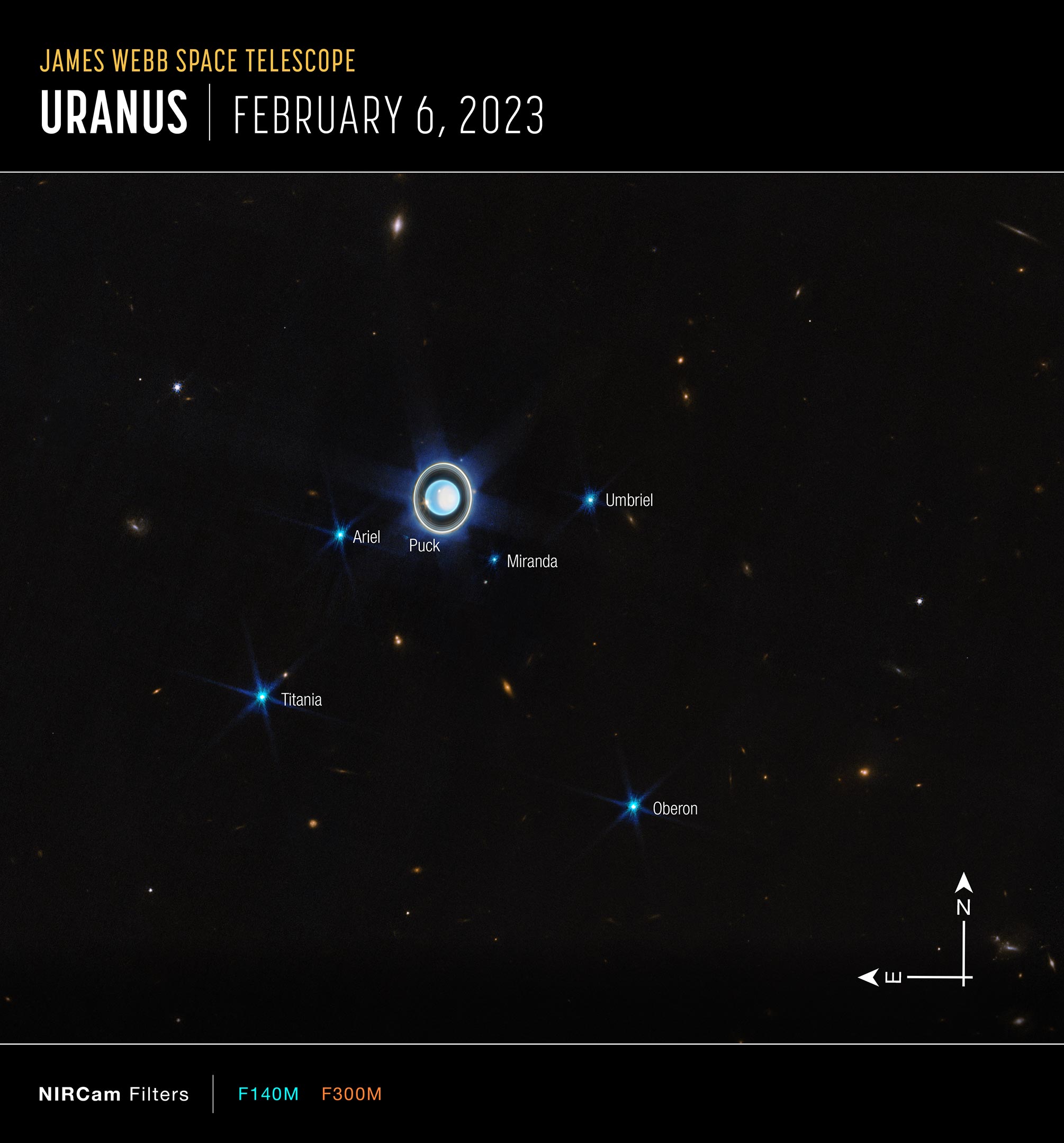
Webb also captured many of Uranus’s 27 known moons (most of which are too small and faint to be seen here); the six brightest are identified in the wide-view image. This was only a short, 12-minute exposure image of Uranus with just two filters. It is just the tip of the iceberg of what Webb can do when observing this mysterious planet. Additional studies of Uranus are happening now, and more are planned in Webb’s first year of science operations.
In 2022, the National Academies of Sciences, Engineering, and Medicine identified Uranus science as a priority in its 2023-2033 Planetary Science and Astrobiology decadal survey.
The James Webb Space Telescope is the foremost space science observatory in the world. It will unravel the secrets of our solar system, explore distant planets around other stars, and examine the enigmatic structures and beginnings of the universe and our position within it. The program is a collaboration between NASA, the European Space Agency (ESA), and the Canadian Space Agency, and is spearheaded by NASA.
Never miss a breakthrough: Join the SciTechDaily newsletter.
Follow us on Google and Google News.
1 Comment
Lots of great shots from thom