
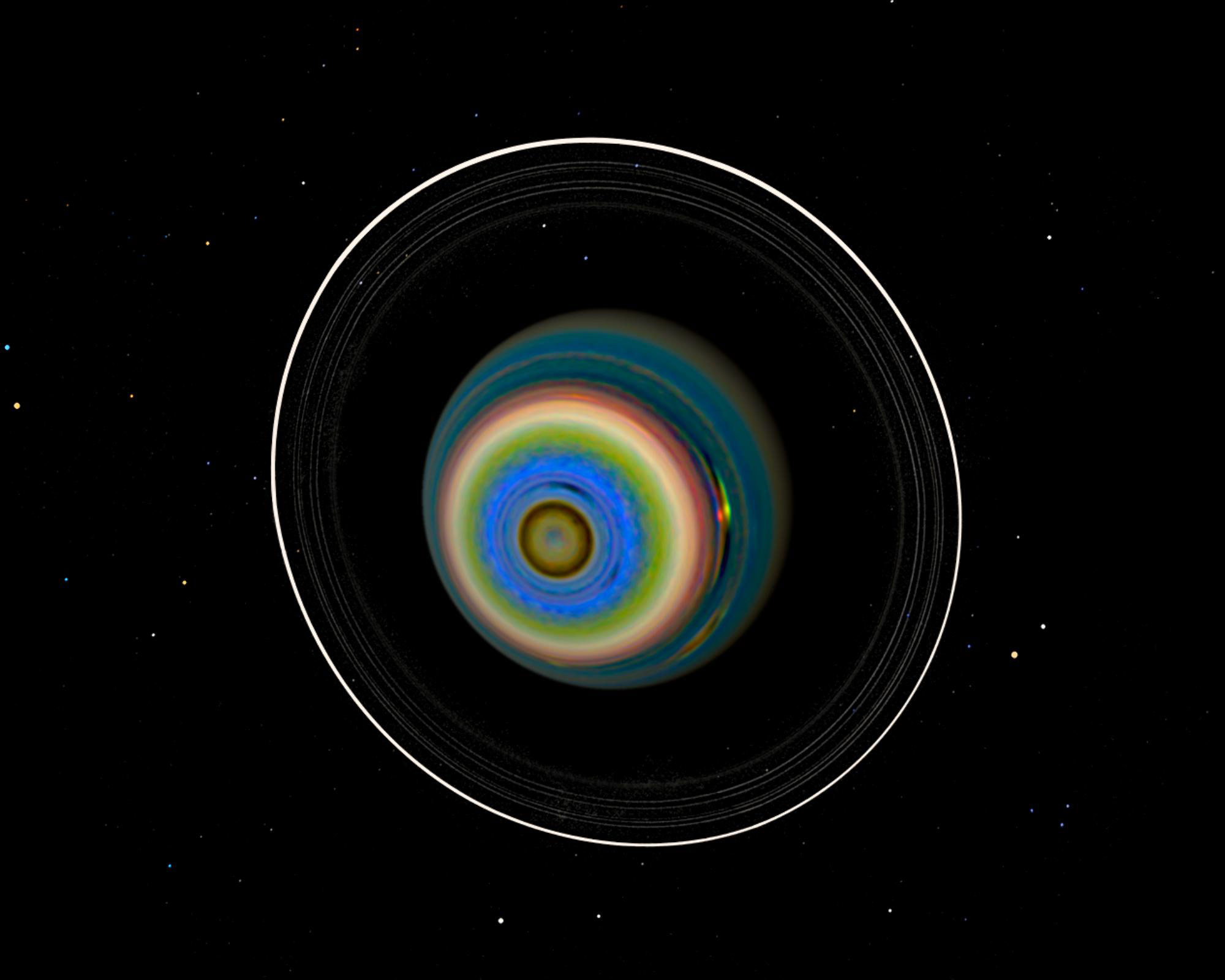
Using images NASA’s Voyager-2, astronomer Erich Karkoschka has uncovered features in Uranus’ atmosphere that reveal an unexpected, strange rotation pattern and point to the possible existence of an unusual feature inside the planet’s interior.
The findings shed light on the interior structures of giant gas planets, not only of Uranus, a planet for which observational data are sparse, but also those of the many extrasolar planets that are being discovered.
When Voyager-2 flew by Uranus in January 1986 and sent the first close-up images back to Earth, it revealed a giant, pale blue icy ball that lacked the stunningly detailed, colorful bands and swirls of Jupiter, Saturn, and Neptune. No more than eight faint features could be tracked, all located in the southern hemisphere. Only one of the eight features was located in the southern half of the southern hemisphere. Images taken with the Hubble Space Telescope and the largest telescopes on Earth did not reveal any feature there. The southern half of Uranus’ southern hemisphere seemed to be the blandest region in the outer solar system.
The animation below, provided by Karkoschka, shows Uranus as Voyager-2 saw it during its fly-by in 1986, superimposed with the new look of the giant gas planet as a result of this study.
By teasing out subtle differences from the information contained in Voyager’s images, Karkoschka discovered previously unseen features in Uranus’ atmosphere, revealing that Uranus’ southern hemisphere rotates unlike any region observed on the giant gas planets before. Karkoschka presented his findings at the meeting of the Division for Planetary Science of the American Astronomical Association in Tucson.
“Some of these features probably are convective clouds caused by updraft and condensation,” said Karkoschka, a senior staff scientist at the UA’s Lunar and Planetary Laboratory. “Some of the brighter features look like clouds that extend over hundreds of kilometers.”
A gas giant’s observable atmosphere extends less than one percent of the planet’s radius. Knowledge is limited about the more than 99 percent beneath it. In the absence of a visible surface, scientists rely on atmospheric features to determine the rotation periods of gas giants. The picture is complicated by atmospheric circulation patterns that vary with latitude and may or may not be in sync with the planet’s core rotation rate.
“What we’re really looking at when we observe the giant planets are their thick atmospheres,” Karkoschka explained. “Cloud features tracking winds move mostly east or west at a speed depending on the latitude. Once we know the wind speed or rotational period at each latitude, we know the circulation of the planet’s atmosphere.”
In 1665, Giovanni Cassini performed the first rotational measurement of a giant planet when he tracked the Great Red Spot on Jupiter. Over the last three and a half centuries, astronomers have pinned down essentially the complete circulation of Jupiter and Saturn and about 75 percent for Uranus and Neptune. Karkoschka’s new work fills in the remaining 25 percent for Uranus.
“All previous observations of the giant planets indicated that these planets rotate in a regular way, meaning the rotational rates in their respective southern and northern latitudes are about the same,” Karkoschka said. “My analysis suggests rotational rates in the high latitudes of Uranus are highly asymmetrical, with some southern latitudes possibly rotating as much as 15 percent faster than their northern counterparts.”
Karkoschka found several sharp kinks in the rotational profile, defying all previous observations and theoretical considerations.
“The unusual rotation of high southern latitudes of Uranus is probably due to an unusual feature in the interior of Uranus,” he said. “While the nature of the feature and its interaction with the atmosphere are not yet known, the fact that I found this unusual rotation offers new possibilities to learn about the interior of a giant planet.”
Astronomers have tried to find clues about the interior of the giant planets, but little is known so far. Signals at radio wavelengths have indicated the rotation of the magnetic field of the giant planets, which likely reflects the rotation of the deep interior core. However, these data do not reveal much about the interior structure. Additional clues have come from measurements of the giant planets’ gravitational fields, but data are extremely sparse. Karkoschka’s detailed rotational measurements of Uranus may help determine the interior structure of Uranus fairly accurately by eliminating some of the proposed models of the planet’s interior.
This animation shows the differential rotation of previously unseen atmospheric features in Uranus’s southern hemisphere. Credit: Erich Karkoschka
“Most of the more than a thousand planets discovered around other stars are similar in size to Uranus,” Karkoschka said. “They are too far for us to be able to measure their rotational profiles for the foreseeable future, but with an improved knowledge about Uranus, we might be better able to draw conclusions about their interior structure.”
Uranus is an oddball in the solar system. Its rotational axis is tilted by almost 90 degrees, like a spinning top lying on its side. One lap around the sun takes about 85 years. Uranus’ spring equinox in 2007 marked the beginning of a 43-year-long period of darkness for the south pole and its surroundings, hidden from Earth’s view. It seemed that the southern half of Uranus southern hemisphere was destined to stay a bland spot in the solar system — a region of unknown winds for decades to come.
Karkoschka did not want to wait that long. He experimented with different processing techniques and developed pattern recognition software until previously unseen features popped out. The largest improvement came when he stacked 1,600 images on top of one another to account for various possibilities of the rotation of Uranus. In the end, dozens of features became visible where only a single one was known before. The features were scattered all over the southern half of Uranus’ southern hemisphere so that its detailed circulation pattern finally became known. All these features, except the one previously known, are of very low contrast and become visible when the contrast is enhanced 300 times.
Karkoschka’s work illustrates the scientific value that can be gleaned from data that have been around for a long time, available to anyone with Internet access. He had similar success when he investigated 13-year-old Voyager images of Uranus’ surroundings and discovered the satellite Perdita.
“The computer memory necessary to process 1,600 images was not available at the time Voyager took these images,” Karkoschka said. “As computers and calibration methods get better, we can now do this kind of work, at a tiny fraction of the cost necessary to send a spacecraft to a planet.”
This work was supported by NASA (grant #NNX12AI68G) and was made possible by individuals involved in NASA’s Voyager project, which is still collecting data 37 years after launch.
Never miss a breakthrough: Join the SciTechDaily newsletter.
Follow us on Google and Google News.