
Close Menu
    Facebook X (Twitter) Instagram
    SciTechDaily
    • Biology
    • Chemistry
    • Earth
    • Health
    • Physics
    • Science
    • Space
    • Technology
    Facebook X (Twitter) Pinterest YouTube RSS
    SciTechDaily
    Home»Space»Keck II Telescope Peers Into Uranus’ Depths Using Adaptive-Optics
    Space

    Keck II Telescope Peers Into Uranus’ Depths Using Adaptive-Optics

    By SciTechDailyOctober 24, 2012No Comments3 Mins Read
    Facebook Twitter Pinterest Telegram LinkedIn WhatsApp Email Reddit
    Share
    Facebook Twitter LinkedIn Pinterest Telegram Email Reddit
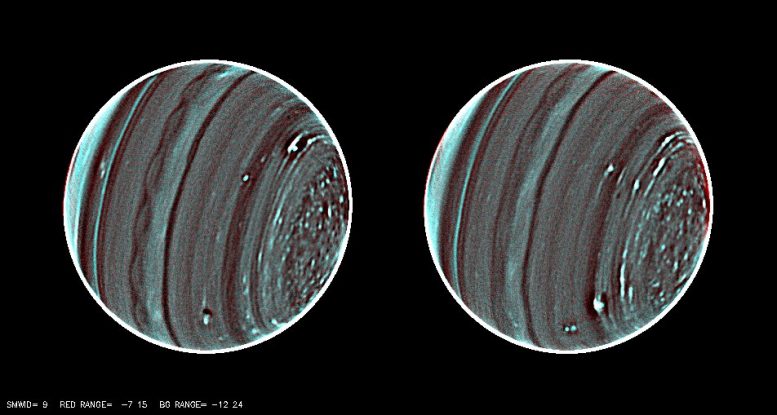
    images of Uranus from Keck II
    High signal-to-noise images of Uranus from Keck II. Two specially processed sets of images of Uranus taken from the Keck telescope on July 25 and 26, 2012, reveal astounding level of detail in Uranus’ clouds. Credit: NASA / ESA / L. A. Sromovsky / P. M. Fry / H. B. Hammel / I. de Pater / K. A. Rages.

    These images showcase the fine-scale structure of the atmosphere of Uranus, and contain vastly more detail than other images. The images were taken by the adaptive-optics-equipped telescope, the Keck II, which employed its NIRC2 camera.

    Near the equator, there is a rhythmic wave structure in a cloud belt. Near the north pole, the mottled texture of high clouds is juxtaposed with atmospheric holes that look similar to IR views of Saturn’s pole. Several image processing techniques were required to tease out these details, which are usually very subtle but coherent.
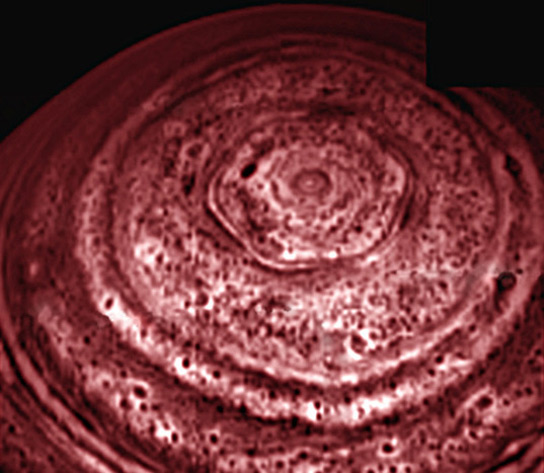
    saturn-hexagonal-pole
    This image of Saturn’s north pole was taken by Cassini’s VIMS spectrometer at a mid-infrared wavelength of 5 microns. It was winter at Saturn’s north pole; all illumination is thermal radiation (heat) welling up from Saturn’s depths. Some of the heat radiation is blocked by clouds floating in Saturn’s atmosphere at about 75 kilometers below the cloud tops that can be seen in visible wavelengths. The pressure at that level is about three times Earth’s atmospheric pressure. The patterns in the image are created by alternating cloudy and clear areas. The image has been contrast-reversed so that the glouds show up as bright spots, while open areas appear dark. Credit: NASA / JPL / U. Arizona

    It’s common in astronomy to take large numbers of images at a rapid rate, and then stack them up in order to bring out details. This stacking involves carefully aligning the images, and then averaging them. This helps reduce the effects of random noise and sharpens them.

    Since Uranus rotates fairly rapidly, the astronomers had to “reproject” the images onto flat maps, and then convert each image from an orthographic to a cylindrical map projection. The images were then shifted to compensate for Uranus’ rotation. Uranus’ surface is a hydrodynamically circulating atmosphere, which has winds that move at different rates at different latitudes, so the astronomers had to further shift the images.

    After this elaborate process, the images were stacked. Most of the variation in pixel values in their stacked composite was from broad-scale atmospheric banding. They applied a high-pass filter to remove the broad features, leaving only smaller, more local features.

    Never miss a breakthrough: Join the SciTechDaily newsletter.
    Follow us on Google and Google News.

    Astronomy Keck II Planetary Science Telescope Uranus
    Share. Facebook Twitter Pinterest LinkedIn Email Reddit

    Related Articles

    Scientists Uncover Strange New State of Matter Inside Uranus and Neptune

    “We Need To Go Back” – Uranus’ Moon May Have Harbored a Colossal 100-Mile Deep Ocean

    Astronomers Discover Evidence of How Giant Planets Form

    Astronomers Discover ‘Trojan’ Asteroid Sharing the Orbit of Uranus

    Researchers Confirm Three Asteroids Are Co-Orbital With Uranus

    Weather on Uranus and Neptune Limited to a “Weather Layer”

    Study Maps the Chemistry Needed for Life on Jupiter’s Moon Europa

    Researchers Observed the Atmosphere of a Jupiter-Like Planet Beyond Our Solar System

    ATLAST Is Being Designed to Discover Life on Planets

    Leave A Reply Cancel Reply

    • Facebook
    • Twitter
    • Pinterest
    • YouTube

    Don't Miss a Discovery

    Subscribe for the Latest in Science & Tech!

    Trending News

    Scientists May Have Found the Key to Jupiter and Saturn’s Moon Mystery

    Scientists Uncover Brain Changes That Link Pain to Depression

    Saunas May Do More Than Raise Body Temperature – They Activate Your Immune System

    Exercise in a Pill? Metformin Shows Surprising Effects in Cancer Patients

    Hidden Oceans of Magma Could Be Protecting Alien Life

    New Study Challenges Alzheimer’s Theories: It’s Not Just About Plaques

    Artificial Sweeteners May Harm Future Generations, Study Suggests

    Splashdown! NASA Artemis II Returns From Record-Breaking Moon Mission

    Follow SciTechDaily
    • Facebook
    • Twitter
    • YouTube
    • Pinterest
    • Newsletter
    • RSS
    SciTech News
    • Biology News
    • Chemistry News
    • Earth News
    • Health News
    • Physics News
    • Science News
    • Space News
    • Technology News
    Recent Posts
    • Researchers Capture Quantum Interference in One of Nature’s Rarest Atoms
    • Ancient DNA Reveals Irish Goats Have a 3,000-Year-Old Lineage Still Alive Today
    • Historians Reveal Secrets of the Strange Hat Wars That Shook Early Modern England
    • “A Plague Is Upon Us”: The Mass Death That Changed an Ancient City Forever
    • This Strange Material Can Turn Superconductivity on and off Like a Switch
    Copyright © 1998 - 2026 SciTechDaily. All Rights Reserved.
    • Science News
    • About
    • Contact
    • Editorial Board
    • Privacy Policy
    • Terms of Use

    Type above and press Enter to search. Press Esc to cancel.