
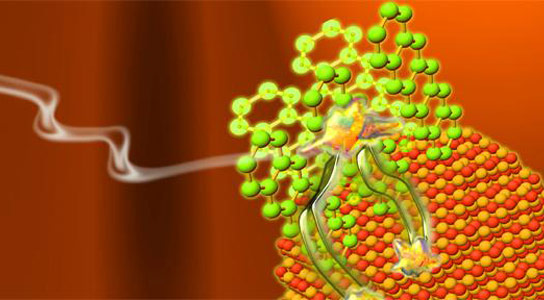
Scientists from the University of Cambridge have developed a new method for transferring energy from organic to inorganic semiconductors that could boost the efficiency of widely used inorganic solar cells.
Researchers have developed a new method for harvesting the energy carried by particles known as ‘dark’ spin-triplet excitons with close to 100% efficiency, clearing the way for hybrid solar cells which could far surpass current efficiency limits.
The team, from the University of Cambridge, have successfully harvested the energy of triplet excitons, an excited electron state whose energy in harvested in solar cells, and transferred it from organic to inorganic semiconductors. To date, this type of energy transfer had only been shown for spin-singlet excitons. The results are published in the journal Nature Materials.
In the natural world, excitons are a key part of photosynthesis: light photons are absorbed by pigments and generate excitons, which then carry the associated energy throughout the plant. The same process is at work in a solar cell.
In conventional semiconductors such as silicon, when one photon is absorbed it leads to the formation of one free electron that can be extracted as current. However, in pentacene, a type of organic semiconductor, the absorption of a photon leads to the formation of two electrons. But these electrons are not free and they are difficult to pin down, as they are bound up within ‘dark’ triplet exciton states.
Excitons come in two ‘flavors’: spin-singlet and spin-triplet. Spin-singlet excitons are ‘bright’ and their energy is relatively straightforward to harvest in solar cells. Triplet-spin excitons, in contrast, are ‘dark’, and the way in which the electrons spin makes it difficult to harvest the energy they carry.
“The key to making a better solar cell is to be able to extract the electrons from these dark triplet excitons,” said Maxim Tabachnyk, a Gates Cambridge Scholar at the University’s Cavendish Laboratory, and the paper’s lead author. “If we can combine materials like pentacene with conventional semiconductors like silicon, it would allow us to break through the fundamental ceiling on the efficiency of solar cells.”
Using state-of-art femtosecond laser spectroscopy techniques, the team discovered that triplet excitons could be transferred directly into inorganic semiconductors, with a transfer efficiency of more than 95%. Once transferred to the inorganic material, the electrons from the triplets can be easily extracted.
“Combining the advantages of organic semiconductors, which are low cost and easily processable, with highly efficient inorganic semiconductors, could enable us to further push the efficiency of inorganic solar cells, like those made of silicon,” said Dr Akshay Rao, who lead the team behind the work.
The team is now investigating how the discovered energy transfer of spin-triplet excitons can be extended to other organic/inorganic systems and is developing a cheap organic coating that could be used to boost the power conversion efficiency of silicon solar cells.
The work at Cambridge forms part of a broader initiative to harness high-tech knowledge in the physical sciences to tackle global challenges such as climate change and renewable energy. This initiative is backed by the UK Engineering and Physical Sciences Research Council (EPSRC) and the Winton Program for the Physics of Sustainability.
Reference: “Resonant energy transfer of triplet excitons from pentacene to PbSe nanocrystals” by Maxim Tabachnyk, Bruno Ehrler, Simon Gélinas, Marcus L. Böhm, Brian J. Walker, Kevin P. Musselman, Neil C. Greenham, Richard H. Friend and Akshay Rao, 5 October 2014, Nature Materials.
DOI: 10.1038/nmat4093
Never miss a breakthrough: Join the SciTechDaily newsletter.
Follow us on Google and Google News.
3 Comments
1 take a square piece of paper,fold in half then fold in half again, you now have 4 power law squares, one quarter of the area of the original square.
2 unfold and draw a circle from the centre crease to the outside edges, do this on both sides of the paper, now unfold and you will see another square.
3 now draw another circle to the crease edges of this square
YOU HAVE NOW JUST SQUARED THIS CIRCLE BOTH INSIDE AND OUTSIDE.
NOT ONLY JUST THAT, YOU HAVE DRAWN AN EXCITON IN QUANTUM TRANSITION TO AN EGG. DRAW A Y IN THE CENTRE LINES 120 DEGREES APART THEN JOIN FREEHAND AND YOU WILL REALISE ITS MAKINGS .THEREFORE RATIO 3:4
addendum to number 2, fold corner to corner and corner to corner, the power law again then un fold and all done:)
I did your exercise in my head …Looks pretty,but how does it relate to solar??? BL