
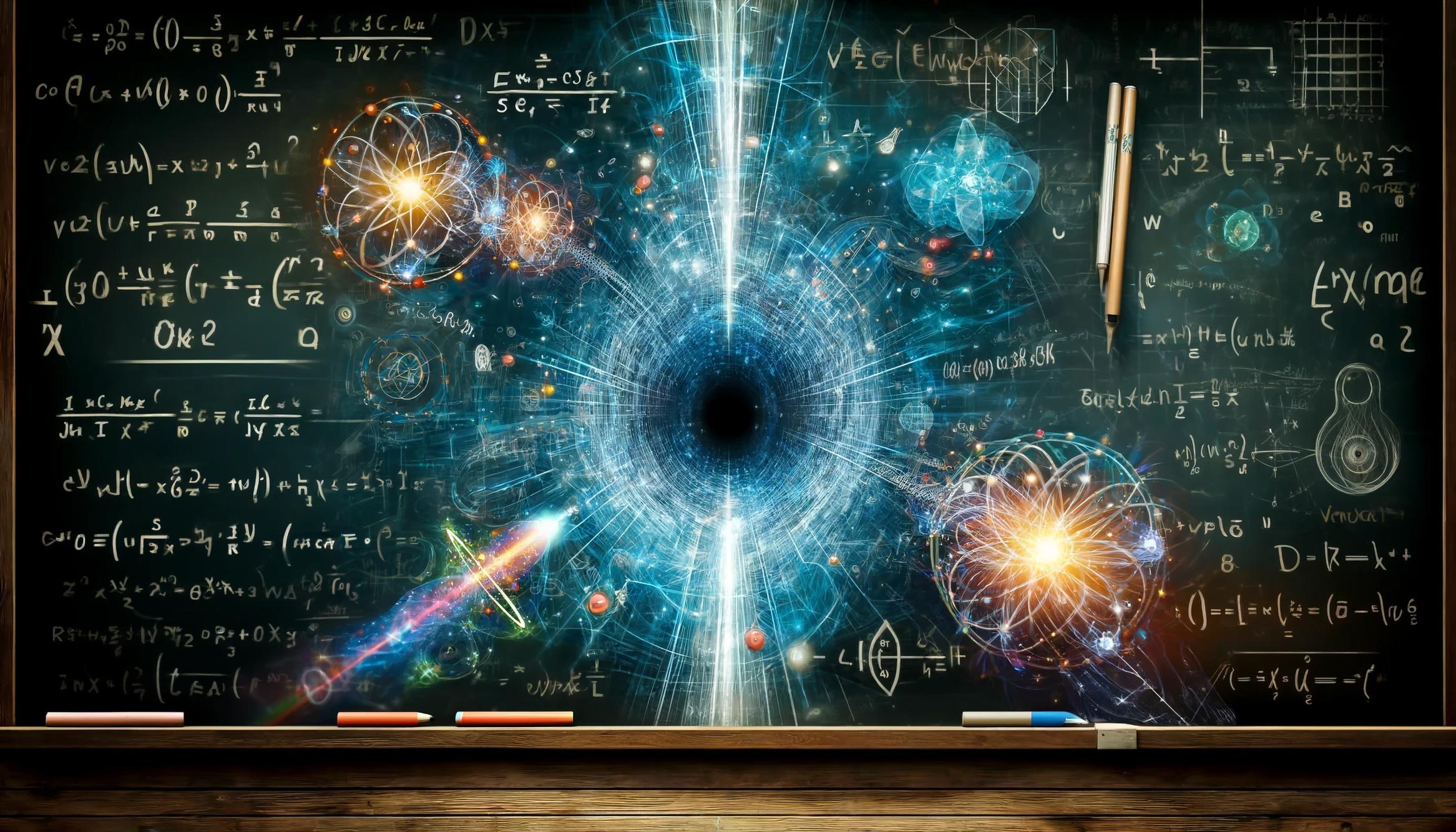
Researchers have successfully used 40-year-old mathematics to explain quantum tunneling, providing a unified approach to diverse quantum phenomena.
Quantum mechanical effects such as radioactive decay, or more generally: ‘tunneling’, display intriguing mathematical patterns. Two researchers at the University of Amsterdam now show that a 40-year-old mathematical discovery can be used to fully encode and understand this structure.
Quantum Physics – Easy and Hard
In the quantum world, processes can be separated into two distinct classes. One class, that of the so-called ‘perturbative’ phenomena, is relatively easy to detect, both in an experiment and in a mathematical computation. Examples are plentiful: the light that atoms emit, the energy that solar cells produce, the states of qubits in a quantum computer.
These quantum phenomena depend on Planck’s constant, the fundamental constant of nature that determines how the quantum world differs from our large-scale world, but in a simple way. Despite the ridiculous smallness of this constant – expressed in everyday units of kilograms, meters, and seconds it takes a value that starts at the 34th decimal place after the comma – the fact that Planck’s constant is not exactly zero is enough to compute such quantum effects.
Then, there are the ‘nonperturbative’ phenomena. One of the best-known is radioactive decay: a process where due to quantum effects, elementary particles can escape the attractive force that ties them to atomic nuclei. If the world were ‘classical’ – that is, if Planck’s constant were exactly zero – this attractive force would be impossible to overcome. In the quantum world, decay does occur, but still only occasionally; a single uranium atom, for example, would on average take over four billion years to decay.
The collective name for such rare quantum events is ‘tunneling’: for the particle to escape, it has to ‘dig a tunnel’ through the energy barrier that keeps it tied to the nucleus. A tunnel that can take billions of years to dig, and makes The Shawshank Redemption look like child’s play.
Mathematics to the Rescue
Mathematically, nonperturbative quantum effects are much more difficult to describe than their perturbative cousins. Still, over the century that quantum mechanics has existed, physicists have found many ways to deal with these effects, and to describe and predict them accurately.
“Still, in this century-old problem, there was work left to be done,” says Alexander van Spaendonck, one of the authors of the new publication. “The descriptions of tunneling phenomena in quantum mechanics needed further unification – a framework in which all such phenomena could be described and investigated using a single mathematical structure.”
Surprisingly, such a structure was found in 40-year-old mathematics. In the 1980s, French mathematician Jean Écalle had set up a framework that he dubbed resurgence, and that had precisely this goal: giving structure to nonperturbative phenomena. So why did it take 40 years for the natural combination of Écalle’s formalism and the application to tunneling phenomena to be taken to their logical conclusion?
Marcel Vonk, the other author of the publication, explains: “Écalle’s original papers were lengthy – over 1000 pages all combined – highly technical, and only published in French. As a result, it took until the mid-2000s before a significant number of physicists started getting familiar with this ‘toolbox’ of resurgence. Originally, it was mostly applied to simple ‘toy models’, but of course, the tools were also tried on real-life quantum mechanics. Our work takes these developments to their logical conclusion.”
Beautiful Structure
That conclusion is that one of the tools in Écalle’s toolbox, that of a ‘transseries’, is perfectly suited to describe tunneling phenomena in essentially any quantum mechanics problem, and does so always in the same way. By spelling out the mathematical details, the authors found that it became possible not only to unify all tunneling phenomena into a single mathematical object, but also to describe certain ‘jumps’ in how big the role of these phenomena is – an effect known as Stokes’ phenomenon.
Van Spaendonck: “Using our description Stokes’ phenomenon, we were able to show that certain ambiguities that had plagued the ‘classical’ methods of computing nonperturbative effects – infinitely many, in fact – all dropped out in our method. The underlying structure turned out to be even more beautiful than we originally expected. The transseries that describes quantum tunneling turns out to split – or ‘factorize’ – in a surprising way: into a ‘minimal’ transseries that describes the basic tunneling phenomena that essentially exist in any quantum mechanics problem, and an object that we call the ‘median transseries’ that describes the more problem-specific details, and that depends for example on how symmetric a certain quantum setting is.”
With this mathematical structure completely clarified, the next question is of course where the new lessons can be applied and what physicists can learn from them. In the case of radioactivity, for example, some atoms are stable whereas others decay. In other physical models, the lists of stable and unstable particles may vary as one slightly changes the setup – a phenomenon known as ‘wall-crossing’. What the researchers have in mind next is to clarify this notion of wall-crossing using the same techniques. This difficult problem has again been studied by many groups in many different ways, but now a similar unifying structure might be just around the corner. There is certainly light at the end of the tunnel.
Reference: “Exact instanton transseries for quantum mechanics” by Alexander van Spaendonck and Marcel Vonk, 12 April 2024, SciPost Physics.
DOI: 10.21468/SciPostPhys.16.4.103
Never miss a breakthrough: Join the SciTechDaily newsletter.
Follow us on Google and Google News.
1 Comment
Embedding (entanglement) perfected requires phase conjugation tuned to planck. By equation called. Planckphire.com Results in coherent longitudinal interferometry-THE mechanism of action at a distance