
Close Menu
    Facebook X (Twitter) Instagram
    SciTechDaily
    • Biology
    • Chemistry
    • Earth
    • Health
    • Physics
    • Science
    • Space
    • Technology
    Facebook X (Twitter) Pinterest YouTube RSS
    SciTechDaily
    Home»Space»Mars Reconnaissance Orbiter Reveals Recurring Water Streaks on Mars
    Space

    Mars Reconnaissance Orbiter Reveals Recurring Water Streaks on Mars

    By SciTechDailySeptember 29, 2015No Comments1 Min Read
    Facebook Twitter Pinterest Telegram LinkedIn WhatsApp Email Reddit
    Share
    Facebook Twitter LinkedIn Pinterest Telegram Email Reddit
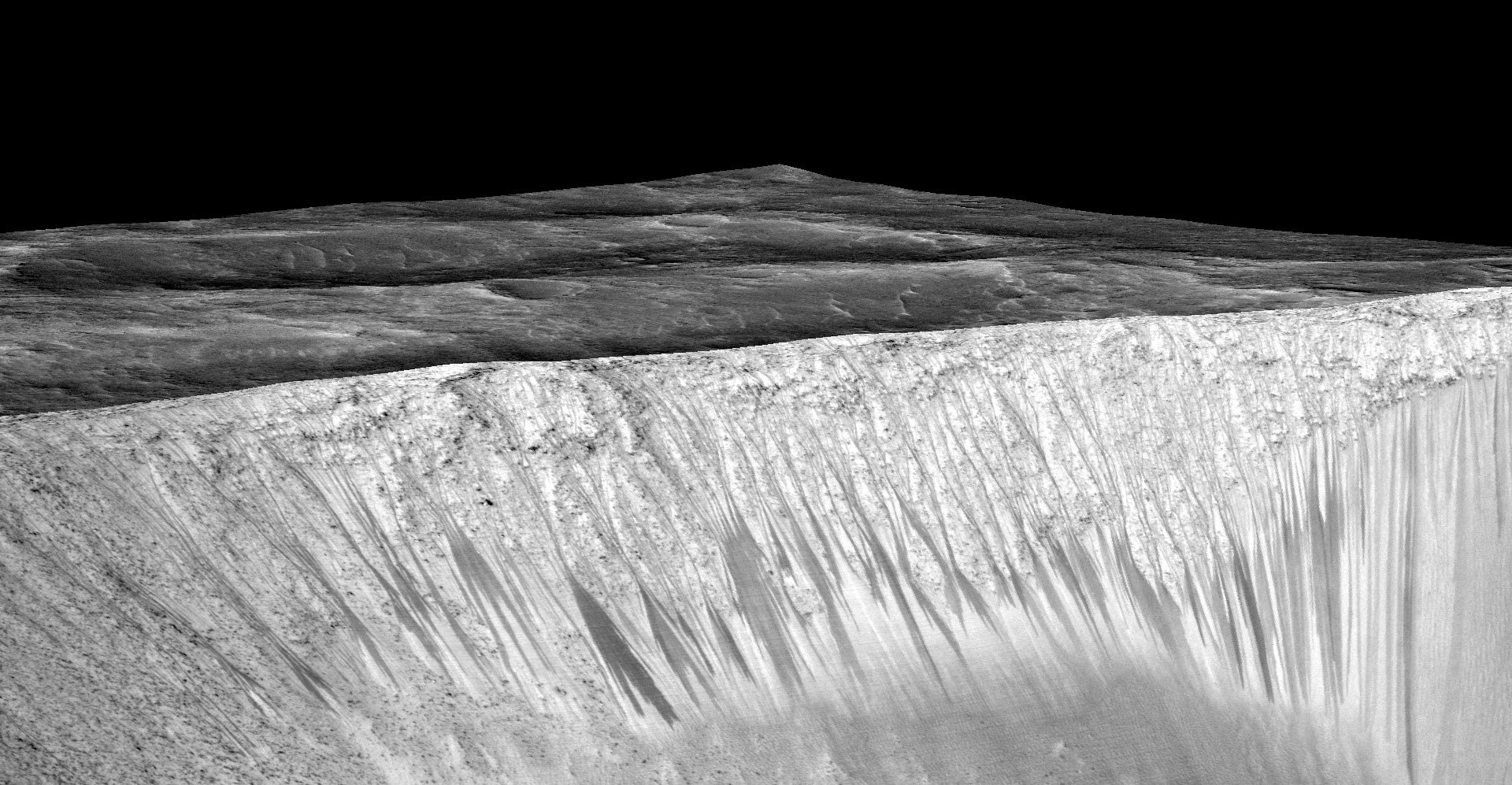
    Water Streaks on Walls of Garni Crater on Mars
    Garni Crater on Mars. Credit: NASA/JPL-Caltech/University of Arizona

    This new image from NASA’s Mars Reconnaissance Orbiter shows dark streaks on the walls of Garni Crater on Mars. Astronomers believe these recurring streaks are formed by the flow of briny liquid water on Mars.

    Dark narrow streaks, called “recurring slope lineae,” emanate from the walls of Garni Crater on Mars, in this view constructed from observations by the High Resolution Imaging Science Experiment (HiRISE) camera on NASA’s Mars Reconnaissance Orbiter.

    The dark streaks here are up to a few hundred yards, or meters, long. They are hypothesized to be formed by the flow of briny liquid water on Mars.

    The image was produced by first creating a 3-D computer model (a digital terrain map) of the area based on stereo information from two HiRISE observations, and then draping an image over the land-shape model. The vertical dimension is exaggerated by a factor of 1.5 compared to horizontal dimensions. The draped image is a red waveband (monochrome) product from HiRISE observation ESP_031059_1685, taken on March 12, 2013, at 11.5 degrees south latitude, 290.3 degrees east longitude. Other image products from this observation are at http://hirise.lpl.arizona.edu/ESP_031059_1685.

    Never miss a breakthrough: Join the SciTechDaily newsletter.
    Follow us on Google and Google News.

    Astronomy Mars Mars Reconnaissance Orbiter NASA Planetary Science University of Arizona
    Share. Facebook Twitter Pinterest LinkedIn Email Reddit

    Related Articles

    Ten Years and Counting, Mars Orbiter Still Going Strong

    New NASA Image of the Northern Plains of Mars

    Mars Orbiter Preparing for Mars InSight Lander’s 2016 Arrival

    NASA’s Mars Reconnaissance Orbiter Completes 40,000 Mars Orbits

    Orbiter Examines Clues to Possible Water Flows on Mars

    Mars Reconnaissance Orbiter Examines a New Impact Crater

    Scientists Find Evidence for Granite on Mars

    Data Indicates Temperatures Rise and Fall Twice a Day on Mars

    Mars Orbiter Shows McLaughlin Crater May Have Once Held a Groundwater-Fed Lake

    Leave A Reply Cancel Reply

    • Facebook
    • Twitter
    • Pinterest
    • YouTube

    Don't Miss a Discovery

    Subscribe for the Latest in Science & Tech!

    Trending News

    Ozempic’s Active Ingredient Shows Surprising Anti-Aging Effects

    Scientists Discover Canada’s First Dinosaur Tracks From a Rarely Documented Cretaceous Age

    Astronomers Just Caught a Giant Planet in the Act of Forming

    Two Dead Stars Are Racing Around Each Other Every 6.2 Minutes

    Natural Compound May Help Protect the Brain and Heart From Excess Salt

    240-Million-Year-Old Fossil Discovery Challenges the Story of the First Dinosaurs

    Knee Osteoarthritis Isn’t Inevitable: Simple Habits May Lower Your Risk

    Ancient DNA Rewrites the Story of the “American Cheetah”

    Follow SciTechDaily
    • Facebook
    • Twitter
    • YouTube
    • Pinterest
    • Newsletter
    • RSS
    SciTech News
    • Biology News
    • Chemistry News
    • Earth News
    • Health News
    • Physics News
    • Science News
    • Space News
    • Technology News
    Recent Posts
    • Even After 300 Years, Scientists Find Recovering Grasslands Can Remain Fundamentally Different
    • Human Sperm Is Rewriting DNA Earlier Than We Realized
    • Stanford Researchers Discover That the Human Brain May Be Two Separate Organs Fused Together
    • Healthy Eating May Slow Biological Aging – but There Isn’t a Single “Best” Diet
    • Scientists Say This Simple Habit Could Help Protect Your Brain for Life
    Copyright © 1998 - 2026 SciTechDaily. All Rights Reserved.
    • Science News
    • About
    • Contact
    • Editorial Board
    • Privacy Policy
    • Terms of Use

    Type above and press Enter to search. Press Esc to cancel.