
Close Menu
    Facebook X (Twitter) Instagram
    SciTechDaily
    • Biology
    • Chemistry
    • Earth
    • Health
    • Physics
    • Science
    • Space
    • Technology
    Facebook X (Twitter) Pinterest YouTube RSS
    SciTechDaily
    Home»Space»“Quite Unexpected” – Astronomers Discover Strange Spike-Like Structures Extending From Protostellar Disk
    Space

    “Quite Unexpected” – Astronomers Discover Strange Spike-Like Structures Extending From Protostellar Disk

    By Kyushu UniversityJuly 23, 20241 Comment4 Mins Read
    Facebook Twitter Pinterest Telegram LinkedIn WhatsApp Email Reddit
    Share
    Facebook Twitter LinkedIn Pinterest Telegram Email Reddit
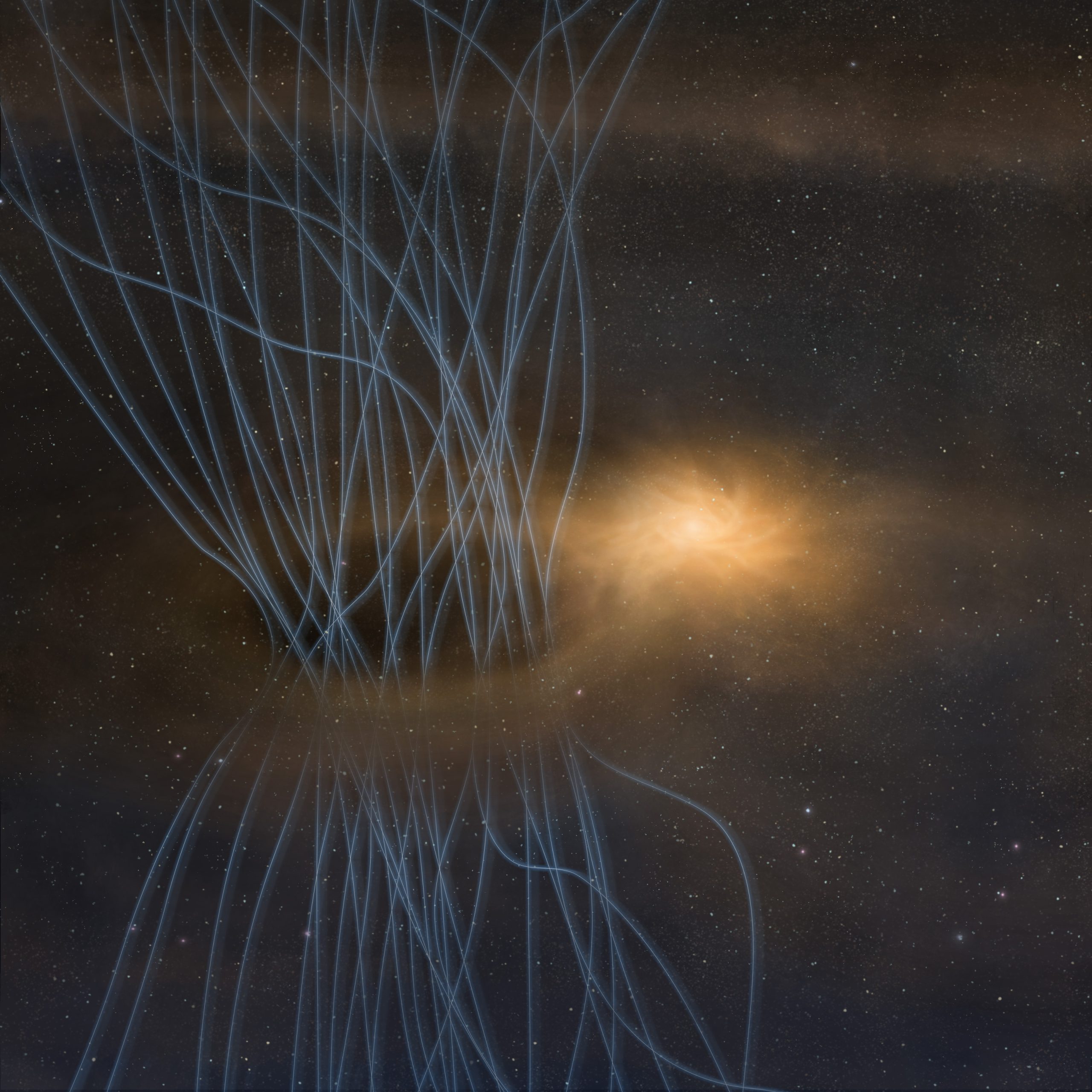
    Magnetic Flux From a Baby Star Illustration
    The baby star at the center surrounded by a bright disk called a protostellar disk. Spikes of magnetic flux, gas, and dust in blue. Researchers found that the protostellar disk will expel magnetic flux, gas, and dust—much like a sneeze—during a star’s formation. Credit: ALMA (ESO/NAOJ/NRAO)

    Researchers have discovered that baby stars emit plumes of magnetic flux during their formation.

    Researchers from Kyushu University have unveiled new insights into the development of baby stars. Utilizing the ALMA radio telescope in Chile, the team discovered that the protostellar disk surrounding a nascent star expels plumes of dust, gas, and electromagnetic energy in its early stages. These ejections, referred to as ‘sneezes’ by the researchers, release the magnetic flux within the protostellar disk and may play a crucial role in star formation. Their findings have been published in The Astrophysical Journal.

    Stars, including our Sun, all develop from what are called stellar nurseries, large concentrations of gas and dust that eventually condense to form a stellar core, a baby star. During this process, gas and dust form a ring around the baby star called the protostellar disk.

    “These structures are perpetually penetrated by magnetic fields, which brings with it magnetic flux. However, if all this magnetic flux were retained as the star developed, it would generate magnetic fields many orders of magnitude stronger than those observed in any known protostar,” explains Kazuki Tokuda of Kyushu University’s Faculty of Sciences and first author of the study.

    For this reason, researchers have hypothesized that there is a mechanism during star development that would remove that magnetic flux. The prevailing view was that the magnetic field gradually weakened over time as the cloud was pulled into the stellar core.
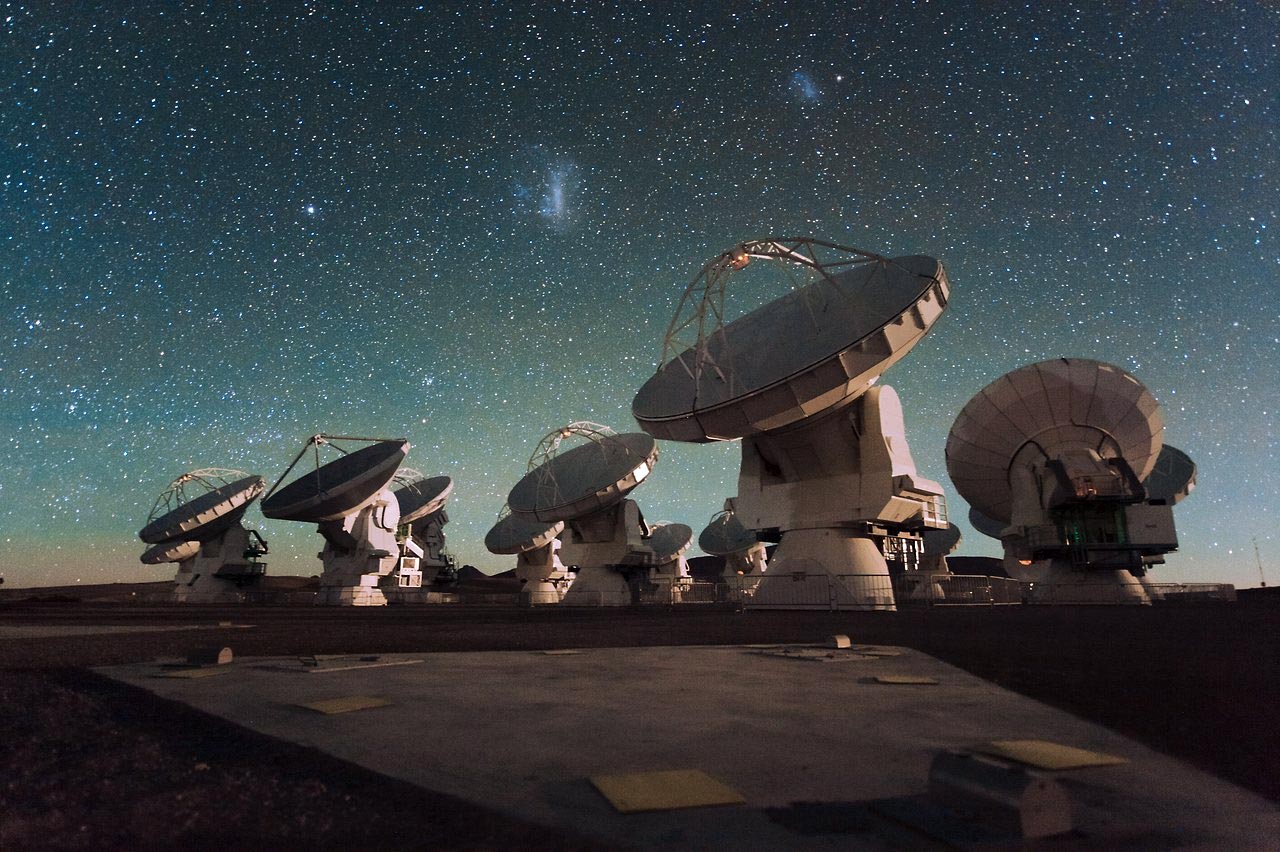
    ALMA Chajnantor Plateau in the Chilean Andes
    Antennas of the Atacama Large Millimeter/submillimeter Array telescope, on the Chajnantor Plateau in the Chilean Andes. Credit: ESO/C. Malin

    Mechanisms of Magnetic Flux Expulsion

    To get to the bottom of this mysterious phenomenon, the team set their sights on MC 27, a stellar nursery located approximately 450 light-years from Earth. Observations were collected using the ALMA array, a collection of 66 high-precision radio telescopes constructed 5,000 meters above sea level in northern Chile.

    “As we analyzed our data, we found something quite unexpected. There were these ‘spike-like’ structures extending a few astronomical units from the protostellar disk. As we dug in deeper, we found that these were spikes of expelled magnetic flux, dust, and gas,” continues Tokuda.

    “This is a phenomenon called ‘interchange instability’ where instabilities in the magnetic field react with the different densities of the gases in the protostellar disk, resulting in an outward expelling of magnetic flux. We dubbed this a baby star’s ‘sneeze’ as it reminded us of when we expel dust and air at high speeds.”

    Additionally, other spikes were observed several thousands of astronomical units away from the protostellar disk. The team hypothesized that these were indications of other ‘sneezes’ in the past.

    The team expects their findings will improve our understanding of the intricate processes that shape the universe that continue to captivate the interest of both the astronomical community and the public.

    “Similar spike-like structures have been observed in other young stars, and it’s becoming a more common astronomical discovery,” concludes Tokuda. “By investigating the conditions that lead to these ‘sneezes’ we hope to expand our understanding of how stars and planets are formed.”

    Reference: “Discovery of Asymmetric Spike-like Structures of the 10 au Disk around the Very Low-luminosity Protostar Embedded in the Taurus Dense Core MC 27/L1521F with ALMA” by Kazuki Tokuda, Naoto Harada, Mitsuki Omura, Tomoaki Matsumoto, Toshikazu Onishi, Kazuya Saigo, Ayumu Shoshi, Shingo Nozaki, Kengo Tachihara, Naofumi Fukaya, Yasuo Fukui, Shu-ichiro Inutsuka and Masahiro N. Machida, 11 April 2024, The Astrophysical Journal.
    DOI: 10.3847/1538-4357/ad2f9a

    The study was funded by the National Astronomical Observatory of Japan and the Japan Society for the Promotion of Science.

    Never miss a breakthrough: Join the SciTechDaily newsletter.
    Follow us on Google and Google News.

    Astronomy Astrophysics Kyushu University Popular Stars
    Share. Facebook Twitter Pinterest LinkedIn Email Reddit

    Related Articles

    A Strange Discovery Just Changed What We Know About the First Stars

    Perplexing 16-Year-Old Cosmic Mystery Solved, Revealing Stellar Missing Link

    Astronomy’s Most Exciting Puzzle Is About to Be Solved: Cosmic Flashes Come in All Different Sizes

    Magnetic Monster? NASA’s Hubble Sees Unexplained Brightness from Colossal Explosion

    Ultrabright Radio Flashes Detected Coming From Inside Our Own Galaxy

    Extreme Magnetic Fields and Temperature Variation of Distant Magnetars

    Death by Spaghettification: Telescopes Record Last Moments of Star Devoured by a Black Hole

    Astronomers Turn Up the Heavy Metal to Shed Light on Star Formation – “It’s Absolutely Mind-Blowing Stuff”

    A White Dwarf’s Surprise Planetary Companion: First-of-Its-Kind Exoplanet Detected Around Dead Star

    1 Comment

    1. Boba on July 25, 2024 8:48 am

      The astronomers really get surprised easily. Makes you wonder what they actually do know.

      Reply
    Leave A Reply Cancel Reply

    • Facebook
    • Twitter
    • Pinterest
    • YouTube

    Don't Miss a Discovery

    Subscribe for the Latest in Science & Tech!

    Trending News

    This Copper Drug Clears Alzheimer’s Brain Toxins and Boosts Memory

    Adults Over 65 Lost Massive Amounts of Weight With Ozempic

    How Flocking Birds “Defy” One of Physics’ Most Fundamental Laws

    Physicists Create a New Kind of Schrödinger’s Cat State From Exotic Quantum Building Blocks

    Your Diet Could Be Missing the Key Ingredient for Heart Protection

    Researchers Warn Widely Prescribed Blood Pressure Drugs Could Be Harming Diabetic Kidneys

    James Webb Spots Something Strange Between Day and Night on an Alien Planet

    How Ancient People Moved a 6-Ton Stone 700 Kilometers to Stonehenge

    Follow SciTechDaily
    • Facebook
    • Twitter
    • YouTube
    • Pinterest
    • Newsletter
    • RSS
    SciTech News
    • Biology News
    • Chemistry News
    • Earth News
    • Health News
    • Physics News
    • Science News
    • Space News
    • Technology News
    Recent Posts
    • Scientists Uncover Cause of Inflammatory Bowel Disease Solving Decades-Old Mystery
    • The Surprising Reason Swimming Could Be Better for Your Heart Than Running
    • Could Vitamin C Be the Secret to Keeping Your Brain Younger?
    • The Surprising Fix for Robot Traffic Jams
    • Near Absolute Zero, This Transistor Starts Acting Like a Brain Cell
    Copyright © 1998 - 2026 SciTechDaily. All Rights Reserved.
    • Science News
    • About
    • Contact
    • Editorial Board
    • Privacy Policy
    • Terms of Use

    Type above and press Enter to search. Press Esc to cancel.