
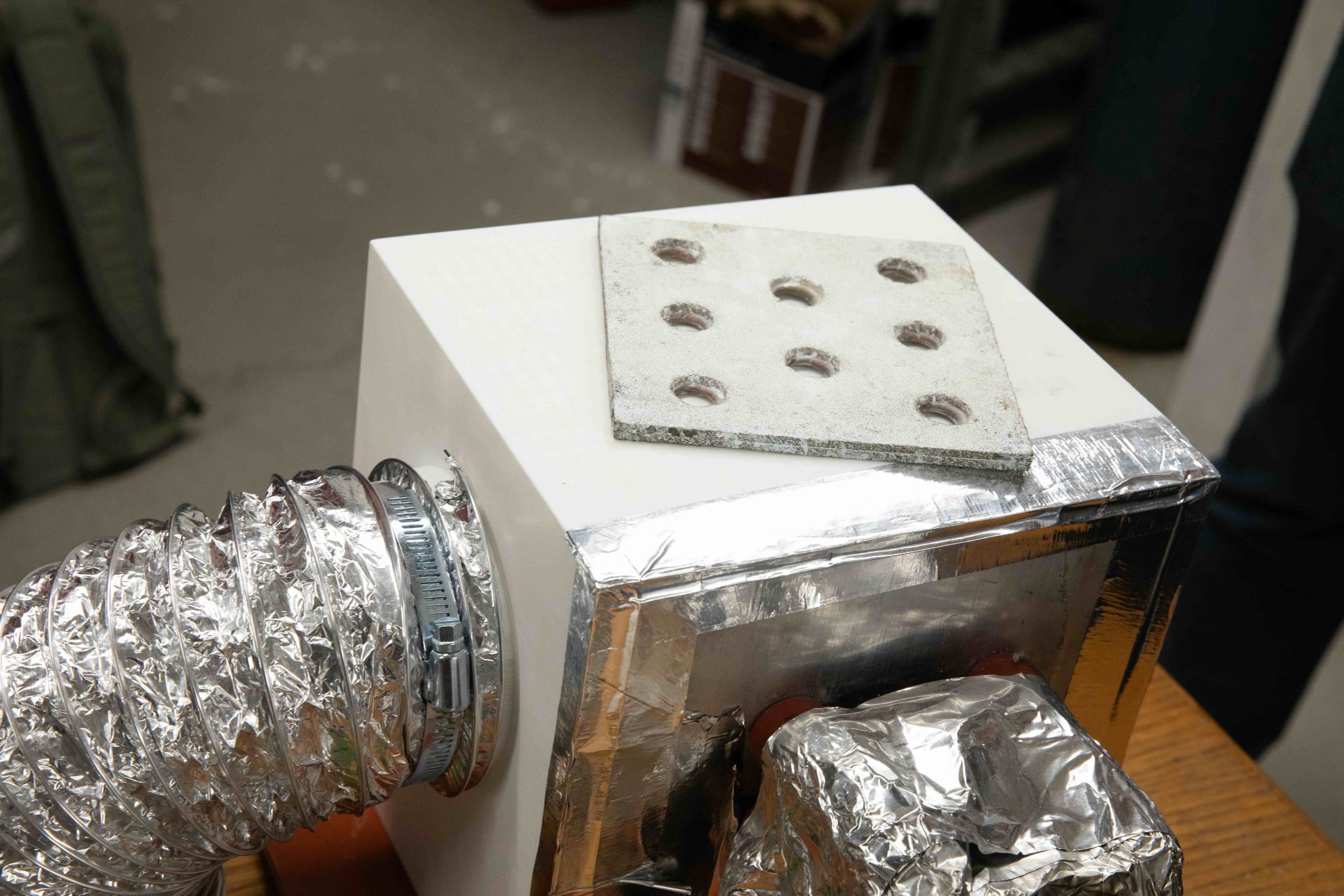
Utah engineers, funded by the Army, have developed a device that harvests water from the atmosphere, even in arid locations.
Researchers at the University of Utah have unveiled a compact device for atmospheric water harvesting that efficiently extracts water from the air using a fuel-fired process, promising to alleviate global water shortages.
Earth’s atmosphere contains a vast amount of water, enough to fill Utah’s Great Salt Lake 800 times over. Extracting some of this moisture is considered a promising solution to provide clean drinking water for billions of people worldwide who face chronic shortages.
Existing technologies for atmospheric water harvesting (AWH) are saddled with numerous downsides associated with size, cost, and efficiency. However new research from University of Utah engineering researchers has yielded insights that could improve efficiencies and bring the world one step closer to tapping the air as a culinary water source in arid places.
The study unveils the first-of-its-kind compact rapid cycling fuel-fired AWH device. This two-step prototype relies on adsorbent materials that draw water molecules out of non-humid air, and then applies heat to release those molecules into liquid form, according to Sameer Rao, senior author of the study published in the journal Cell Reports Physical Science and an assistant professor of mechanical engineering.
“Hygroscopic materials intrinsically have an affinity to water. They soak up water wherever you go. One of the best examples is the stuff inside diapers,” said Rao, who happens to be the father of an infant son. “We work with a specific type of hygroscopic material called a metal-organic framework.”
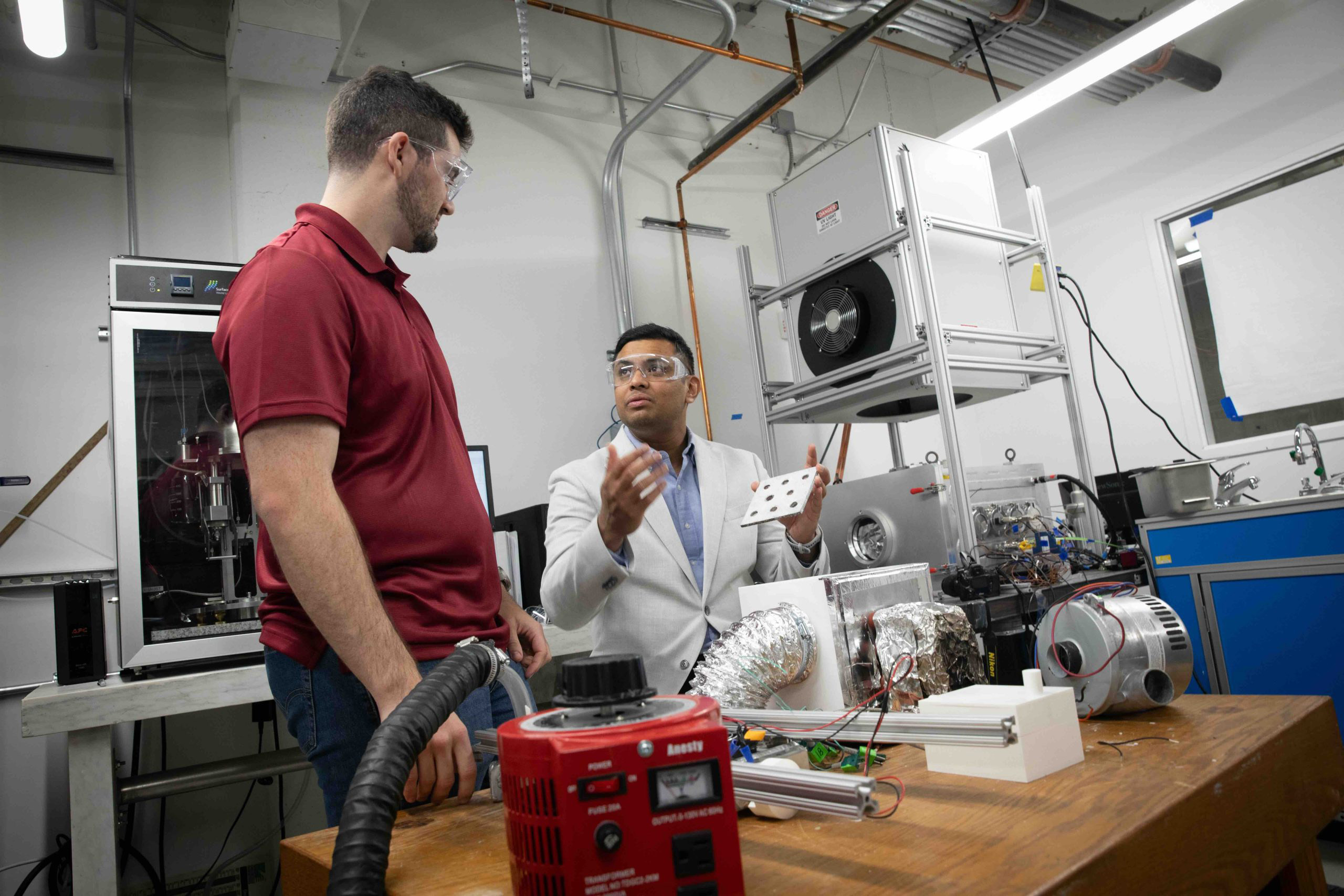
Rao likened metal-organic frameworks to Lego blocks, which can be rearranged to build all sorts of structures. In this case they are arranged to create a molecule ideal for gas separation.
“They can make it specific to adsorb water vapor from the air and nothing else. They’re really selective,” Rao said. Developed with graduate student Nathan Ortiz, the study’s lead author, this prototype uses aluminum fumarate that was fashioned into panels that collect the water as air is drawn through.
“The water molecules themselves get trapped on the surfaces of our material, and that’s a reversible process. And so instead of becoming ingrained into the material itself, it sits on the walls,” Ortiz said. “What’s special about these absorbent materials is they have just an immense amount of internal surface area. There’s so many sites for water molecules to get stuck.”
Just a gram of this material holds as much surface area as two football fields, according to Rao. So just a little material can capture a lot of water.
Technological Details and Military Applications
“All of this surface area is at the molecular scale,” Rao said. “And that’s awesome for us because we want to trap water vapor onto that surface area within the pores of this material.”
Funding for the research came from the DEVCOM Soldier Center, a program run by the Department of Defense to facilitate technology transfer that supports Army modernization. The Army’s interest in the project stems from the need to keep soldiers hydrated while operating in remote areas with few water sources.
“We specifically looked at this for defense applications so that soldiers have a small compact water generation unit and don’t need to lug around a large canteen filled with water,” Rao said. “This would literally produce water on demand.”
Rao and Ortiz have filed for a preliminary patent based on the technology, which addresses non-military needs as well.
“As we were designing the system, I think we also had perspective of the broader water problem. It’s not just a defense issue, it’s very much a civilian issue,” Rao said. “We think in terms of water consumption of a household for drinking water per day. That’s about 15 to 20 liters per day.”
In this proof of concept, the prototype achieved its target of producing 5 liters of water per day per kilogram of adsorbent material. In a matter of three days in the field, this device would outperform packing water, according to Ortiz.
In the device’s second step, the water is precipitated into liquid by applying heat using a standard-issue Army camping stove. This works because of the exothermic nature of its water-collecting process.
“As it collects water, it’s releasing little bits of heat. And then to reverse that, we add heat,” Ortiz said. “We just put a flame right under here, anything to get this temperature up. And then as we increase the temperature, we rapidly release the water molecules. Once we have a really humid airstream, that makes condensation at ambient temperature much easier.”
Nascent technologies abound for atmospheric water harvesting, which is more easily accomplished when the air is humid, but none has resulted in equipment that can be put to practical use in arid environments. Ortiz believes his device can be the first, mainly because it is powered with energy-dense fuel like the white gasoline used in camping stoves.
The team decided against using photovoltaics.
“If you’re reliant on solar panels, you’re limited to daytime operation or you need batteries, which is just more weight. You keep stacking challenges. It just takes up so much space,” Ortiz said. “This technology is superior in arid conditions, while refrigeration is best in high humidity.”
Reference: “Compact rapid cycling fuel-fired atmospheric water harvesting device for all-day water production” by Nathan P. Ortiz and Sameer R. Rao, 22 July 2024, Cell Reports Physical Science.
DOI: 10.1016/j.xcrp.2024.102115
The study was funded by the DEVCOM Army Research Laboratory and the U.S. National Science Foundation.
Never miss a breakthrough: Join the SciTechDaily newsletter.
Follow us on Google and Google News.
2 Comments
There are ALWAYS unintended consequences, usually related to scaling up the processes. An obvious concern would be to reduce precipitation downwind of the extraction process, which in turn might lead to a change in the vegetation and transpiration, which might cascade farther downwind.
Yeah, right. Ten years ago, a bike bottle that generates water out of thin air made rounds on Kickstarter. Turned out it was a total scam. Fool me once…