
Close Menu
    Facebook X (Twitter) Instagram
    SciTechDaily
    • Biology
    • Chemistry
    • Earth
    • Health
    • Physics
    • Science
    • Space
    • Technology
    Facebook X (Twitter) Pinterest YouTube RSS
    SciTechDaily
    Home»Space»New Horizons Image Shows Pluto’s Methane Snowcaps
    Space

    New Horizons Image Shows Pluto’s Methane Snowcaps

    By SciTechDailyAugust 31, 2016No Comments2 Mins Read
    Facebook Twitter Pinterest Telegram LinkedIn WhatsApp Email Reddit
    Share
    Facebook Twitter LinkedIn Pinterest Telegram Email Reddit
    Snowcaps on Pluto
    NASA’s New Horizons spacecraft captured an image of the southernmost part of Pluto during its closest approach in 2015, offering insight into the unobserved regions during the flyby. Credit: NASA/JHUAPL/SwRI

    This newly released image shows the southernmost part of Pluto that NASA’s New Horizons spacecraft could “see” during its closest approach in July 2015. The image contains a range of fascinating geological features, and offers clues into what might lurk in the regions shrouded in darkness during the flyby.

    The area shown above is south of Pluto’s dark equatorial band informally named Cthulhu Regio, and southwest of the vast nitrogen ice plains informally named Sputnik Planum or Sputnik Planitia, as the mission team recently redesignated the area to more accurately reflect the low elevation of the plains. North is at the top; in the western portion of the image, a chain of bright mountains extends north into Cthulhu Regio. The mountains reveal themselves as snowcapped – something hauntingly familiar from our Earth-based experience. But New Horizons compositional data indicate the bright snowcap material covering these mountains isn’t water, but atmospheric methane that has condensed as frost onto these surfaces at high elevations. Between some mountains are sharply cut valleys – indicated by the white arrows below. These valleys are each a few miles across and tens of miles long.
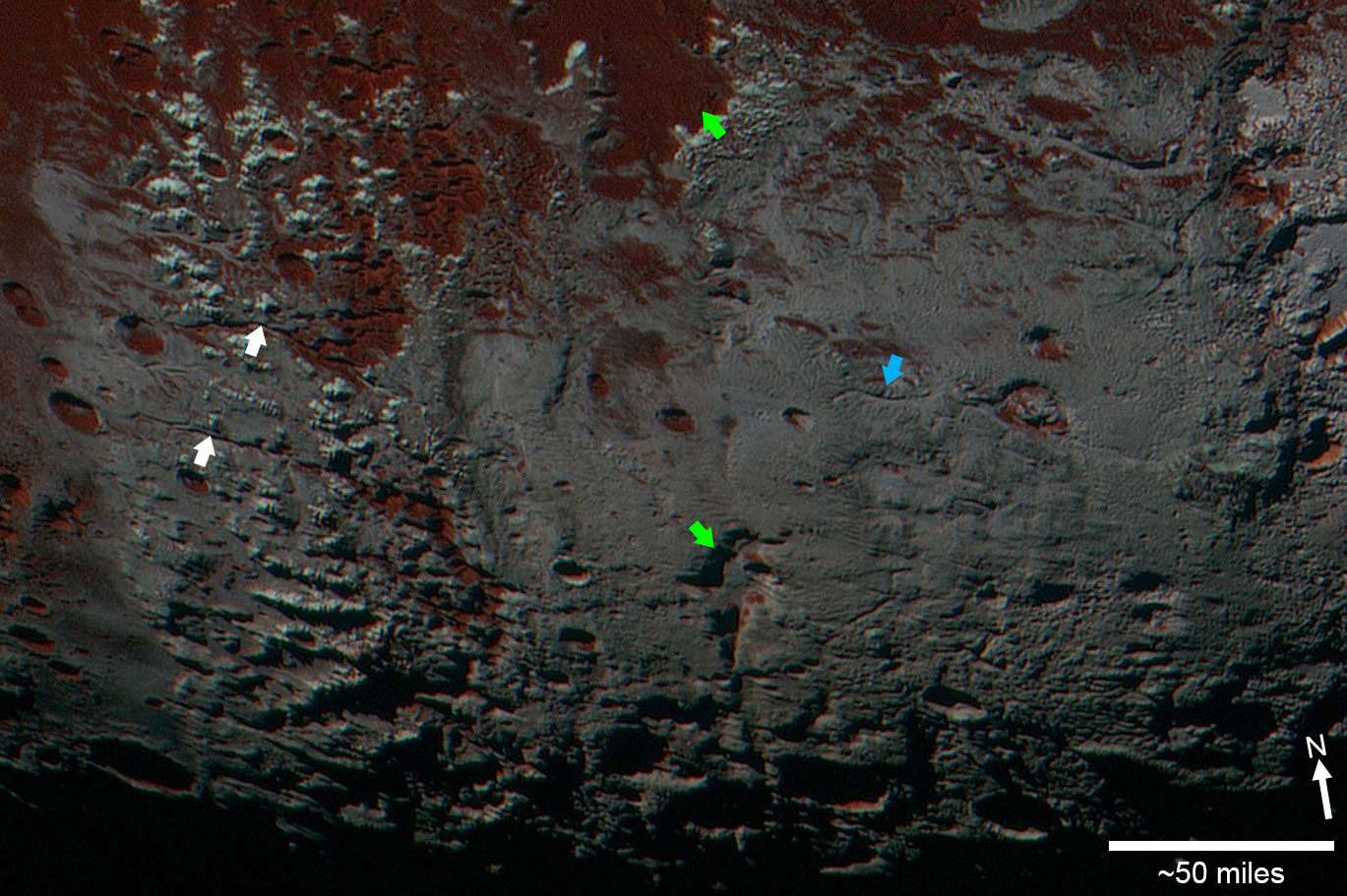
    Pluto’s Methane Snowcaps on the Edge of Darkness
    Credit: NASA/JHUAPL/SwRI

    A similar valley system in the expansive plains to the east (blue arrows) appears to be branched, with smaller valleys leading into it. New Horizons scientists think flowing nitrogen ice that once covered this area – perhaps when the ice in Sputnik was at a higher elevation — may have formed these valleys. The area is also marked by irregularly shaped, flat-floored depressions (green arrows) that can reach more than 50 miles (80 kilometers) across and almost 2 miles (3 kilometers) deep. The great widths and depths of these depressions suggest that they may have formed when the surface collapsed, rather than through the sublimation of ice into the atmosphere.

    Never miss a breakthrough: Join the SciTechDaily newsletter.
    Follow us on Google and Google News.

    Astronomy NASA New Horizons Planetary Science Pluto
    Share. Facebook Twitter Pinterest LinkedIn Email Reddit

    Related Articles

    New Horizons Reveals Signs of Pluto’s Geology

    NASA’s New Horizons Pluto Flyby Begins

    New Horizons Reflectance and Color Map of Pluto

    The Latest New Horizons Images of Dwarf Planet Pluto

    Dwarf Planet Pluto: The ‘Other’ Red Planet

    New Horizons Spacecraft Reveals Series of Spots on Pluto That Fascinate

    New Horizons Spacecraft Awakens for Encounter with Pluto System

    New ScienceCast Video Previews What New Horizons May See on Pluto

    New ScienceCast Video – Countdown to Pluto

    Leave A Reply Cancel Reply

    • Facebook
    • Twitter
    • Pinterest
    • YouTube

    Don't Miss a Discovery

    Subscribe for the Latest in Science & Tech!

    Trending News

    Scientists Say Love Follows Mathematical Patterns

    “Zombie Cells” Reveal a Hidden Weakness That Could Help Fight Aging

    Alien Signals May Be Hiding in a Radio Band SETI Has Barely Explored

    Earth’s Hidden Thermostat Has Regulated Climate for 60 Million Years

    This 518-Million-Year-Old Creature Reveals How Spiders Got Their Bite

    Scientists Built a Programmable Chip That Can Slow Light on Command

    The Backyard “Silly Sprinkler” That Cracked One of Physics’ Biggest Puzzles

    This Common Sleep Habit Could Be Making You Gain Weight

    Follow SciTechDaily
    • Facebook
    • Twitter
    • YouTube
    • Pinterest
    • Newsletter
    • RSS
    SciTech News
    • Biology News
    • Chemistry News
    • Earth News
    • Health News
    • Physics News
    • Science News
    • Space News
    • Technology News
    Recent Posts
    • Where on Earth Was This Fossil 200 Million Years Ago?
    • A 25,000-Year-Old Ritual Tradition Was Hidden Beneath This Cave Floor
    • A Hidden Source of Metal-Mining Emissions Could Be 10x Larger Than Estimated
    • Plant Compounds in Berries, Tea, and Cocoa May Support Healthy Brain Aging
    • Scientists Find a Way To Keep Cancer-Fighting T Cells From Burning Out
    Copyright © 1998 - 2026 SciTechDaily. All Rights Reserved.
    • Science News
    • About
    • Contact
    • Editorial Board
    • Privacy Policy
    • Terms of Use

    Type above and press Enter to search. Press Esc to cancel.