
Close Menu
    Facebook X (Twitter) Instagram
    SciTechDaily
    • Biology
    • Chemistry
    • Earth
    • Health
    • Physics
    • Science
    • Space
    • Technology
    Facebook X (Twitter) Pinterest YouTube RSS
    SciTechDaily
    Home»Space»Harvard Astronomers Examine Y-Type Brown Dwarfs
    Space

    Harvard Astronomers Examine Y-Type Brown Dwarfs

    By Harvard-Smithsonian Center for AstrophysicsJuly 10, 2017No Comments3 Mins Read
    Facebook Twitter Pinterest Telegram LinkedIn WhatsApp Email Reddit
    Share
    Facebook Twitter LinkedIn Pinterest Telegram Email Reddit
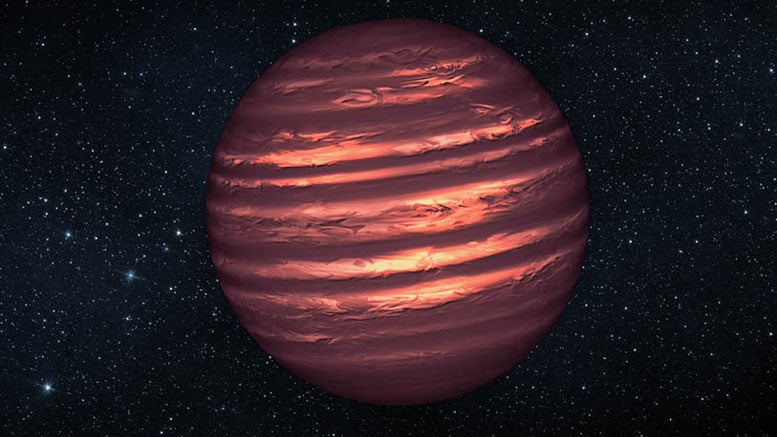
    Astronomers Examine Y-Type Brown Dwarfs
    An artist’s conception of a brown dwarf star, an object that is more massive and hotter than a planet but not massive enough to become a normal star. Y-type brown dwarfs are the coolest subset with surface temperatures between about 200-500 degrees kelvin.

    A newly published Harvard-Smithsonian study of the twenty-four known Y-dwarfs finds that the models for the coolest of them fail to explain the observed properties.

    Brown dwarf stars are failed stars. Their masses are so small, less than about eighty Jupiter-masses, that they lack the ability to heat up their interiors to the roughly ten million kelvin temperatures required for normal hydrogen burning (hydrogen burning fuels the Sun, whose surface temperature is about 5700 kelvin). The surface temperatures and properties of brown dwarfs depend on their precise masses and ages, and range from a few thousand degrees down to a mere 200 kelvin (comparable to the Earth’s surface temperature) with the warmest group being designated as L Dwarfs, the next warmest group as T Dwarfs, and the coolest objects as Y Dwarfs. Not surprisingly, because they are so cool, brown dwarfs are faint and hard to detect, and so although theorists predict that there could be as many brown dwarf stars as there are normal stars our understanding of their evolution and interior properties is quite incomplete.

    NASA’s Wide-field Infrared Survey Explorer (WISE), which was sensitive to the emission from cool objects, discovered the Y class of brown dwarfs in 2011, and today there are twenty-four of them known. CfA astronomer Caroline Morley and her colleagues used the Spitzer Space Telescope and the Gemini observatory, as well as some other facilities, to refine the distances, luminosities, colors, and spectral characteristics of these objects and compared the results to current models. The scientists determined the masses and ages for twenty-two of them, and confirmed that at least for the slightly warmer Y-dwarfs (whose temperatures are around 450 kelvin) the cloud-free surface models agree with observations. All of them have elemental abundances comparable to those found in the Sun, and all appear to have turbulent atmospheres. However for the coolest few objects, whose temperatures are more like 250 kelvin, the models do not agree. A larger sample of objects for study would help to constrain the parameters, but the authors note that it is unlikely more will be found until a more sensitive infrared mission is flown.

    Reference: “The Y-type Brown Dwarfs: Estimates of Mass and Age from New Astrometry, Homogenized Photometry, and Near-infrared Spectroscopy” by S. K. Leggett, P. Tremblin, T. L. Esplin, K. L. Luhman and Caroline V. Morley, 21 June 2017, The Astrophysical Journal.
    DOI: 10.3847/1538-4357/aa6fb5
    PDF

    Never miss a breakthrough: Join the SciTechDaily newsletter.
    Follow us on Google and Google News.

    Astronomy Astrophysics Brown Dwarf Harvard-Smithsonian Center for Astrophysics Popular
    Share. Facebook Twitter Pinterest LinkedIn Email Reddit

    Related Articles

    Intriguing Remains of a Rare Stellar Explosion Discovered in Milky Way Center

    Four Exoplanets – Including a Super-Earth Planet – Discovered by High School Students

    Astronomers Discover First Cloudless, Jupiter-Like Planet – “Smoking Gun Evidence”

    Chandra Studies Extraordinary Magnetar: Fastest Spinning and Possibly the Youngest Magnetar Known

    Growing Interest in Limited Moon Resources Could Cause Tension

    Brown Dwarf Discovered by Radio Telescope Observations for the First Time

    First Habitable-Zone, Earth-Sized Exoplanet Discovered With Planet-Hunter TESS

    Stranger Than Fiction: The Monster in the Middle of the Milky Way Is…Spinning Slowly?

    The Evolving Volatile Chemistry of Protoplanetary Disks

    Leave A Reply Cancel Reply

    • Facebook
    • Twitter
    • Pinterest
    • YouTube

    Don't Miss a Discovery

    Subscribe for the Latest in Science & Tech!

    Trending News

    Scientists May Have Discovered How To Heal Damaged Kidneys

    Interstellar Visitor 3I/ATLAS Is Bursting With an Unexpected Chemical

    Scientists Just Found All 5 Genetic “Letters” of DNA and RNA on an Asteroid

    The 4,000-Year-Old City That Defied History’s Rules on Wealth and Power

    The World’s Biggest Population Fear Has Flipped – and It Could Change Everything

    This “Fake” Pill Improved Memory and Physical Performance in Just 3 Weeks

    Scientists Say Frequent Ejaculation May Improve Sperm Quality and Fertility

    Scientists Have Found “The Heaven Sword” After Years of Looking

    Follow SciTechDaily
    • Facebook
    • Twitter
    • YouTube
    • Pinterest
    • Newsletter
    • RSS
    SciTech News
    • Biology News
    • Chemistry News
    • Earth News
    • Health News
    • Physics News
    • Science News
    • Space News
    • Technology News
    Recent Posts
    • NASA’s Lucy Uncovers Ancient Water Clues on a Weirdly Wobbling Asteroid
    • Could This Visitor From Another Star System Be Alien Technology? SETI Investigates
    • NASA Moon Base Could Become Earth’s First Defense Against Alien Microbes
    • Europe’s First TES Spectrometer Makes Previously Impossible X-Ray Experiments Possible
    • This Sodium Battery From China Matched Tesla in a Surprising Head-to-Head Test
    Copyright © 1998 - 2026 SciTechDaily. All Rights Reserved.
    • Science News
    • About
    • Contact
    • Editorial Board
    • Privacy Policy
    • Terms of Use

    Type above and press Enter to search. Press Esc to cancel.