
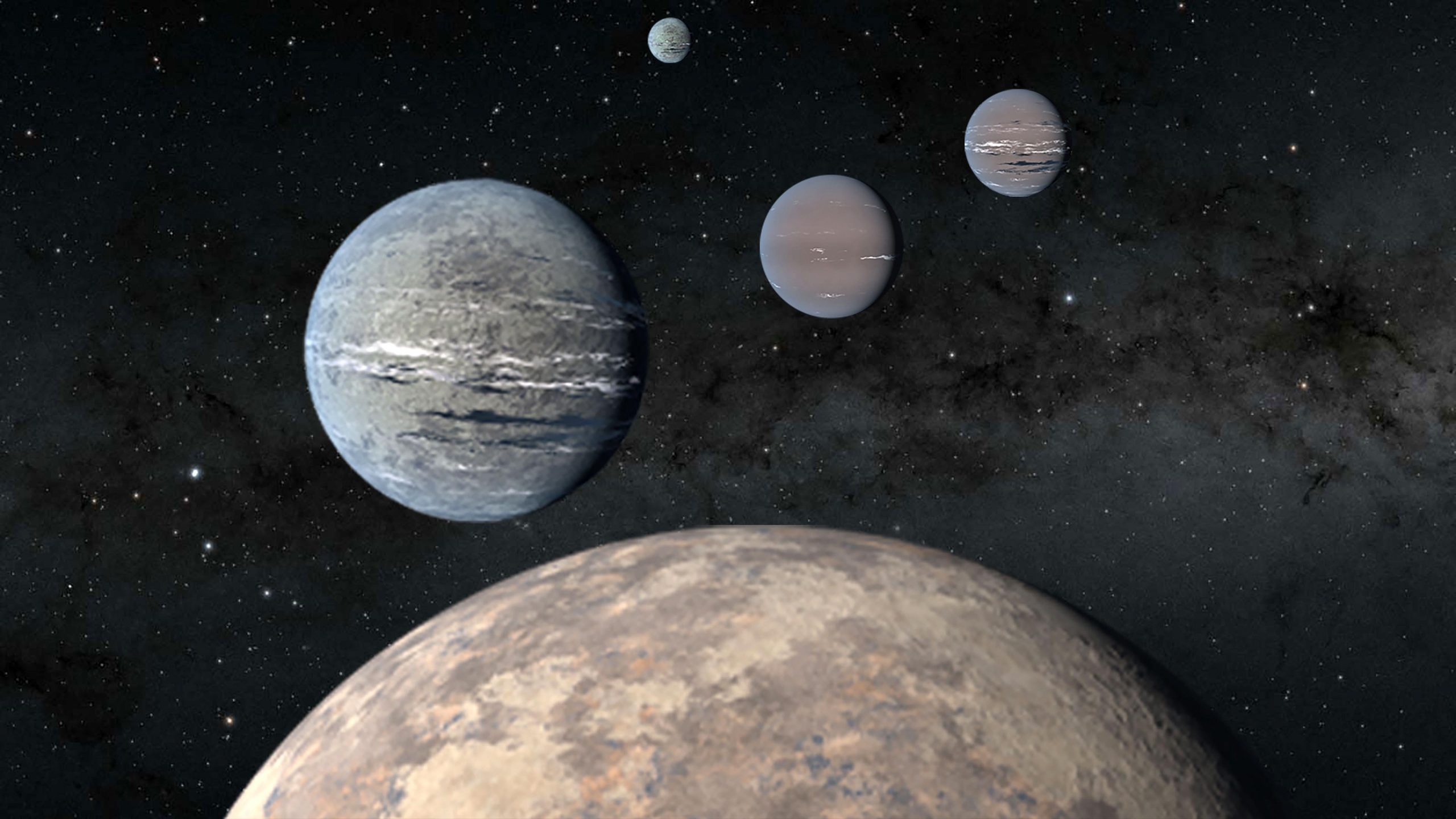
The high schoolers turned scientists published their findings this week, thanks to a research mentorship program at the Center for Astrophysics; Harvard and Smithsonian.
They may be the youngest astronomers to make a discovery yet.
This week, 16-year-old Kartik Pinglé and 18-year-old Jasmine Wright have co-authored a peer-reviewed paper in The Astronomical Journal describing the discovery of four new exoplanets about 200 light-years away from Earth.
The high schoolers participated in the research through the Student Research Mentoring Program (SRMP) at the Center for Astrophysics | Harvard & Smithsonian. Directed by astrochemist Clara Sousa-Silva, the SRMP connects local high schoolers who are interested in research with real-world scientists at Harvard and MIT. The students then work with their mentors on a year-long research project.
“It’s a steep learning curve,” says Sousa-Silva, but it’s worth it. “By the end of the program, the students can say they’ve done active, state-of-the-art research in astrophysics.”
Pinglé and Wright’s particular achievement is rare. High schoolers seldom publish research, Sousa-Silva says. “Although that is one of the goals of the SRMP, it is highly unusual for high-schoolers to be co-authors on journal papers.”
With guidance from mentor Tansu Daylan, a postdoc at the MIT Kavli Institute for Astrophysics and Space Research, the students studied and analyzed data from the Transiting Exoplanet Survey Satellite (TESS). TESS is a space-based satellite that orbits around Earth and surveys nearby bright stars with the ultimate goal of discovering new planets.
Hunting for Hidden Worlds
The team focused on TESS Object of Interest (TOI) 1233, a nearby, bright Sun-like star. To perceive if planets were orbiting around the star, they narrowed in on TOI-1233’s light.
“We were looking to see changes in light over time,” Pinglé explains. “The idea being that if the planet transits the star, or passes in front of it, it would [periodically] cover up the star and decrease its brightness.”
To the team’s surprise, they discovered not one but four planets orbiting around TOI-1233.
“I was very excited and very shocked,” Wright says. “We knew this was the goal of Daylan’s research, but to actually find a multiplanetary system, and be part of the discovering team, was really cool.”
Sub-Neptunes and a Super-Earth
Three of the planets are considered “sub-Neptunes,” gaseous planets that are smaller than, but similar to our own solar system’s Neptune. It takes between 6 and 19.5 days for each of them to orbit around TOI-1233. The fourth planet is labeled a “super-Earth” for its large size and rockiness; it orbits around the star in just under four days.
Daylan hopes to study the planets even closer in the coming year.
“Our species has long been contemplating planets beyond our solar system and with multi-planetary systems, you’re kind of hitting the jackpot,” he says. “The planets originated from the same disk of matter around the same star, but they ended up being different planets with different atmospheres and different climates due to their different orbits. So, we would like to understand the fundamental processes of planet formation and evolution using this planetary system.”
Daylan adds that it was a “win-win” to work with Pinglé and Wright on the study.
Fostering Young Scientific Minds
“As a researcher, I really enjoy interacting with young brains that are open to experimentation and learning and have minimal bias,” he says. “I also think it is very beneficial to high school students, since they get exposure to cutting-edge research and this prepares them quickly for a research career.”
The SRMP was established in 2016 by Or Graur, a former postdoctoral fellow at the Center for Astrophysics |Harvard & Smithsonian. The program accepts about a dozen students per year with priority given to underrepresented minorities.
Thanks to a partnership with the City of Cambridge, the students are paid four hours per week for the research they complete.
“They are salaried scientists,” Sousa-Silva says. “We want to encourage them that pursuing an academic career is enjoyable and rewarding–no matter what they end up pursuing in life.”
For more on this discovery, read Four New Exoplanets Orbiting a Nearby Sun-Like Star Discovered by TESS.
Reference: “TESS Discovery of a Super-Earth and Three Sub-Neptunes Hosted by the Bright, Sun-like Star HD 108236” by Tansu Daylan, Kartik Pinglé, Jasmine Wright, Maximilian N. Günther, Keivan G. Stassun, Stephen R. Kane, Andrew Vanderburg, Daniel Jontof-Hutter, Joseph E. Rodriguez, Avi Shporer, Chelsea X. Huang, Thomas Mikal-Evans, Mariona Badenas-Agusti, Karen A. Collins, Benjamin V. Rackham, Samuel N. Quinn, Ryan Cloutier, Kevin I. Collins, Pere Guerra, Eric L. N. Jensen, John F. Kielkopf, Bob Massey, Richard P. Schwarz, David Charbonneau, Jack J. Lissauer, Jonathan M. Irwin, Özgür Bastürk, Benjamin Fulton, Abderahmane Soubkiou, Benkhaldoun Zouhair, Steve B. Howell, Carl Ziegler, César Briceño, Nicholas Law, Andrew W. Mann, Nic Scott, Elise Furlan, David R. Ciardi, Rachel Matson, Coel Hellier, David R. Anderson, R. Paul Butler, Jeffrey D. Crane, Johanna K. Teske, Stephen A. Shectman, Martti H. Kristiansen, Ivan A. Terentev, Hans Martin Schwengeler, George R. Ricker, Roland Vanderspek, Sara Seager, Joshua N. Winn, Jon M. Jenkins, Zachory K. Berta-Thompson, Luke G. Bouma, William Fong, Gabor Furesz, Christopher E. Henze, Edward H. Morgan, Elisa Quintana, Eric B. Ting and Joseph D. Twicken, 25 January 2021, The Astronomical Journal.
DOI: 10.3847/1538-3881/abd73e
Pinglé, a junior in high school, is considering studying applied mathematics or astrophysics after graduation. Wright has just been accepted into a five-year Master of Astrophysics program at the University of Edinburgh in Scotland.
Never miss a breakthrough: Join the SciTechDaily newsletter.
Follow us on Google and Google News.
3 Comments
There are many, many scientific discoveries of great import that are ignored for no comprehensible reason. Perhaps someone can uncover the reason why scientists with a platform and professional visibility should foster this discovery and glorify these high school student scientists.
Claims in need of evidence. And I note, the exact opposite reaction of what one would expect to see from an article on young students making good!
Science is exponentially expanding (peer reviewed published papers) and it is hard to follow any specific area. But it is also a meritocracy and important results are promoted – we can trust the experts even if they have to narrow their area in order to follow it – and even if they weren’t promoted, science is integrative so all work is supportive.
In general we see less corruption et cetera within science than elsewhere. “Only about four of every 10,000 papers are now retracted.” [“What a massive database of retracted papers reveals about science publishing’s ‘death penalty’” @ Science]
The reason why this work is promoted is of course that it is education and encouraging.
“Daylan adds that it was a “win-win” to work with Pinglé and Wright on the study.
“As a researcher, I really enjoy interacting with young brains that are open to experimentation and learning and have minimal bias,” he says. “I also think it is very beneficial to high school students, since they get exposure to cutting-edge research and this prepares them quickly for a research career.””
The discovery is worth it. Thumbs up for your goo and great work your team is doing to help us understand what is in space. You are great.