
Close Menu
    Facebook X (Twitter) Instagram
    SciTechDaily
    • Biology
    • Chemistry
    • Earth
    • Health
    • Physics
    • Science
    • Space
    • Technology
    Facebook X (Twitter) Pinterest YouTube RSS
    SciTechDaily
    Home»Technology»A New Kind of Quantum Computer Uses Photons as Qubits
    Technology

    A New Kind of Quantum Computer Uses Photons as Qubits

    By Harvard-Smithsonian Center For AstrophysicsNovember 7, 20172 Comments3 Mins Read
    Facebook Twitter Pinterest Telegram LinkedIn WhatsApp Email Reddit
    Share
    Facebook Twitter LinkedIn Pinterest Telegram Email Reddit
    New Kind of Quantum Computer Uses Photons as Qubits
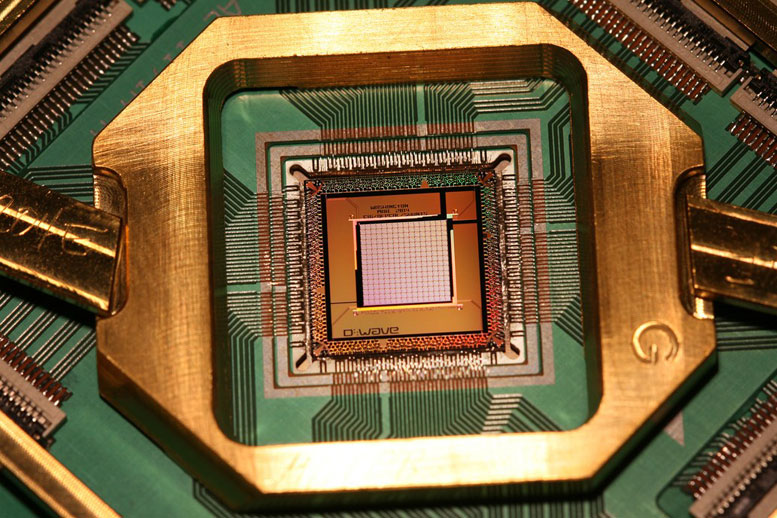
    A photograph of Google’s 1000+ qubit computer chip under development.

    Harvard scientists have proposed a new way to use photons of light instead of silicon chips as qubits, opening the door to new quantum technologies.

    Quantum mechanics incorporates some very non-intuitive properties of matter. Quantum superposition, for example, allows an atom to be simultaneously in two different states with its spin axis pointed both up and down, or combinations in between. A computer that uses quantum mechanical manipulation of atoms or particles therefore has many more possible options than a conventional one that works with “zeros” and “ones” and has only two choices, called bits. A quantum computer’s memory uses instead what are called quantum bits – qubits – and each qubit can be in a superposition of these two states. As a result, theoretical physicists estimate a quantum computer with only about one hundred of these qubits could in principle exceed the computing power of the powerful current classical computers. Building a quantum computer is therefore one of the main technological goals in modern physics and astrophysics.

    CfA physicist Hannes Pichler, of the CfA’s Institute for Theoretical Atomic, Molecular and Optical Physics (ITAMP), and three colleagues have proposed a new way to build a quantum computer using just a single atom. Light quanta (photons) can be used as information carriers and act as qubits, but to use them in a quantum computer they must interact with each other. Under normal conditions, however, light does not interact with itself and so the challenge is to create correlations between them. The key idea of their new paper is to allow light photons from an atom to interact with their own mirror image reflections Photons that the atom emits are reflected by the mirror and can interact again with the atom but with a very slight time delay. That delay, the scientists show, results in the combined waveform of the photons being so complex that in principle any quantum computation can be achieved by simply measuring the emitted photons.

    The theoretical discovery is not only a conceptual breakthrough in quantum optics and information, it opens the door to new technology. In particular, the proposed single atom setup is appealing since it minimizes the resources needed and relies only on elements that have already been demonstrated in state-of-the-art experiments.

    Reference: “Universal photonic quantum computation via time-delayed feedback” by Hannes Pichler, Soonwon Choi, Peter Zoller and Mikhail D. Lukin, 10 October 2017, PNAS.
    DOI: 10.1073/pnas.1711003114

    Never miss a breakthrough: Join the SciTechDaily newsletter.
    Follow us on Google and Google News.

    Google Harvard-Smithsonian Center for Astrophysics Quantum Computing Quantum Mechanics
    Share. Facebook Twitter Pinterest LinkedIn Email Reddit

    Related Articles

    How 1,432 GPUs Cracked Google’s 53-Qubit Quantum Computer

    Google Quantum AI Braids Non-Abelian Anyons – A Breakthrough That Could Revolutionize Quantum Computing

    Russian Scientists Break Google’s Quantum Algorithm

    Summit Supercomputer Harnessed for Quantum Supremacy Milestone (Video)

    Quantum Supremacy Achieved by NASA and Google

    Quantum Computing Continues to Move Forward

    Photon Devices Could Outperform Traditional Computers

    Samarium Hexoboride Behaves Like a Topological Insulator

    Electronic Read-Out of the Quantum State of an Atom

    2 Comments

    1. Norma B. Billings on November 25, 2021 4:42 am

      I am grateful to you for posting this article about Quantum computer which is a very useful machine. I have read this whole article meticulously and got the main point from it. I hope this information will be very assistive for me in the future as technology is looming now. I would definitely get research paper help online from https://studyclerk.com/help-with-research-paper website to write my papers about this computer which is going to be valuable for me.

      Reply
    2. Les Broadbent on December 18, 2021 12:24 am

      How can photons be used as qubits, since they are never stationary?

      Reply
    Leave A Reply Cancel Reply

    • Facebook
    • Twitter
    • Pinterest
    • YouTube

    Don't Miss a Discovery

    Subscribe for the Latest in Science & Tech!

    Trending News

    Once-in-a-Century Impact: NASA Just Found a Massive New Crater on the Moon

    Anak Krakatau Just Blasted Ash 50,000 Feet Into the Sky

    NASA’s Chandra Reveals Galaxies Being Torn Apart, Blasted by Black Holes, and Reborn in Stars

    Ozempic’s Active Ingredient Shows Surprising Anti-Aging Effects

    Scientists Discover Canada’s First Dinosaur Tracks From a Rarely Documented Cretaceous Age

    Astronomers Just Caught a Giant Planet in the Act of Forming

    Two Dead Stars Are Racing Around Each Other Every 6.2 Minutes

    Natural Compound May Help Protect the Brain and Heart From Excess Salt

    Follow SciTechDaily
    • Facebook
    • Twitter
    • YouTube
    • Pinterest
    • Newsletter
    • RSS
    SciTech News
    • Biology News
    • Chemistry News
    • Earth News
    • Health News
    • Physics News
    • Science News
    • Space News
    • Technology News
    Recent Posts
    • Losing the Same Weight Didn’t Produce the Same Health Benefits
    • Feeling Lonely Could Take Nearly 6 Years From Your Healthy Lifespan
    • Hidden Artery Plaque Found in 1 in 13 Adults Before Age 30
    • Can Species Evolve Fast Enough To Survive Climate Change?
    • Scientists Solve a Decades-Old Stick Insect Mystery
    Copyright © 1998 - 2026 SciTechDaily. All Rights Reserved.
    • Science News
    • About
    • Contact
    • Editorial Board
    • Privacy Policy
    • Terms of Use

    Type above and press Enter to search. Press Esc to cancel.