
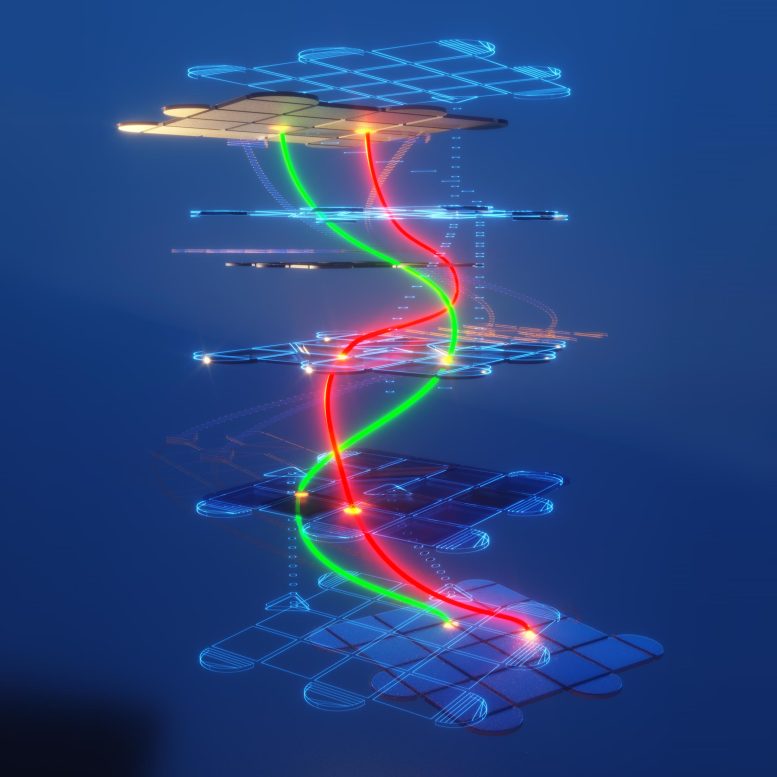
Google Quantum AI has observed non-Abelian anyons for the first time, a breakthrough that could revolutionize quantum computing by making it more robust to noise and leading to topological quantum computation.
Our intuition tells us that it should be impossible to see whether two identical objects have been swapped back and forth, and for all particles observed to date, that has been the case. Until now.
Non-Abelian anyons — the only particles that have been predicted to break this rule — have been sought for their fascinating features and their potential to revolutionize quantum computing by making the operations more robust to noise. Microsoft and others have chosen this approach for their quantum computing effort. But after decades of efforts by researchers in the field, observing non-Abelian anyons and their strange behavior has proven challenging, to say the least.
“Observing the bizarre behavior of non-Abelian anyons for the first time really highlights the type of exciting phenomena we can now access with quantum computers.” Trond I. Andersen, Google Quantum AI
In a paper published in the journal Nature on May 11, researchers at Google Quantum AI announced that they had used one of their superconducting quantum processors to observe the peculiar behavior of non-Abelian anyons for the first time ever. They also demonstrated how this phenomenon could be used to perform quantum computations. Earlier this week the quantum computing company Quantinuum released another study on the topic, complementing Google’s initial discovery. These new results open a new path toward topological quantum computation, in which operations are achieved by winding non-Abelian anyons around each other like strings in a braid.
Google Quantum AI team member and first author of the manuscript, Trond I. Andersen says, “Observing the bizarre behavior of non-Abelian anyons for the first time really highlights the type of exciting phenomena we can now access with quantum computers.”
The Bizarre Behavior of Non-Abelian Anyons
Imagine you’re shown two identical objects and then asked to close your eyes. Open them again, and you see the same two objects. How can you determine if they have been swapped? Intuition says that if the objects are truly identical, there is no way to tell.
Quantum mechanics supports this intuition, but only in our familiar three-dimensional world. If the identical objects are restricted to only move in a two-dimensional plane, sometimes, our intuition can fail and quantum mechanics allows for something bizarre: non-Abelian anyons retain a sort of memory — it is possible to tell when two of them have been exchanged, despite being completely identical.
This “memory” of the non-Abelian anyons can be thought of as a continuous line in space-time: the particle’s so-called “world-line.” When two non-Abelian anyons are exchanged, their world-lines wrap around one another. Wrap them in the right way, and the resulting knots and braids form the basic operations of a topological quantum computer.
Leveraging Non-Abelian Anyons for Quantum Computing
The team started by preparing their superconducting qubits in an entangled quantum state that is well represented as a checkerboard — a familiar configuration for the Google team, who recently demonstrated a milestone in quantum error correction using this setup. In the checkerboard arrangement, related — but less useful — particles called Abelian anyons can emerge.
To realize non-Abelian anyons, the researchers stretched and squashed the quantum state of their qubits to transform the checkered pattern into oddly shaped polygons. Particular vertices in these polygons hosted the non-Abelian anyons. Using a protocol developed by Eun-Ah Kim at Cornell University and former postdoc Yuri Lensky, the team could then move the non-Abelian anyons around by continuing to deform the lattice and shifting the locations of the non-Abelian vertices.
In a series of experiments, the researchers at Google observed the behavior of these non-Abelian anyons and how they interacted with the more mundane Abelian anyons. Weaving the two types of particles around one another yielded bizarre phenomena — particles mysteriously disappeared, reappeared and shapeshifted from one type to another as they wound around one another and collided. Most importantly, the team observed the hallmark of non-Abelian anyons: when two of them were swapped, it caused a measurable change in the quantum state of their system — a striking phenomenon that had never been observed before.
Finally, the team demonstrated how braiding of non-Abelian anyons might be used in quantum computations. By braiding several non-Abelian anyons together, they were able to create a well-known quantum entangled state called the Greenberger-Horne-Zeilinger (GHZ) state.
The physics of non-Abelian particles is also at the core of the approach that Microsoft has chosen for its quantum computing effort. While they are attempting to engineer material systems that intrinsically host these anyons, the Google team has now shown that the same type of physics can be realized on their superconducting processors.
Last week the quantum computing company Quantinuum released an impressive complementary study that also demonstrated non-Abelian braiding, in this case using a trapped-ion quantum processor. Andersen is excited to see other quantum computing groups observing non-Abelian braiding as well. He says, “It will be very interesting to see how non-Abelian anyons are employed in quantum computing in the future, and whether their peculiar behavior can hold the key to fault-tolerant topological quantum computing.”
Reference: “Non-Abelian braiding of graph vertices in a superconducting processor” by Google Quantum AI and Collaborators, 11 May 2023, Nature.
DOI: 10.1038/s41586-023-05954-4
Never miss a breakthrough: Join the SciTechDaily newsletter.
Follow us on Google and Google News.