

Close Menu
    Facebook X (Twitter) Instagram
    SciTechDaily
    • Biology
    • Chemistry
    • Earth
    • Health
    • Physics
    • Science
    • Space
    • Technology
    Facebook X (Twitter) Pinterest YouTube RSS
    SciTechDaily
    Home»Technology»Russian Scientists Break Google’s Quantum Algorithm
    Technology

    Russian Scientists Break Google’s Quantum Algorithm

    By Skolkovo Institute of Science and Technology (Skoltech)March 18, 20201 Comment3 Mins Read
    Facebook Twitter Pinterest Telegram LinkedIn WhatsApp Email Reddit
    Share
    Facebook Twitter LinkedIn Pinterest Telegram Email Reddit
    Quantum Algorithm Concept Design
    Scientists from Skolkovo Institute of Science and Technology (Skoltech), a private graduate research institute in Moscow, Russia, discovered and quantified what appears to be a fundamental limitation in the wildly adopted quantum approach initiated by Google.

    Google is racing to develop quantum-enhanced processors that utilize quantum mechanical effects to one day dramatically increase the speed at which data can be processed.

    In the near term, Google has devised new quantum-enhanced algorithms that operate in the presence of realistic noise. The so-called quantum approximate optimization algorithm, or QAOA for short, is the cornerstone of a modern drive towards noise-tolerant quantum-enhanced algorithm development.

    The celebrated approach taken by Google in QAOA has sparked vast commercial interest and ignited a global research community to explore novel applications. Yet, little actually remains known about the ultimate performance limitations of Google’s QAOA algorithm.

    A team of scientists, hailing from Skoltech’s Deep Quantum Laboratory, took up this contemporary challenge. The all-Skoltech team led by Prof. Jacob Biamonte discovered and quantified what appears to be a fundamental limitation in the wildly adopted approach initiated by Google.
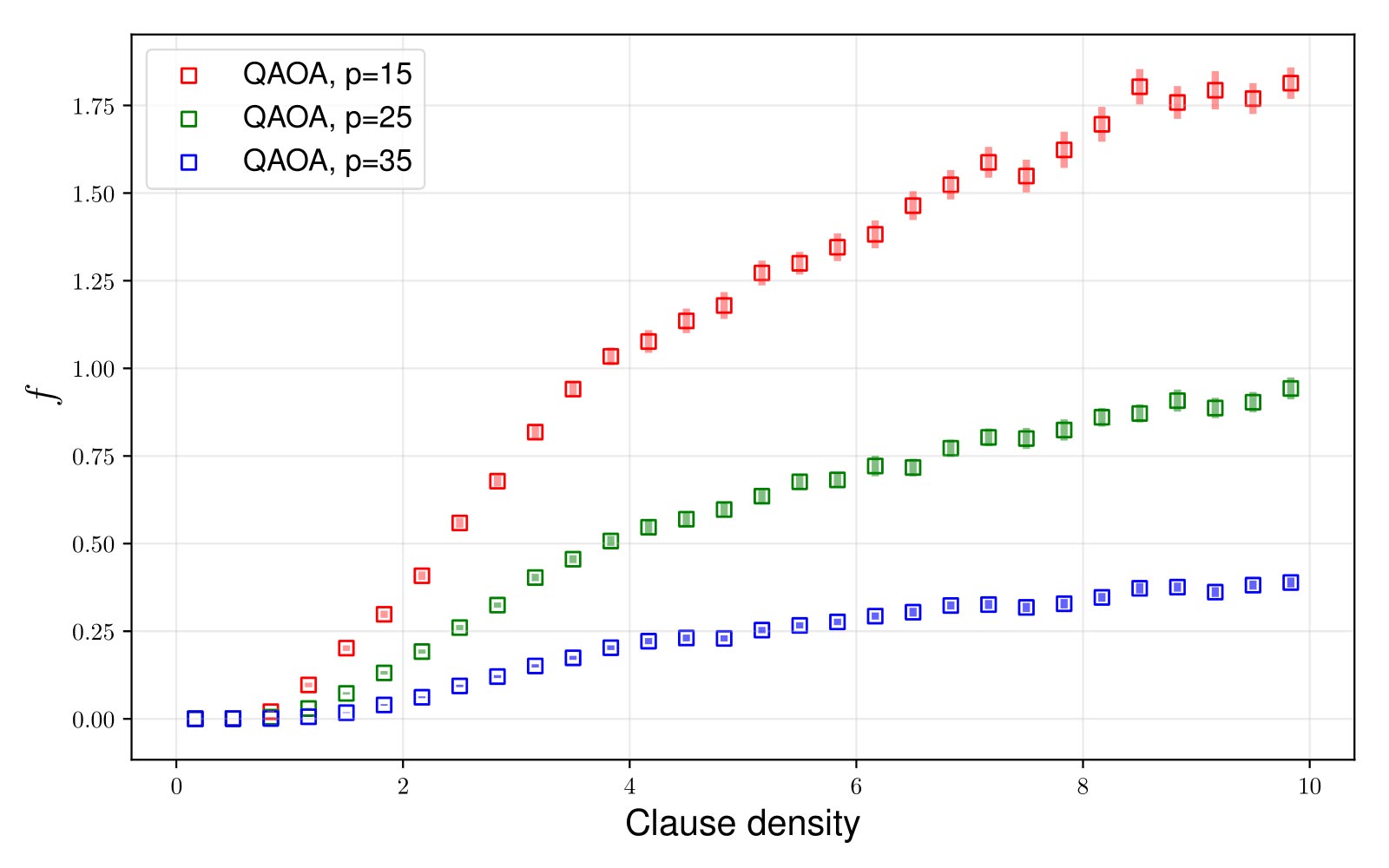
    Fixed Depth QAOA Circuits Performance
    The graph represents the performance (difference between QAOA optima and exact optima) of fixed depth QAOA circuits on randomly generated MAX-SAT instances with increasing problem densities. Although higher depth versions achieve better performances, they still exhibit reachability deficits. Credit: Physical Review Letters

    Reporting in Physical Review Letters, the authors detail the discovery of so-called reachability deficits — the authors show how these deficits place a fundamental limitation on the ability of QAOA to even approximate a solution to a problem instance.

    The Skoltech team’s findings report a clear limitation of the variational QAOA quantum algorithm. QAOA and other variational quantum algorithms have proven extremely difficult to analyze using known mathematical techniques due to an internal quantum-to-classical feedback process. Namely, a given quantum computation can only run for a fixed amount of time. Inside this fixed time, a fixed number of quantum operations can be executed. QAOA seeks to iteratively utilize these quantum operations by forming a sequence of increasingly optimal approximations to minimize an objective function. The study places new limits on this process.

    The authors discovered that QAOA’s ability to approximate optimal solutions for any fixed-depth quantum circuit is fundamentally dependent on the problem’s “density.” In the case of the problem called MAX-SAT, the so-called density can be defined as the ratio of the problem’s constraints to variable count. This is sometimes called clause density.

    The authors discovered problem instances of high density whose optimal solutions cannot be approximated with guaranteed success, regardless of the algorithms’ run-time.

    Reference: “Reachability Deficits in Quantum Approximate Optimization” by V. Akshay, H. Philathong, M. E. S. Morales and J. D. Biamonte, 5 March 2020, Physics Review Letters.
    DOI: 10.1103/PhysRevLett.124.090504

    Never miss a breakthrough: Join the SciTechDaily newsletter.
    Follow us on Google and Google News.

    Algorithm Google Optics Popular Quantum Computing Skoltech
    Share. Facebook Twitter Pinterest LinkedIn Email Reddit

    Related Articles

    Secret to Building Superconducting Quantum Computers With Massive Processing Power

    New “Fast Forward” Algorithm Could Unleash the Power of Quantum Computers

    Tiny Quantum Computer Solves Real Logistics Optimization Problem

    Quantum Algorithm Breakthrough

    The Quantum Gate Hack – Applying Ideas From Gaming Hacks to Quantum Computing

    Quantum Supremacy Achieved by NASA and Google

    Blanket of Entangled Light Pulses for Larger and More Powerful Quantum Computers

    Prototype Large-Scale Quantum Processor Made Entirely of Light

    New Tunable Optical Chips Can Be Used As Building-Blocks for Next Generation Quantum Computers

    1 Comment

    1. Jake Nelson on May 28, 2025 7:46 pm

      Great article!!

      Reply
    Leave A Reply Cancel Reply

    • Facebook
    • Twitter
    • Pinterest
    • YouTube

    Don't Miss a Discovery

    Subscribe for the Latest in Science & Tech!

    Trending News

    Largest-Ever Study Finds Medicinal Cannabis Ineffective for Anxiety, Depression, PTSD

    250-Million-Year-Old Egg Solves One of Evolution’s Biggest Mysteries

    Living With Roommates Might Be Changing Your Gut Microbiome Without You Knowing

    Century-Old Cleaning Chemical Linked to 500% Increased Risk of Parkinson’s Disease

    What if Your Memories Never Happened? Physicists Take a New Look at the Boltzmann Brain Paradox

    One of the Universe’s Largest Stars May Be Getting Ready To Explode

    Scientists Discover Enzyme That Could Supercharge Ozempic-Like Weight Loss Drugs

    Popular Sweetener Linked to DNA Damage – “It’s Something You Should Not Be Eating”

    Follow SciTechDaily
    • Facebook
    • Twitter
    • YouTube
    • Pinterest
    • Newsletter
    • RSS
    SciTech News
    • Biology News
    • Chemistry News
    • Earth News
    • Health News
    • Physics News
    • Science News
    • Space News
    • Technology News
    Recent Posts
    • Want Less Stress? Landmark Study Points to a Simple Habit
    • Scientists Reveal Eating Fruits and Vegetables May Increase Your Risk of Lung Cancer
    • AI Reveals Explosive Growth of Floating Algae Across the World’s Oceans
    • 5.5 Million Bees Discovered Living Beneath a New York Cemetery
    • Scientists Reverse Brain Aging With Simple Nasal Spray
    Copyright © 1998 - 2026 SciTechDaily. All Rights Reserved.
    • Science News
    • About
    • Contact
    • Editorial Board
    • Privacy Policy
    • Terms of Use

    Type above and press Enter to search. Press Esc to cancel.