
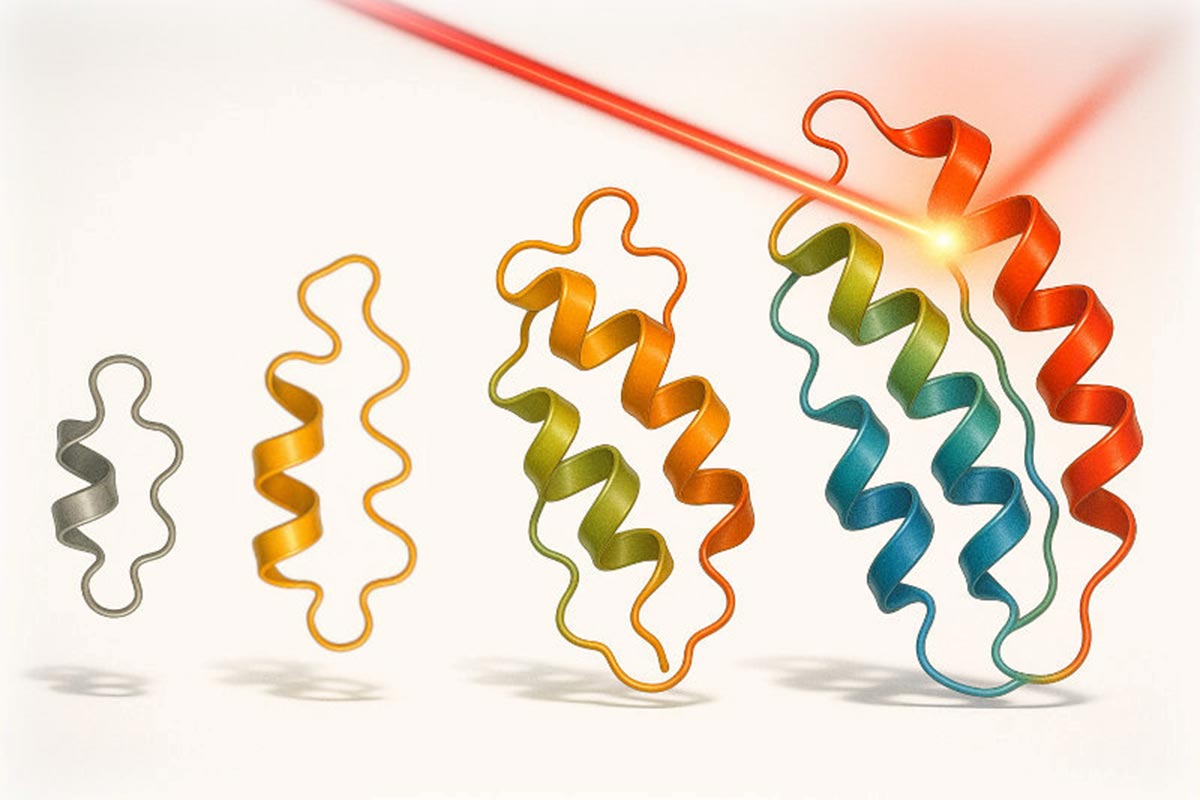
Scientists used light to evolve proteins that can switch, sense, and even “compute” inside living cells.
Evolution is one of biology’s most powerful design tools. It works by producing many variations of DNA, RNA, and proteins within cells and allowing natural selection to favor the organisms that function best. Humans have taken advantage of this process for thousands of years. Early farmers shaped crops and livestock by selecting the most productive individuals for breeding.
In modern laboratories, scientists have adapted this concept into a technique known as directed evolution. Researchers use it to improve proteins such as enzymes and antibodies that are widely used in medicine, industrial manufacturing, and even household detergents.
However, traditional directed evolution methods have a limitation. They typically apply constant selection pressure, which favors proteins that remain strongly active all the time. Real biological systems rarely operate that way. Many proteins function as signals, switches, or even “logic gates” (proteins that combine multiple inputs to make a yes-or-no decision), meaning they must shift between active and inactive states over time.
For instance, a protein may need to briefly activate, then shut off, and later turn on again. When evolution experiments only reward one state, other essential states may deteriorate. As a result, proteins can lose their ability to switch properly, which can be harmful for cells (e.g. kill a cell). Because of this challenge, creating proteins with dynamic, multi-state behavior has been difficult with existing directed evolution techniques.
A Light-Guided Method for Protein Evolution
A research team led by Sahand Jamal Rahi at EPFL’s Laboratory of the Physics of Biological Systems has introduced a new approach called “optovolution.” This technique uses light to guide the evolution of proteins that perform dynamic functions and can carry out simple computational tasks by following specific yes-or-no rules.
The research, published today (March 6) in Cell, moves directed evolution closer to how living cells actually operate, where timing and switching are just as important as overall activity.
To test their system, the scientists used the budding yeast Saccharomyces cerevisiae, a species commonly used both in brewing and as a laboratory model organism. The team redesigned the yeast cell cycle so that cell division depended on the behavior of the protein being evolved. The system required the protein to switch cleanly between off and on states.
Engineering Yeast Cells to Test Protein Switching
The researchers achieved this by linking the protein’s output signal to a regulator that controls the cell cycle. This regulator is necessary at one stage of the cycle but becomes harmful at another. If the engineered protein remained on or off for too long, the yeast cells either stalled or died. Only cells containing proteins that switched at the correct time were able to keep dividing.
Light provided precise external control over this process. Using optogenetics, a method that activates or deactivates genes with light, the team could manipulate the protein’s behavior using timed flashes of light. These pulses forced the protein to alternate between states.
Each yeast cell cycle lasts about 90 minutes. During that time, the cell effectively performed a rapid pass or fail test to determine whether the protein switched at the proper moment. Variants with the best switching behavior survived and multiplied, allowing the system to automatically favor proteins with improved dynamics without manual screening.
New Protein Variants and Expanded Light Sensitivity
Using optovolution, the researchers evolved several different types of proteins. They first improved a commonly used light-controlled transcription factor. The team generated 19 new variants that were either more responsive to light, less active in darkness, or capable of responding to green light instead of only blue light. Engineering proteins to respond to warmer colors than blue has long been considered extremely challenging because of the way these molecules absorb light.
The researchers also modified a red light optogenetic system so that yeast cells no longer needed an added chemical cofactor. Evolution produced a mutation that disabled a normal yeast transport protein. Surprisingly, this allowed the system to use light-sensitive molecules that are naturally present in the cell, simplifying experimental use.
Finally, the team demonstrated that optovolution can go beyond light-sensing proteins. They evolved a transcription factor that functions like a single protein computer. This protein activated genes only when two separate inputs appeared simultaneously. One input was a light signal, and the other was a chemical signal.
Toward Smarter Cellular Circuits
Dynamic protein behavior is central to many biological processes, including sensing environmental signals, making cellular decisions, and controlling when cells divide or respond to stress. By enabling these behaviors to evolve continuously inside living cells, optovolution provides a new tool for synthetic biology, biotechnology, and basic research.
The approach could allow scientists to design more sophisticated cellular circuits, build optogenetic systems that respond to different colors of light independently, and gain deeper insight into how complex protein behaviors evolve.
Reference: “Light-directed evolution of dynamic, multi-state, and computational protein functionalities” by Vojislav Gligorovski, Marco Labagnara, Lorenzo Scutteri, Marius Blackholm, Andreas Möglich, Nahal Mansouri and Sahand Jamal Rahi, 6 March 2026, Cell.
DOI: 10.1016/j.cell.2026.02.002
Other contributors
- EPFL Laboratory of Protein and Cell Engineering
- University of Bayreuth
- Lausanne University Hospital (CHUV)
Never miss a breakthrough: Join the SciTechDaily newsletter.
Follow us on Google and Google News.