
This full assembly may contain clues to ape and human divergence; certain immune, brain and heart disorders; and other biomedical questions.
The full assembly of human chromosome 8 is reported in Nature. While on the outside this chromosome looks typical, being neither short nor long or distinctive, its DNA content and arrangement are of interest in primate and human evolution, in several immune and developmental disorders, and in chromosome sequencing structure and function generally.
This linear assembly is a first for a human autosome — a chromosome not involved in sex determination. The entire sequence of chromosome 8 is 146,259,671 bases. The completed assembly fills in the gap of more than 3 million bases missing from the current reference genome.
The Nature paper is titled “The structure, function, and evolution of a complete chromosome 8.”
Unique Features and Evolutionary Clues
One of several intriguing characteristics of chromosome 8 is a fast-evolving region, where the mutation rate appears to be highly accelerated in humans and human-like species, in contrast to the rest of the human genome.
While chromosome 8 offers some insights into evolution and human biology, the researchers point out that the complete assembly of all human chromosomes would be necessary to acquire a fuller picture.
An international team of scientists collaborated on the chromosome 8 assembly and analysis. The lead author of the paper is Glennis Logsdon, a postdoctoral fellow in genome sciences at the University of Washington School of Medicine in Seattle.
The senior author is Evan Eichler, professor of genome sciences at the UW School of Medicine and a Howard Hughes Medical Institute investigator. His group is noted for developing better methods for sequencing DNA and for analyzing mutational trends that may be important in research on primate evolution and neurological disorders.
Decoding the Centromere’s Evolutionary History
In addition to the human chromosome 8 assembly, the project researchers also created high quality draft assemblies of the linking site at the waist of the chromosome, the centromere, in the chimpanzee, orangutan, and macaque. The data allowed the scientists to begin to chart the evolutionary history of the chromosome 8 centromere.
Almost like inspecting the depths of a geological site, the researchers observed, on a molecular scale, a layered, mirrored symmetry in how this centromere structure evolved from great ape ancestors. More ancient parts were pushed to the periphery, similar to making room for new material in the middle of a factory production line.
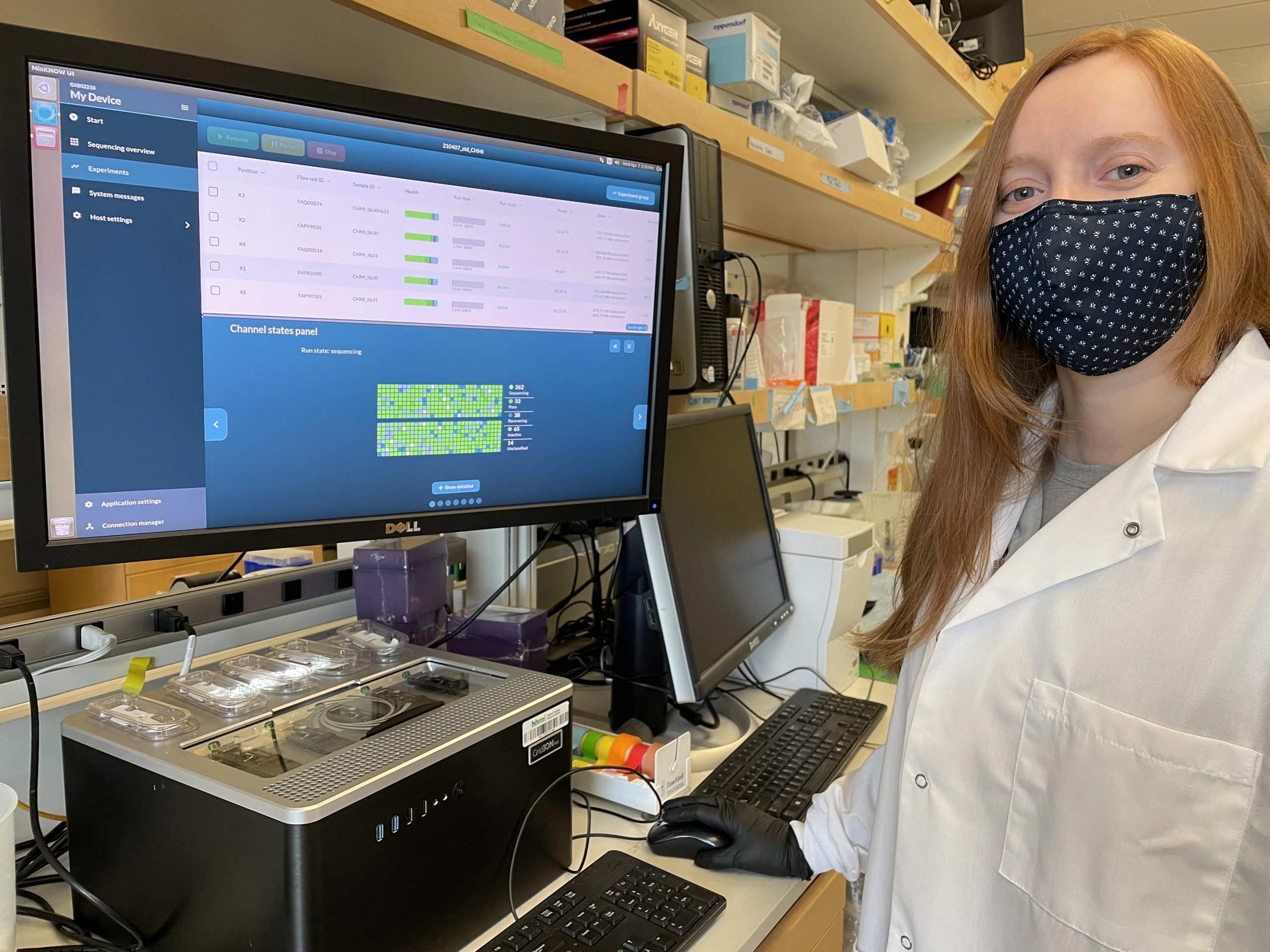
Other research institutions involved in the chromosome 8 assembly project include the Development Therapeutics Branch of the National Cancer Institute, the Genome Informatics Section of the National Human Genome Research Institute, the University of Bari, Italy; the Center for Algorithmic Biology at St. Petersburg State University, Russia; University of California, San Diego, Washington University in St. Louis, University of Pittsburgh, and the University of California, Santa Cruz. Data were also generated with Oxford Nanopore Technologies and Pacific Biosciences long-read sequencing to resolve gaps in the telomere-to-telomere, or end-to-end, assembly of the chromosome.
Earlier research by a number of scientists had pointed to regions of chromosome 8 as being important both in the normal formation of the brain, as well as to some developmental variations, such as small head size or skull and facial differences. Mutations on this chromosome have also been implicated in some heart defects, certain forms of cancer, premature aging syndromes, immune responses, and immune disorders like psoriasis and Crohn’s disease.
However, the full sequencing of this and most other human chromosomes could not be attempted until recently because the technology and methods to wade through large areas of duplication and identical repeats had not become available. Putting together the puzzle accurately from short reads of DNA, for instance, would have been extremely difficult.
The chromosome 8 assembly achievement benefited from advances in long-read technologies, as well as from the availability of DNA material from hydatidiform moles. These are rare, abnormal growths in the placenta.
Personalized Medicine and Future Research
The full sequencing of chromosome 8 now provides information that might improve, for example, the understanding of what predisposes specific parts of the chromosome’s DNA to microdeletions suspected in certain forms of developmental delay, brain and heart malformations, and autoimmune problems.
The researchers were also able to obtain more information on a part of chromosome 8 that contains some of the greatest copy-number variability among people. The repeat unit can vary from 53 to 326 copies.
With the chromosome 8 assembly finished, researchers look forward to the world scientific community completing other human chromosome assemblies, and to new challenges in applying what has been learned to further studies of human genome sequencing.
Reference: “The structure, function and evolution of a complete human chromosome 8” by Glennis A. Logsdon, Mitchell R. Vollger, PingHsun Hsieh, Yafei Mao, Mikhail A. Liskovykh, Sergey Koren, Sergey Nurk, Ludovica Mercuri, Philip C. Dishuck, Arang Rhie, Leonardo G. de Lima, Tatiana Dvorkina, David Porubsky, William T. Harvey, Alla Mikheenko, Andrey V. Bzikadze, Milinn Kremitzki, Tina A. Graves-Lindsay, Chirag Jain, Kendra Hoekzema, Shwetha C. Murali, Katherine M. Munson, Carl Baker, Melanie Sorensen, Alexandra M. Lewis, Urvashi Surti, Jennifer L. Gerton, Vladimir Larionov, Mario Ventura, Karen H. Miga, Adam M. Phillippy and Evan E. Eichler, 7 April 2021, Nature.
DOI: 10.1038/s41586-021-03420-7
The researchers on this study declare no competing financial interests.
Never miss a breakthrough: Join the SciTechDaily newsletter.
Follow us on Google and Google News.