
Octo-Tiger revolutionizes how scientists simulate stellar mergers by offering faster, more precise modeling with powerful parallelization and scalability.
“Octo-Tiger,” a breakthrough astrophysics code, simulates the evolution of self-gravitating and rotating systems of arbitrary geometry using adaptive mesh refinement and a new method to parallelize the code to achieve superior speeds.
This new code to model stellar collisions is more expeditious than the established code used for numerical simulations. The research came from a unique collaboration between experimental computer scientists and astrophysicists in the LSU Department of Physics & Astronomy, the LSU Center for Computation & Technology, Indiana University Kokomo, and Macquarie University, Australia, culminating in over of a year of benchmark testing and scientific simulations, supported by multiple NSF grants, including one specifically designed to break the barrier between computer science and astrophysics.
Accelerating Astrophysical Insights with Efficiency
“Thanks to a significant effort across this collaboration, we now have a reliable computational framework to simulate stellar mergers,” said Patrick Motl, professor of physics at Indiana University Kokomo. “By substantially reducing the computational time to complete a simulation, we can begin to ask new questions that could not be addressed when a single-merger simulation was precious and very time consuming. We can explore more parameter space, examine a simulation at very high spatial resolution or for longer times after a merger, and we can extend the simulations to include more complete physical models by incorporating radiative transfer, for example.”
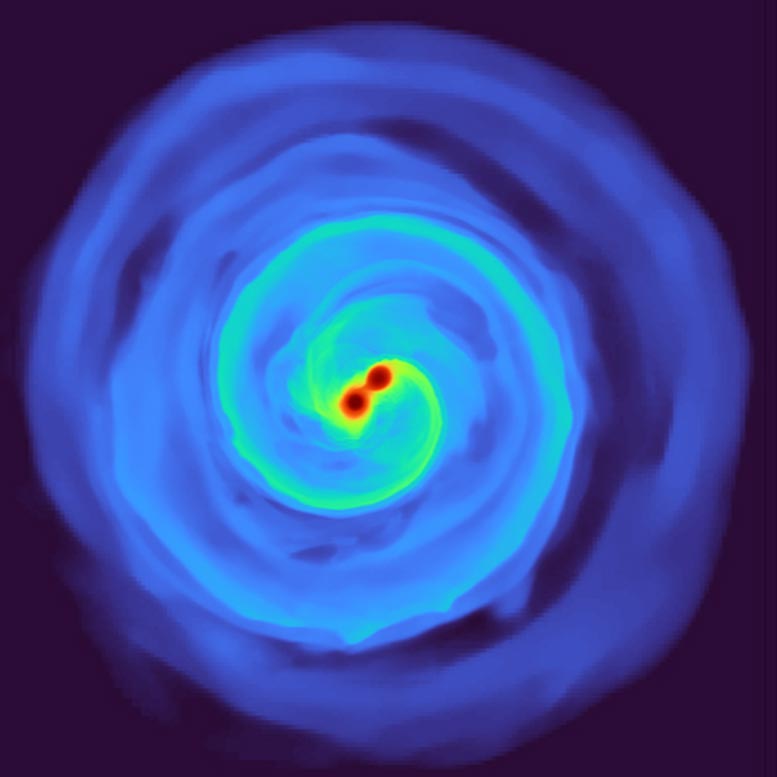
This movie shows an Octo-Tiger simulation of two white dwarf stars in orbit around each other. We are looking down on the two stars as they start to merge together. The color indicates how dense the gas is in the orbital or midplane, with brown indicating the densest gas and blue the least dense. The arrows indicate the speed of the gas. Red arrows correspond to high velocities of 1,000 km/s and blue arrows correspond to low velocities of 1 km/s. Time is shown in seconds in the upper-left corner. The binary initially completes an orbit every two minutes and the total simulated time is less than two hours, representing the last hours in the life of this binary before merging. Credit: Sagiv Shiber, LSU
Recently published in Monthly Notices of the Royal Astronomical Society, “Octo-Tiger: A New, 3D Hydrodynamic Code for Stellar Mergers That Uses HPX Parallelisation,” investigates the code performance and precision through benchmark testing. The authors, Dr. Dominic C. Marcello, postdoctoral researcher; Dr. Sagiv Shiber, postdoctoral researcher; Dr. Juhan Frank, professor; Dr. Geoffrey C. Clayton, professor; Dr. Patrick Diehl, research scientist; and Dr. Hartmut Kaiser, research scientist, of Louisiana State University—together with collaborators Dr. Orsola De Marco, professor at Macquarie University and Dr. Patrick M. Motl, professor at Indiana University Kokomo—compared their results to analytic solutions, when known, and other grid-based codes, such as the popular FLASH. In addition, they computed the interaction between two white dwarfs from the early mass transfer through to the merger and compared the results with past simulations of similar systems.
“A test on Australia’s fastest supercomputer, Gadi (#25 in the World’s Top 500 list), showed that Octo-Tiger, running on a core count over 80,000, displays excellent performance for large models of merging stars,” De Marco said. “With Octo-Tiger, we cannot only reduce the wait time dramatically, but our models can answer many more of the questions we care to ask.”
Octo-Tiger is currently optimized to simulate the merger of well-resolved stars that can be approximated by barotropic structures, such as white dwarfs or main sequence stars. The gravity solver conserves angular momentum to machine precision, thanks to a correction algorithm. This code uses HPX parallelization, allowing the overlap of work and communication and leading to excellent scaling properties to solve large problems in shorter time frames.
HPX Parallelization Powers Performance Gains
“This paper demonstrates how an asynchronous task-based runtime system can be used as a practical alternative to Message Passing Interface to support an important astrophysical problem,” Diehl said.
The research outlines the current and planned areas of development aimed at tackling a number of physical phenomena connected to observations of transients.
“While our particular research interest is in stellar mergers and their aftermath, there are a variety of problems in computational astrophysics that Octo-Tiger can address with its basic infrastructure for self-gravitating fluids,” Motl said.
The animation above was prepared by Shiber, who says, “Octo-Tiger shows remarkable performance both in the accuracy of the solutions and in scaling to tens of thousands of cores. These results demonstrate Octo-Tiger as an ideal code for modeling mass transfer in binary systems and in simulating stellar mergers.”
Reference: “Octo-Tiger: a new, 3D hydrodynamic code for stellar mergers that uses HPX parallelization” Dominic C Marcello, Sagiv Shiber, Orsola De Marco, Juhan Frank, Geoffrey C Clayton, Patrick M Motl, Patrick Diehl and Hartmut Kaiser, 10 April 2021, Monthly Notices of the Royal Astronomical Society.
DOI: 10.1093/mnras/stab937
Never miss a breakthrough: Join the SciTechDaily newsletter.
Follow us on Google and Google News.
7 Comments
Comparision is between two basic codes with own view point and method of calculations which are radical and accurate in presentation.Thanks to Octo ‐Tiger code auther.
Study of collision phenomena of white dwarfs from their inherent geometricl form and structure is a successful method.Hence Octo-Tiger code is in right path.
Study of collision phenomena of white dwarfs from their inherent geometricl form and structure is a successful method.Hence Octo-Tiger code is in right path.Motion or velocity of a galaxy with referrence to other(s) is related by Hubble’s law.Now indivisual galaxy stars obey law of gravity modified by Einstein.So geometric description along with orientation must be followed by laws with perfect representation of time and position in space.
Sometimes the right path based on understanding of classical black holes with a singularity could mean a left path.
More research is required on transients and condensates that are able to mimic properties of black holes without a singularity, but with a dipolar electromagnetic vector fields.
We are guaranteed by general relativity and – confirmed by observations – that a black hole has only a net charge [search for "no hair theorem"]. So no dipole layers.
If you are looking for alternatives to the basic black hole solutions you have GEODE’s, say (though I found them almost equally problematic) [ https://en.wikipedia.org/wiki/Generic_object_of_dark_energy ].
“and – confirmed by observations -” := – and confirmed by observations -.
And I should have said tentatively, since albeit there are several observations – foremost gravitational waves generated close to the holes appears confirming their perfect sphericity (or ellipsoidal, for a rotating black hole) – they are not yet forming a consensus choice (that I know of).
… some that starts with R…. effect, not a Astrophysics, though.
However, there is a way more important question: ” How much wood, would a woodchuck chuck, if a woodchuck could chuck wood”… it is not cold outside any more, or is it…