
NASA’s new Mars helicopter rotors survived supersonic testing, boosting lift by 30% and paving the way for heavier, more capable aerial explorers on the Red Planet.
NASA engineers have successfully pushed helicopter rotor blades past the speed of sound during tests designed to support future Mars missions. The experiments, conducted in March at NASA’s Jet Propulsion Laboratory (JPL) in Southern California, showed that rotor blade tips could safely exceed Mach 1 inside a chamber built to recreate conditions on the Red Planet. Information collected during 137 test runs will help engineers develop aircraft capable of carrying larger payloads, including scientific instruments.
“NASA had a great run with the Ingenuity Mars Helicopter, but we are asking these next-generation aircraft to do even more at the Red Planet,” said Al Chen, Mars Exploration Program manager at JPL. “That’s not an easy ask. While everything about Mars is hard, flying there is just about the hardest thing you can do. That’s because its atmosphere is so incredibly thin that it is hard to generate lift, and yet Mars has significant gravity.”
Ingenuity made history on April 19, 2021, when it achieved the first powered and controlled flight on another world. However, the helicopter was built as a technology demonstration and carried no scientific instruments. NASA’s newly announced SkyFall project and other future Mars aircraft are being designed to transport science tools and sensors that can gather valuable data for future robotic and human exploration missions. These aircraft could also take advantage of low-altitude aerial exploration to study areas that are difficult to reach from the ground.
NASA’s Ingenuity Mars Helicopter does a slow spin test of its blades on April 8, 2021, the 48th Martian day, or sol, of the mission. The rotorcraft, captured here by the Mastcam-Z instrument aboard NASA’s Perseverance rover, completed its historic first flight less than two Earth weeks later. Credit: NASA/JPL-Caltech/ASU/MSSS
For rotorcraft, greater thrust typically comes from either faster rotation speeds or larger rotor diameters. While that principle also applies on Earth, designing helicopters for Mars requires engineers to push the technology much further. Mars’ atmosphere is only about 1% as dense as Earth’s, meaning rotor blades must approach the speed of sound to generate enough lift. On Earth, small rotor systems can spin at extremely high speeds, but the denser atmosphere provides far more air molecules to push against, reducing the need to reach near supersonic conditions.
Why Flying on Mars Is So Difficult
During Ingenuity’s 72 flights on Mars, engineers kept the helicopter’s composite-skinned foam rotor blades below 2,700 rpm for two main reasons. They wanted to avoid the unpredictable effects that occur near the sound barrier and ensure sudden wind gusts, such as those caused by dust devils, would not push the rotor tips into supersonic speeds.
“If Chuck Yeager were here, he’d tell you things can get squirrely around Mach 1,” said JPL’s Jaakko Karras, the rotor test lead. “With that in mind, we planned Ingenuity’s flights to keep the rotor blade tips at Mach 0.7 with no wind so that if we encountered a Martian headwind while in flight, the rotor tips wouldn’t go supersonic. But we want more performance from our next-gen Mars aircraft. We needed to know that our rotors could go faster safely.”
At sea level on Earth, Mach 1 is about 760 mph (1,223 kph). On Mars, the speed of sound is much lower at roughly 540 mph (869 kph) because of the planet’s thin, cold atmosphere that is rich in carbon dioxide.
Supersonic Rotor Tests Inside NASA’s Mars Chamber
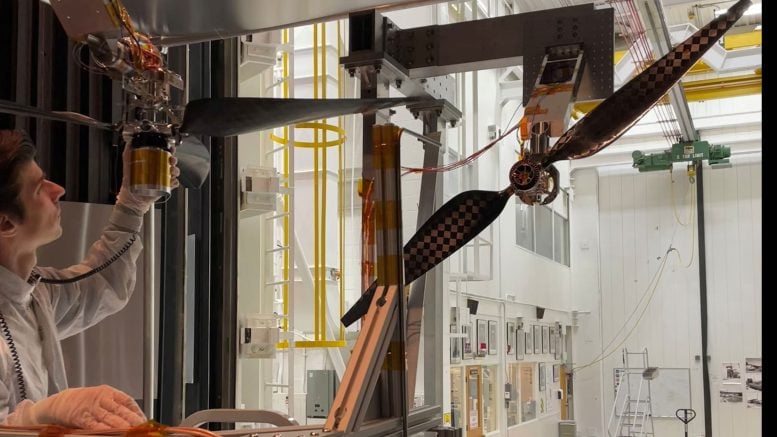
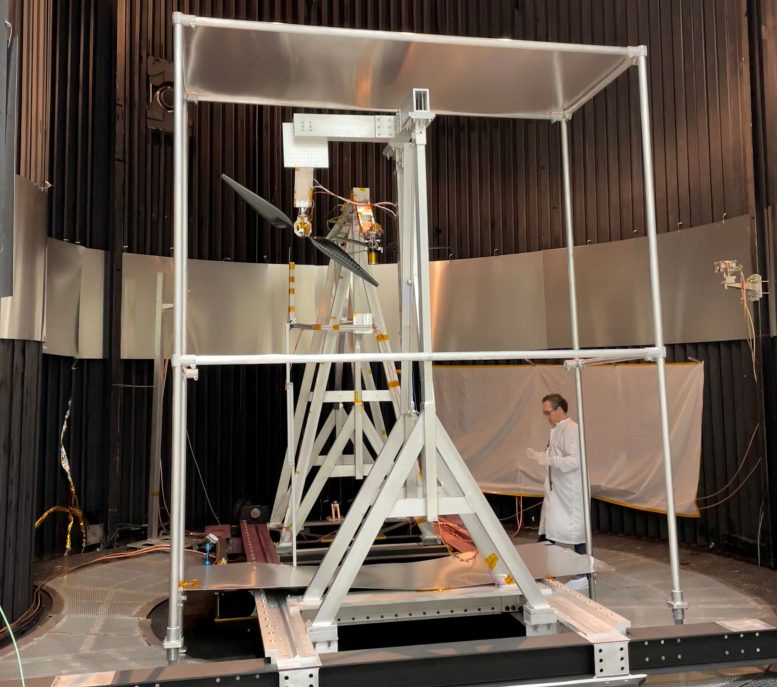
To test the new rotor systems, Karras and his team used a three-bladed rotor built by AeroVironment of Simi Valley, California. The rotor was mounted inside JPL’s historic 25-Foot Space Simulator, a chamber capable of recreating the Martian atmosphere. Engineers removed the air inside the chamber and replaced it with carbon dioxide at pressure levels similar to those found on Mars. The rotor was then exposed to increasing wind speeds while spinning faster and faster.
By pushing rotors beyond the speed of sound during recent testing at NASA’s Jet Propulsion Laboratory, engineers are unlocking new possibilities for low-altitude aerial exploration of Mars. Credit: NASA/JPL-Caltech
As a safety measure, parts of the chamber were lined with sheet metal in case the blades shattered during testing. From a nearby control room, engineers monitored live data and video feeds as the rotor speed climbed to 3,750 rpm. At that point, the blade tips were traveling at Mach 0.98. Engineers then introduced strong headwinds into the chamber, increasing the wind speed after each test run.
Eventually, the rotor tips reached Mach 1.08, increasing the aircraft’s lifting capability by 30%. The improvement could allow future Mars helicopters to carry larger scientific payloads, more advanced sensors, and bigger batteries for longer flights.
The team also tested a two-bladed rotor designed for the SkyFall mission concept. Because the blades are slightly longer than the three-bladed design, the rotor only needed to reach 3,570 rpm to achieve similar near-supersonic tip speeds before headwinds were introduced.
SkyFall Helicopters Could Carry Heavier Science Payloads
“The successful testing of these rotors was a major step toward proving the feasibility of flight in more demanding environments, which is key for next-gen vehicles,” said Shannah Withrow-Maser, an aerodynamicist from NASA’s Ames Research Center in Silicon Valley and member of the test team. “We thought we’d be lucky to hit Mach 1.05, and we reached Mach 1.08 on our last runs. We’re still digging into the data, and there may be even more thrust on the table. These next-gen helicopters are going to be amazing.”
The SkyFall mission team has already incorporated the test results into its design requirements. Inspired by Ingenuity, which remains the only aircraft to fly on another planet, the mission is planned to deliver three next-generation Mars helicopters to the Red Planet in December 2028.
The faster-than-sound spin test campaign was funded by the agency’s Mars Exploration Program in pursuit of maximizing the capability of future aircraft flying at the Red Planet.
Never miss a breakthrough: Join the SciTechDaily newsletter.
Follow us on Google and Google News.