
Ingenuity, NASA’s Mars Helicopter, surpassed expectations as the first aircraft to operate on another planet.
Despite being designed for five test flights over 30 days, it completed 72 flights across three years, demonstrating exceptional resilience. Its last mission ended due to navigation errors caused by a featureless terrain, leading to severe rotor damage. Lessons from this historic feat are already informing future Mars exploration technologies, including a new, larger rotorcraft concept capable of autonomous exploration.
Pioneering Ingenuity: Mars Helicopter’s Legacy
Engineers from NASA’s Jet Propulsion Laboratory (JPL) in Southern California and AeroVironment are finalizing their analysis of the Ingenuity Mars Helicopter’s final flight, which took place on January 18, 2024. The findings will be published in a NASA technical report in the coming weeks. Originally designed as a technology demonstration to conduct up to five test flights over 30 days, Ingenuity became the first aircraft to fly on another planet. Over nearly three years, it completed 72 flights, covering distances over 30 times its original goal and logging more than two hours of total flight time.
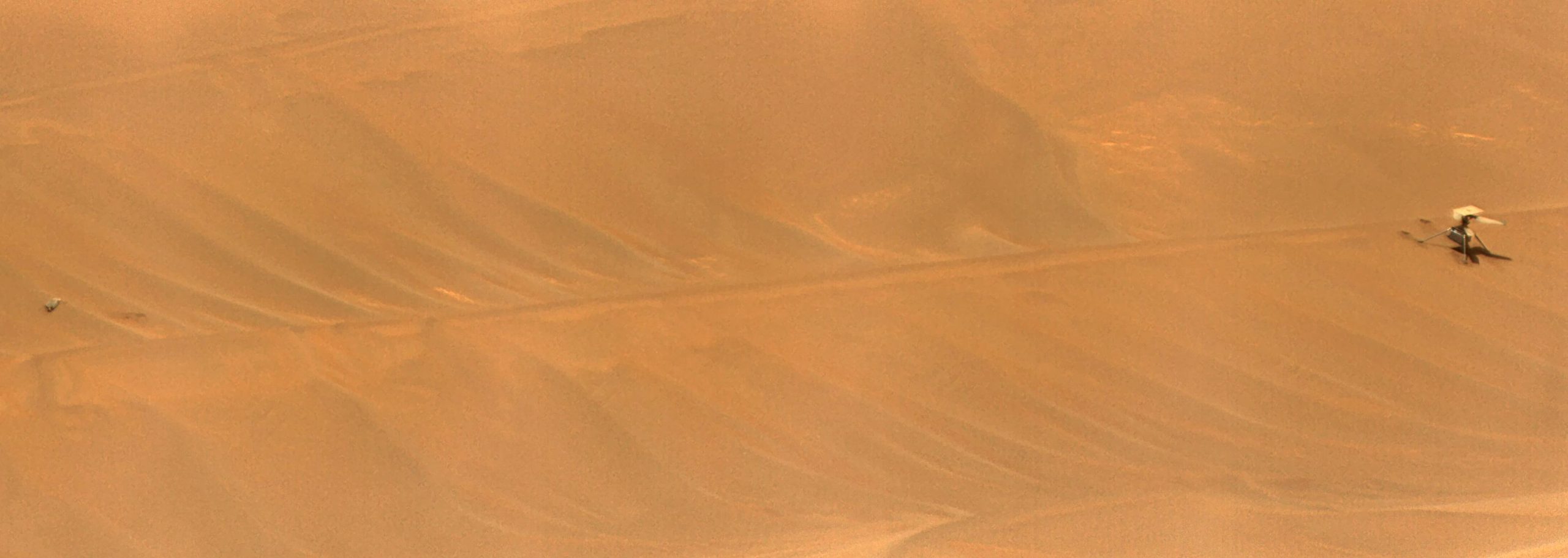
Preliminary findings suggest that navigation system errors, caused by insufficient surface data during the flight, triggered a series of events that ultimately ended Ingenuity’s mission. Insights from the investigation are expected to inform the design of future Mars helicopters and other planetary aircraft, advancing exploration beyond Earth.
NASA’s Ingenuity Mars Helicopter used its black-and-white navigation camera to capture this video on February 11, 2024, showing the shadow of its rotor blades. The imagery confirmed damage had occurred during Flight 72. Credit: NASA/JPL-Caltech
Final Ascent: Ingenuity’s 72nd Flight
Flight 72 was planned as a brief vertical hop to assess Ingenuity’s flight systems and photograph the area. Data from the flight shows Ingenuity climbing to 40 feet (12 meters), hovering, and capturing images. It initiated its descent at 19 seconds, and by 32 seconds the helicopter was back on the surface and had halted communications. The following day, the mission reestablished communications, and images that came down six days after the flight revealed Ingenuity had sustained severe damage to its rotor blades.
What Went Wrong: Analysis of the Incident
“When running an accident investigation from 100 million miles away, you don’t have any black boxes or eyewitnesses,” said Ingenuity’s first pilot, Håvard Grip of JPL. “While multiple scenarios are viable with the available data, we have one we believe is most likely: Lack of surface texture gave the navigation system too little information to work with.”
The helicopter’s vision navigation system was designed to track visual features on the surface using a downward-looking camera over well-textured (pebbly) but flat terrain. This limited tracking capability was more than sufficient for carrying out Ingenuity’s first five flights, but by Flight 72 the helicopter was in a region of Jezero Crater filled with steep, relatively featureless sand ripples.
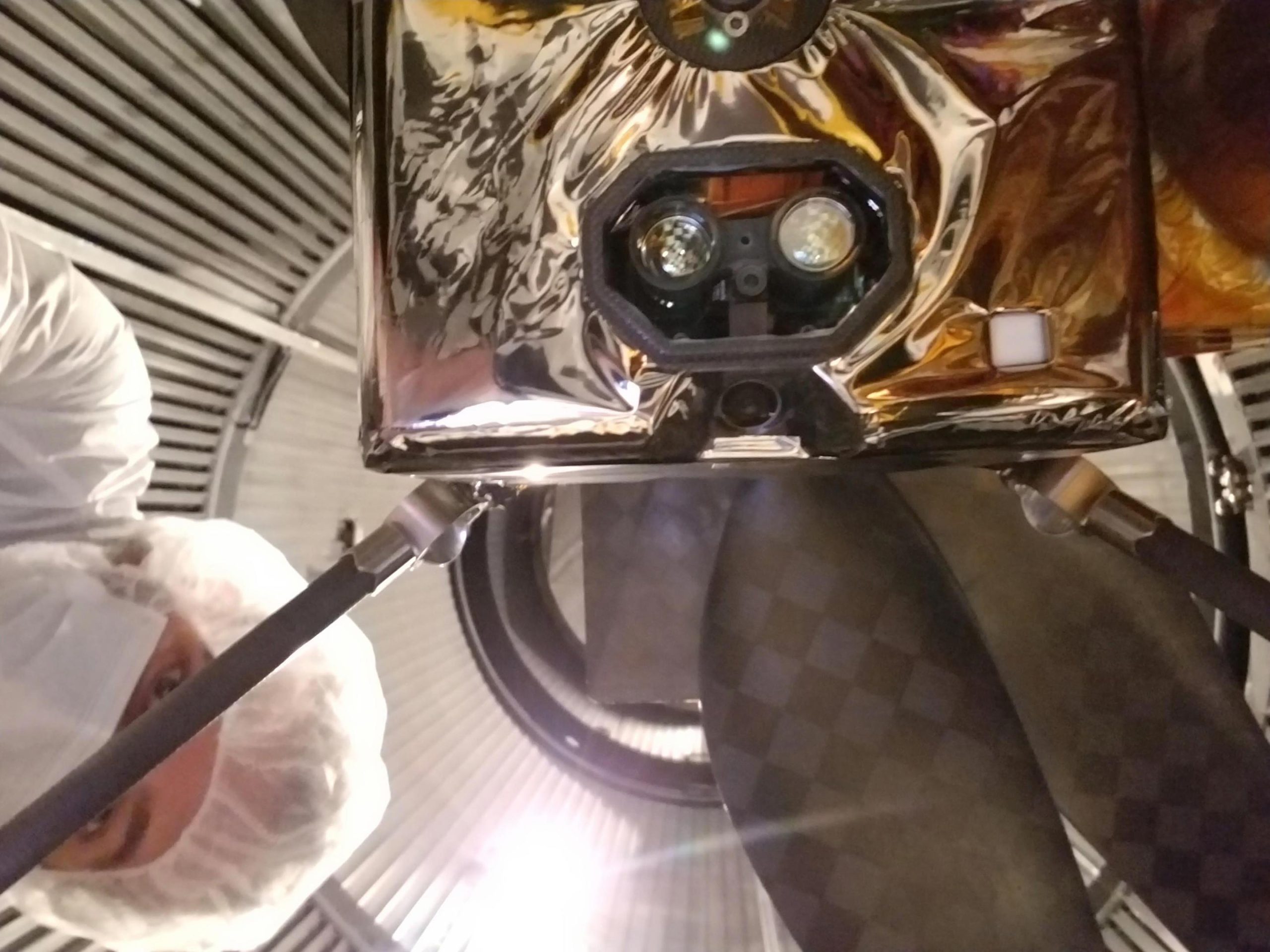
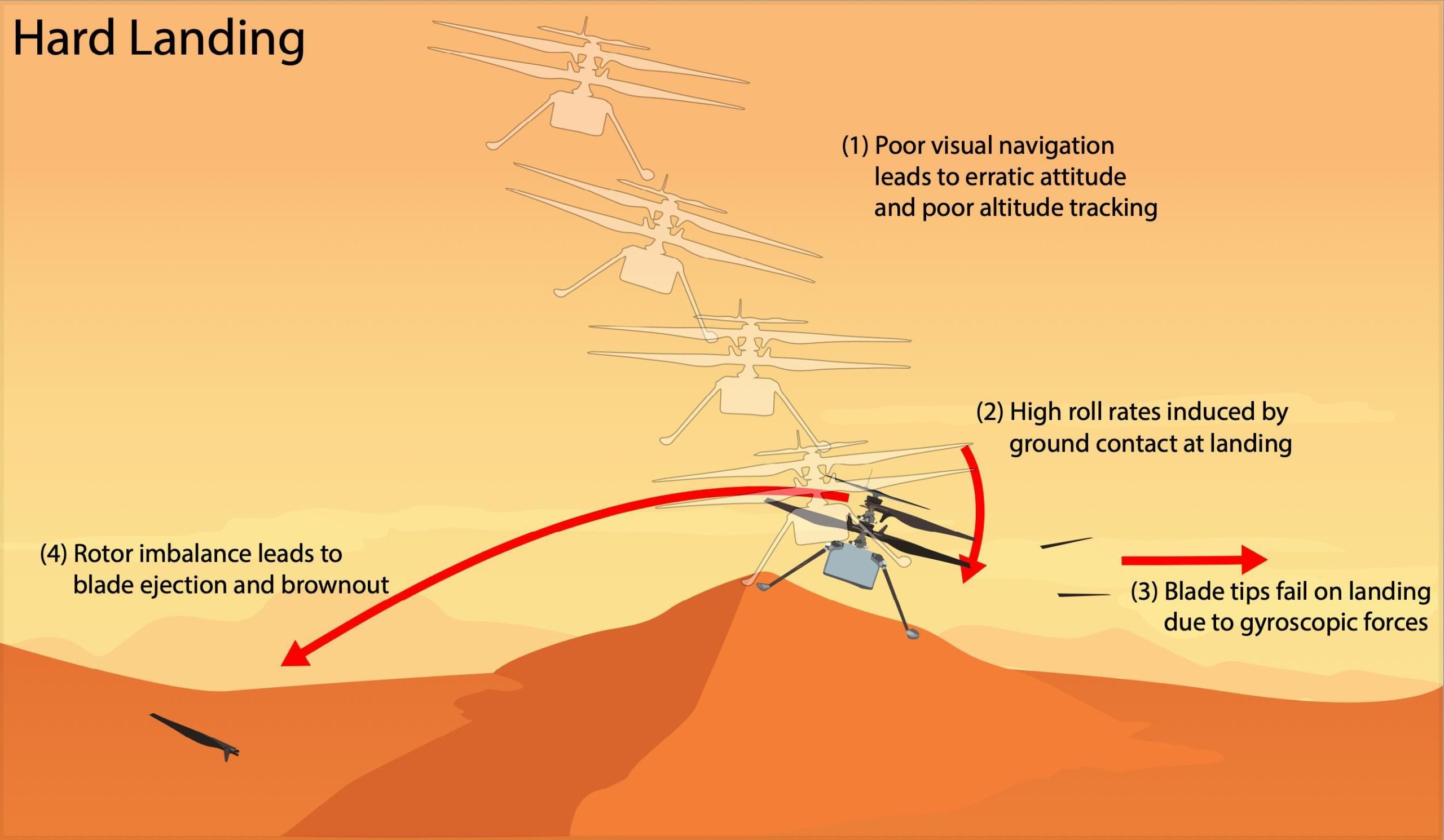
One of the navigation system’s main requirements was to provide velocity estimates that would enable the helicopter to land within a small envelope of vertical and horizontal velocities. Data sent down during Flight 72 shows that, around 20 seconds after takeoff, the navigation system couldn’t find enough surface features to track.
Photographs taken after the flight indicate the navigation errors created high horizontal velocities at touchdown. In the most likely scenario, the hard impact on the sand ripple’s slope caused Ingenuity to pitch and roll. The rapid attitude change resulted in loads on the fast-rotating rotor blades beyond their design limits, snapping all four of them off at their weakest point — about a third of the way from the tip. The damaged blades caused excessive vibration in the rotor system, ripping the remainder of one blade from its root and generating an excessive power demand that resulted in loss of communications.

Down but Not Out: Ingenuity’s Ongoing Contributions
Although Flight 72 permanently grounded Ingenuity, the helicopter still beams weather and avionics test data to the Perseverance rover about once a week. The weather information could benefit future explorers of the Red Planet. The avionics data is already proving useful to engineers working on future designs of aircraft and other vehicles for the Red Planet.
“Because Ingenuity was designed to be affordable while demanding huge amounts of computer power, we became the first mission to fly commercial off-the-shelf cellphone processors in deep space,” said Teddy Tzanetos, Ingenuity’s project manager. “We’re now approaching four years of continuous operations, suggesting that not everything needs to be bigger, heavier, and radiation-hardened to work in the harsh Martian environment.”
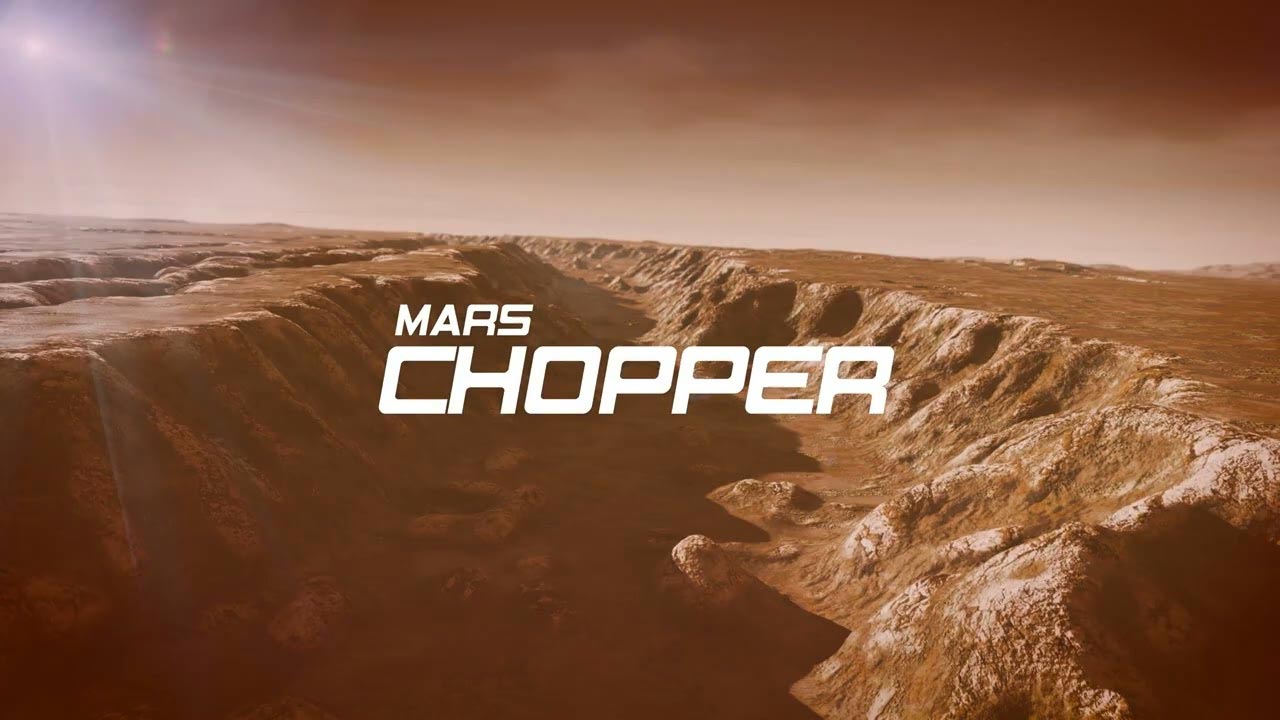
This short animation depicts a NASA concept for a proposed follow-on to the agency’s Ingenuity Mars Helicopter called Mars Chopper, which remains in early conceptual and design stages. In addition to scouting, such a helicopter could carry science instruments to study terrain rovers can’t reach. Credit: NASA/JPL-Caltech
Looking Ahead: Future Mars Rotorcraft
Inspired by Ingenuity’s longevity, NASA engineers have been testing smaller, lighter avionics that could be used in vehicle designs for the Mars Sample Return campaign. The data is also helping engineers as they research what a future Mars helicopter could look like — and do.
Credit: NASA/JPL-Caltech
During a Wednesday, December 11, briefing at the American Geophysical Union’s annual meeting in Washington, Tzanetos shared details on the Mars Chopper rotorcraft, a concept that he and other Ingenuity alumni are researching. As designed, Chopper is approximately 20 times heavier than Ingenuity, could fly several pounds of science equipment, and autonomously explore remote Martian locations while traveling up to 2 miles (3 kilometers) in a day. (Ingenuity’s longest flight was 2,310 feet, or 704 meters.)
“Ingenuity has given us the confidence and data to envision the future of flight at Mars,” said Tzanetos.
More About Ingenuity
The Ingenuity Mars Helicopter is a groundbreaking aerial vehicle developed by NASA’s Jet Propulsion Laboratory (JPL), which also manages the project for NASA Headquarters. Built as a technology demonstration, it became the first aircraft to achieve powered flight on another planet. The project is supported by NASA’s Science Mission Directorate, with significant contributions from NASA’s Ames Research Center in California and Langley Research Center in Virginia, which provided vital flight performance analysis and technical expertise.
Ingenuity’s development involved collaborations with industry partners, including AeroVironment, Qualcomm, and SolAero, which contributed to the design and key components. The Mars Helicopter Delivery System was designed and built by Lockheed Space. Dave Lavery serves as the program executive for Ingenuity at NASA Headquarters, overseeing this historic mission that has paved the way for future exploration of other worlds.
Never miss a breakthrough: Join the SciTechDaily newsletter.
Follow us on Google and Google News.
1 Comment
After Chopper is found, a member of the Martian Committee considers that the Earthlings do everything in sixes.
The hexagonal symmetries of chassis and rotors should increase stability and by delocalizing counterrotation it could increase load capability. I suspect that in denser atmospheres a more massive intermeshing counter-rotator design would increase airflow efficiency though.