
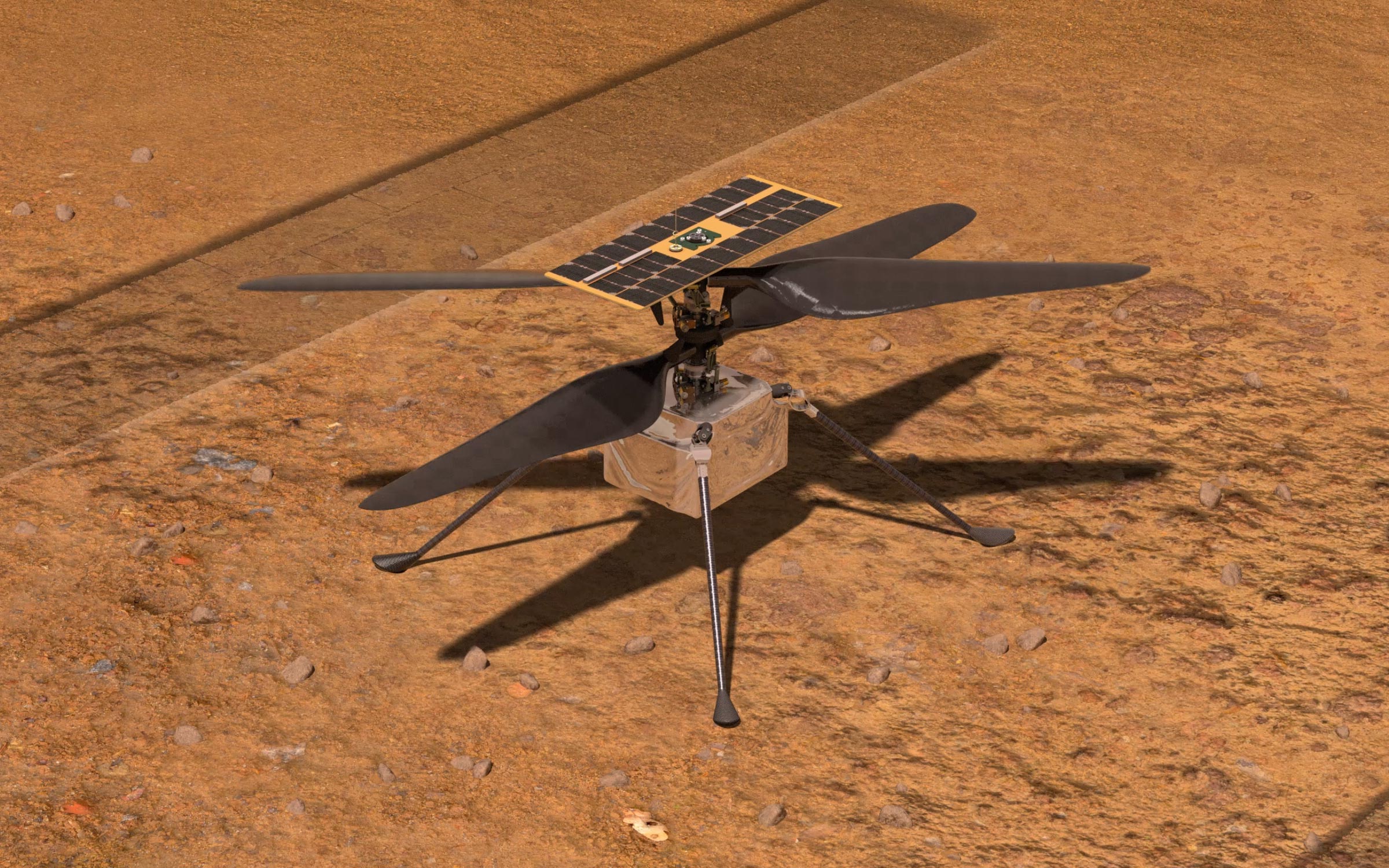
The Mars Helicopter, Ingenuity, is a technology experiment that achieved the first powered, controlled flight on the Red Planet. It rode to Mars in the belly of the Perseverance Rover, which dropped it to the planet’s surface after finding a suitable airfield.
It’s been enormously successful, and NASA extended its mission in March. However, it is also facing its challenges from the harsh conditions on Mars and the fact that it has been in operation far longer and flown many more flights than expected. Now it has a new challenge to overcome – one of its navigation sensors has stopped functioning.
As the season has turned to winter in Jezero Crater, conditions have become increasingly challenging for Ingenuity, which was designed for a short flight-test campaign during the much warmer Martian spring. Increased amounts of dust in the atmosphere, combined with lower daytime temperatures and shorter days, have impacted Ingenuity’s energy budget to the point where it is unable to keep itself warm throughout the Martian nights.
In its new winter operations paradigm, Ingenuity is effectively shutting down during the night, letting its internal temperature drop to about minus 112 degrees Fahrenheit (minus 80 degrees Celsius) and letting the onboard electronics reset. This new way of operating carries with it risks to Ingenuity’s electronic components, many of which are not designed to survive the temperatures they are being exposed to at night. Moreover, extreme temperature cycles between daytime and nighttime tend to cause stresses that can result in component failure.
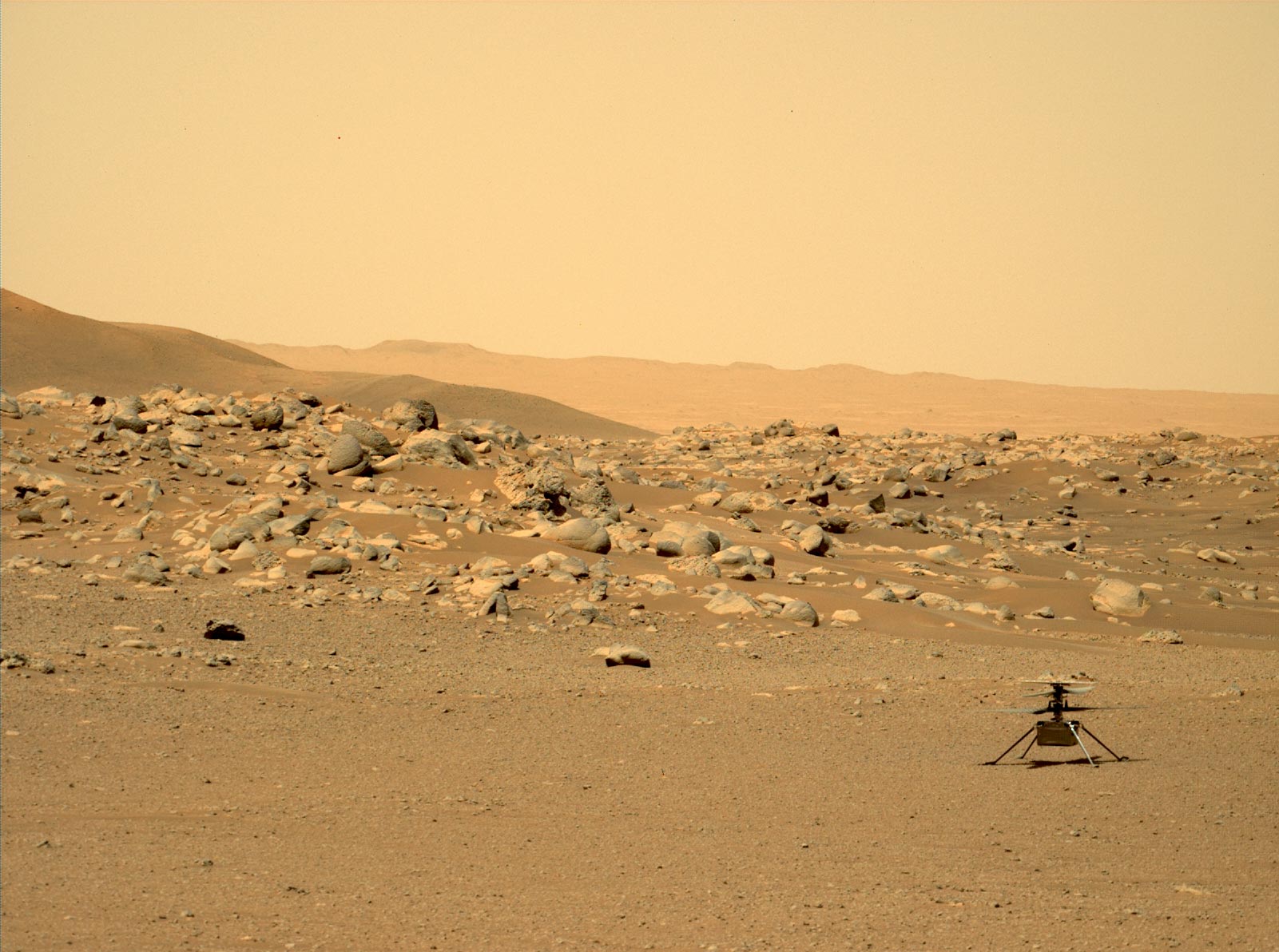
Over the past several sols on Mars, the Ingenuity team has been busy recommissioning the helicopter for flight, going through a series of activities that include preflight checkout of sensors and actuators and a high-speed spin of the rotor. These activities have revealed that one of the helicopter’s navigation sensors, called the inclinometer, has stopped functioning. A nonworking navigation sensor sounds like a big deal – and it is – but it’s not necessarily an end to our flying at Mars.
Navigation Sensors
When Ingenuity is flying, the onboard flight control system keeps close track of the helicopter’s current position, velocity, and orientation. It does so with the help of a sensor suite consisting of:
- an inertial measurement unit (IMU), which measures accelerations and angular rates in three directions
- a laser rangefinder, which measures the distance to the ground
- a navigation camera, which takes pictures of the ground below
The data from these sensors is processed by a set of algorithms implemented on Ingenuity’s navigation computer. For the algorithms to function properly, they must be initialized prior to takeoff with an estimate of Ingenuity’s roll and pitch attitude. This is where the inclinometer comes in.
The inclinometer consists of two accelerometers, whose sole purpose is to measure gravity prior to spin-up and takeoff; the direction of the sensed gravity is used to determine how Ingenuity is oriented relative to the downward direction. The inclinometer is not used during the flight itself, but without it we are forced to find a new way to initialize the navigation algorithms prior to takeoff.
Impersonating the Inclinometer
Ingenuity’s sensor suite provides some redundancy when it comes to sensing attitude on the ground. The IMU contains accelerometers, which – just like the accelerometers within the inclinometer – can be used to estimate the initial attitude. Unlike the inclinometer, the IMU is not purpose-built for sensing static orientation, so its initial attitude estimates will generally be somewhat less accurate. However, we believe an IMU-based initial attitude estimate will allow us to take off safely and thus provides an acceptable fallback that will allow Ingenuity to resume flying.
Taking advantage of this redundancy requires a patch to Ingenuity’s flight software. The patch inserts a small code snippet into the software running on Ingenuity’s flight computer, intercepting incoming garbage packets from the inclinometer and injecting replacement packets constructed from IMU data. To the navigation algorithms, everything will look as before, the only difference being that the received inclinometer packets do not actually originate from the inclinometer.
Anticipating that this situation could potentially arise, we prepared the required software patch prior to last year’s arrival on Mars and kept it on the shelf for this eventuality. We are therefore able to move quickly with the update, and the process of uplinking it to Ingenuity is already underway.
Returning to Service
If all goes well, over the next few sols, the team expects to finalize uplinking and applying the software patch, which will be followed by commissioning activities to ensure the new software is operating as planned. Barring additional surprises, we anticipate that Ingenuity will take to the skies for Flight 29 – a repositioning move to the southwest designed to keep us within communication range of Perseverance – in the near future.
Written by Håvard Grip, Ingenuity Mars Helicopter Chief Pilot at NASA’s Jet Propulsion Laboratory.
Never miss a breakthrough: Join the SciTechDaily newsletter.
Follow us on Google and Google News.
2 Comments
This is a good and wise decision to fly mars helicopter Ingenuity with a dead sensor.By this act the sole nature of planet mars,reflected on an earthly object flowing in martin air with own technology can be regulated.This is due as our science has not yet advanced so much to escape the failure of machine at som future point.
… it might be powered by _____ …