
Close Menu
    Facebook X (Twitter) Instagram
    SciTechDaily
    • Biology
    • Chemistry
    • Earth
    • Health
    • Physics
    • Science
    • Space
    • Technology
    Facebook X (Twitter) Pinterest YouTube RSS
    SciTechDaily
    Home»Biology»Tiny Genetic Change Turns Female Mice Into Males, Scientists Discover
    Biology

    Tiny Genetic Change Turns Female Mice Into Males, Scientists Discover

    By Bar-Ilan UniversityJune 7, 2026No Comments4 Mins Read
    Facebook Twitter Pinterest Telegram LinkedIn WhatsApp Email Reddit
    Share
    Facebook Twitter LinkedIn Pinterest Telegram Email Reddit
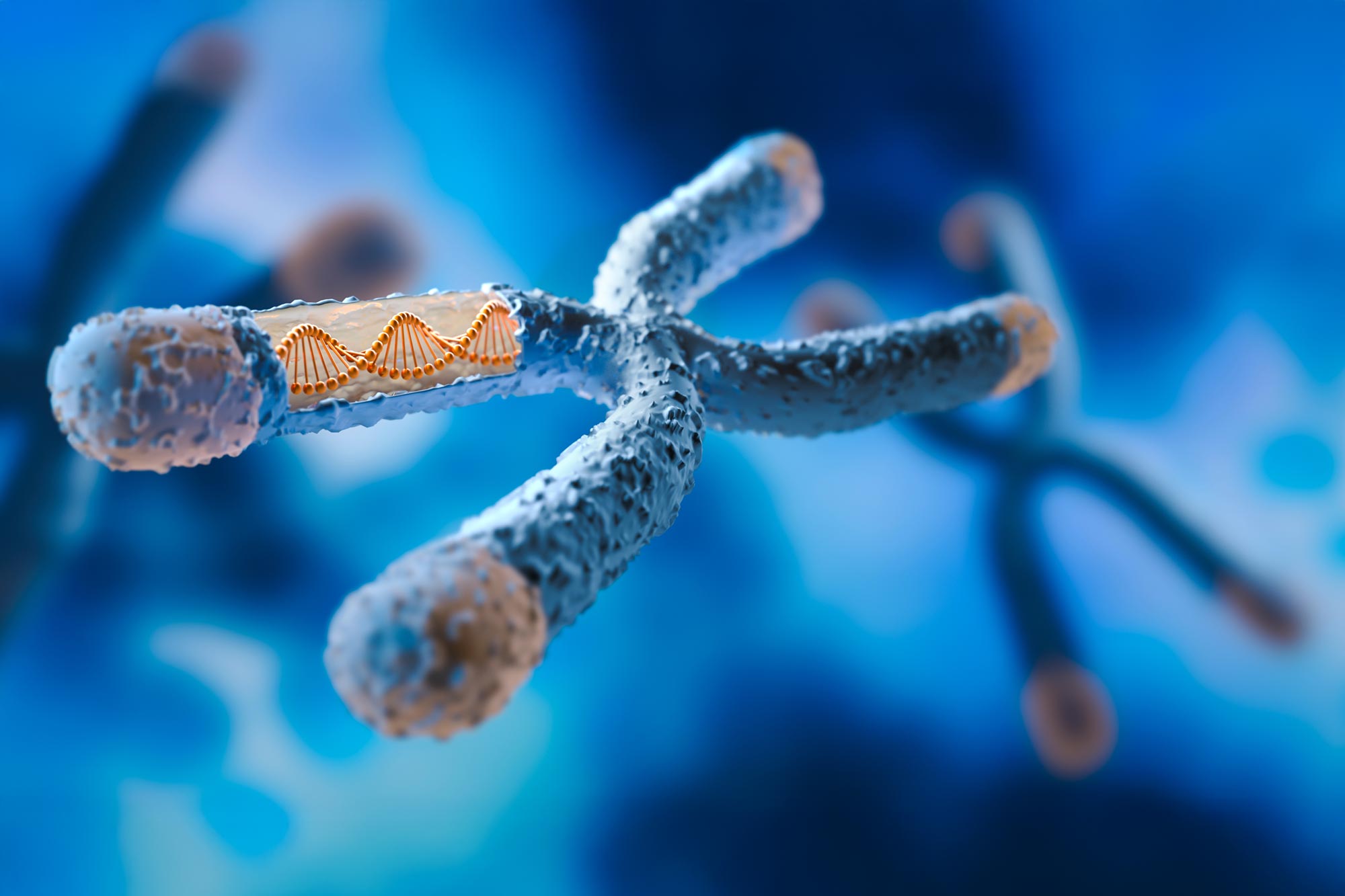
    X Chromosome DNA Strand
    One DNA-letter change in non-coding DNA caused female mice to develop as males, revealing how regulatory DNA can profoundly influence sex development and disease. Credit: Shutterstock

    A new study reveals that an extremely small change in a non-coding region of DNA can dramatically alter how sex develops in mice.

    How much can a single letter of DNA matter? According to new research from Bar-Ilan University, one misplaced genetic “letter” can completely change the course of sexual development. In a study published in Nature Communications, researchers showed that adding just one DNA base to a regulatory region caused XX mice, which normally develop as females, to instead develop testes and male reproductive anatomy.

    Remarkably, the mutation was not located within a gene. It occurred in non-coding DNA, a vast portion of the genome once dismissed as “junk” but now recognized as a critical control system for gene activity. The results demonstrate how subtle changes in these regulatory sequences can have profound biological effects.

    “This is a remarkable finding because such a tiny change — just one DNA letter out of ~2.8 billion — was enough to produce a dramatic developmental outcome,” said Dr. Nitzan Gonen, from the Goodman Faculty of Life Sciences and Institute of Nanotechnology and Advanced Materials at Bar-Ilan University. “It shows that non-coding DNA can have a profound effect on development and disease.”
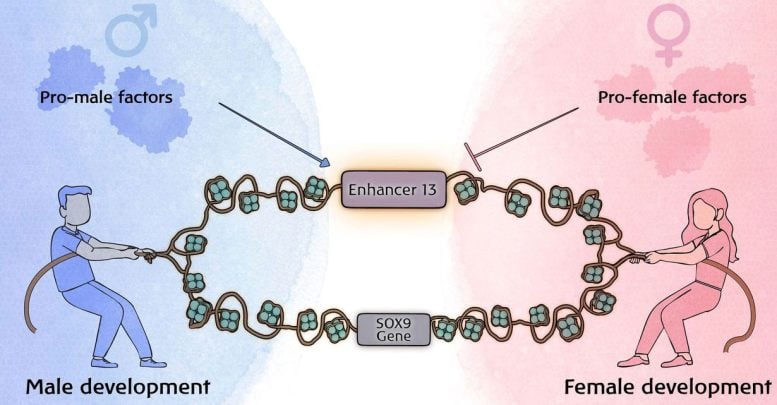
    Enh13 Regulatory Region Alongside the Sox9 Gene as a Battle Site
    The figure depicts the Enh13 regulatory region alongside the Sox9 gene as a “battle site” between the sexes. Pro-female factors act to repress Sox9 via binding to Enh13, while pro-male factors activate it. The balance between these opposing forces ultimately determines whether male or female development occurs. Credit: Neta Varsano

    Enh13 Controls the Critical Sox9 Development Switch

    The mutation was introduced into a regulatory element called Enh13, which controls the activity of Sox9, a gene required for testis development. For ovaries to form normally, Sox9 must remain inactive. The researchers found that Enh13 functions as a molecular switch. In males, factors that promote testis formation bind to Enh13 and activate Sox9. In females, factors that support ovary development bind to the same region and suppress the gene.

    Nitzan Gonen
    Dr. Nitzan Gonen, Goodman Faculty of Life Sciences and Institute of Nanotechnology and Advanced Materials, Bar-Ilan University. Credit: Courtesy Bar-Ilan University

    Using CRISPR genome editing, the team introduced the mutation and found that this female-specific repression no longer worked. As a result, Sox9 became active in XX mice, triggering testis formation and complete internal and external male development.

    The researchers also generated several mouse models carrying very small changes in Enh13, including a one-base pair insertion and a three-base pair deletion. Both mutations caused XX mice to develop testes. Cell line reporter assays were then used to investigate how these alterations disrupted the normal regulatory process.

    Dual Role of Enh13 Revealed in Sex Determination

    The findings build on earlier research from the same group published in 2024. That study showed that other small mutations in Enh13 could produce the opposite outcome, causing XY mice to develop as females. Together, the results indicate that Enh13 serves two functions: it promotes male development while also needing to be suppressed during female development.

    Beyond advancing basic biological knowledge, the research may have implications for people with Differences of Sex Development (DSD), a group of conditions affecting about 1 in 4,000 births worldwide. More than half of DSD cases still remain genetically unexplained, even after sequencing the protein-coding regions of the genome.

    “Our findings show that it is not enough to look only at genes,” said Elisheva Abberbock, the PhD student leading the research. “Important disease-causing mutations may also lie in the non-coding genome, in DNA regions that control gene activity rather than encode proteins.”

    The researchers believe Enh13 is likely only one example of many regulatory regions within non-coding DNA that influence sex determination and other developmental disorders. They are now working to systematically identify additional regions and test their biological functions.

    Reference: “A single-nucleotide enhancer mutation overrides chromosomal sex to drive XX male development” by Elisheva Abberbock, Meshi Ridnik, Isabelle Stévant, Roni Weiss, Carmel Bamberger, Shelly Ziv Lhermann, Maor Lubman, Yumi Minyi Yao, Ariel Afek, Francis Poulat and Nitzan Gonen, 9 April 2026, Nature Communications.
    DOI: 10.1038/s41467-026-71328-9

    Never miss a breakthrough: Join the SciTechDaily newsletter.
    Follow us on Google and Google News.

    Bar-Ilan University CRISPR DNA Genetics Molecular Biology
    Share. Facebook Twitter Pinterest LinkedIn Email Reddit

    Related Articles

    CRISPR-LICHT: A Groundbreaking New Genetic Screening Tool for Human Organoids

    Powerful DNA Manipulation: Improved Gene Editing With New Understanding of CRISPR-Cas9 Tool

    New Tool for Rapidly Analyzing CRISPR Edits Reveals Frequent Unintended DNA Changes

    Re-Cracking the Genetic Code – We May Have Only Begun to Scratch the Surface

    First Direct Evidence That Fragile X Syndrome Neurons Can Be Restored

    Harvard Study Identifies Genetic ‘Switches’ That Affect Height

    Bioengineers Develop a New System for Human Genome Editing

    Key Differences in Seemingly Synonymous Parts of the Genetic Code

    Sequencing DNA From Individual Cells Yields Dramatic New Information

    Leave A Reply Cancel Reply

    • Facebook
    • Twitter
    • Pinterest
    • YouTube

    Don't Miss a Discovery

    Subscribe for the Latest in Science & Tech!

    Trending News

    Scientists Finally Uncover How a “Forever Chemical” Causes Birth Defects

    Scientists Uncover the Earliest Brain Changes That May Predict Alzheimer’s Decades Before Symptoms

    Surprising New Study Challenges a Century-Old Theory of Habit Formation

    Scientists Turn Seawater Into Drinking Water Without Toxic Brine

    Vitamin D Drug Shows Surprising Promise Against One of the Deadliest Cancers

    NASA’s X-59 Sonic Boom Killer Is Ready for Its Biggest Test Yet

    The Best Exercise Combination for Longevity, According to a 30-Year Study

    Popular Weight-Loss Drug Found To Slow Biological Aging in Landmark Human Trial

    Follow SciTechDaily
    • Facebook
    • Twitter
    • YouTube
    • Pinterest
    • Newsletter
    • RSS
    SciTech News
    • Biology News
    • Chemistry News
    • Earth News
    • Health News
    • Physics News
    • Science News
    • Space News
    • Technology News
    Recent Posts
    • Tiny Genetic Change Turns Female Mice Into Males, Scientists Discover
    • Scientists Discover Strange New Spider Species That Disguises Itself as a Fungus
    • This Simple Drink Could Help Calm the Inflammation Behind Many Diseases
    • Doctors May Be Overlooking the Real Cause of Persistent Arthritis Pain
    • According to Scientists, This Simple Dietary Change Is Linked to Lower Depression Scores
    Copyright © 1998 - 2026 SciTechDaily. All Rights Reserved.
    • Science News
    • About
    • Contact
    • Editorial Board
    • Privacy Policy
    • Terms of Use

    Type above and press Enter to search. Press Esc to cancel.