

Scientists have finally captured a hidden state of matter, revealing a long-predicted phase with intriguing quantum potential.
Researchers from Brown University and the University of Michigan College of Engineering have succeeded in stabilizing a previously elusive state of matter that had existed only in theoretical models.
Using carefully engineered nanoparticles as building blocks, the team created a new material structure that locks in a fleeting intermediate state between two of the most common crystal arrangements found in metals. The achievement not only provides new insight into how materials change their internal structure, but also reveals unusual optical properties that could one day prove useful for quantum computing and other quantum information technologies.
The findings were published in the journal Science.
More broadly, the work demonstrates a powerful new strategy for designing materials from custom-made nanoparticles, opening possibilities for creating entirely new materials with tailored characteristics.
“Our work is a little bit like kids playing with LEGO blocks,” said Ou Chen, an associate professor of chemistry at Brown and a corresponding author of the research. “We synthesize unique nanoscale building blocks and stack them into interesting structures. In this case, we were able to stabilize these theorized transitional structures and demonstrate important quantum optical properties.”
Capturing a Long-Predicted Crystal Transition
Many metals naturally organize their atoms into one of two crystal structures: face-centered cubic (FCC) or body-centered cubic (BCC).
In an FCC arrangement, particles are packed as tightly as possible. Each cube contains particles at its corners and at the center of every face. In a BCC arrangement, particles occupy the cube’s corners and a single position at the cube’s center. These patterns are among the most common atomic arrangements found in metallic materials.
Some metals can switch between these structures when heated. Iron, for example, changes from BCC to FCC at 912 degrees Celsius. Scientists have proposed several possible mechanisms for how these transformations occur.
One of the best-known explanations is called the Nishiyama-Wassermann pathway. This model predicts a series of temporary intermediate structures that appear as a material shifts from FCC to BCC. Because these transition states are inherently unstable, they have been extremely difficult to observe directly.
The new study successfully recreated those elusive intermediate phases using specially designed silver nanoparticles.
“Materials scientists have cared about how to control the amount of FCC and BCC in their metals for a long time, but the transitions between these phases have been hard to study because they are so unstable,” said Tim Moore, a study co-author and an assistant research scientist working in Sharon Glotzer’s lab at the University of Michigan. “Being able to observe these structures is a fundamental breakthrough in materials science, and it gives us greater control over nanomaterial engineering.”
Building New Materials From Custom Nanoparticles
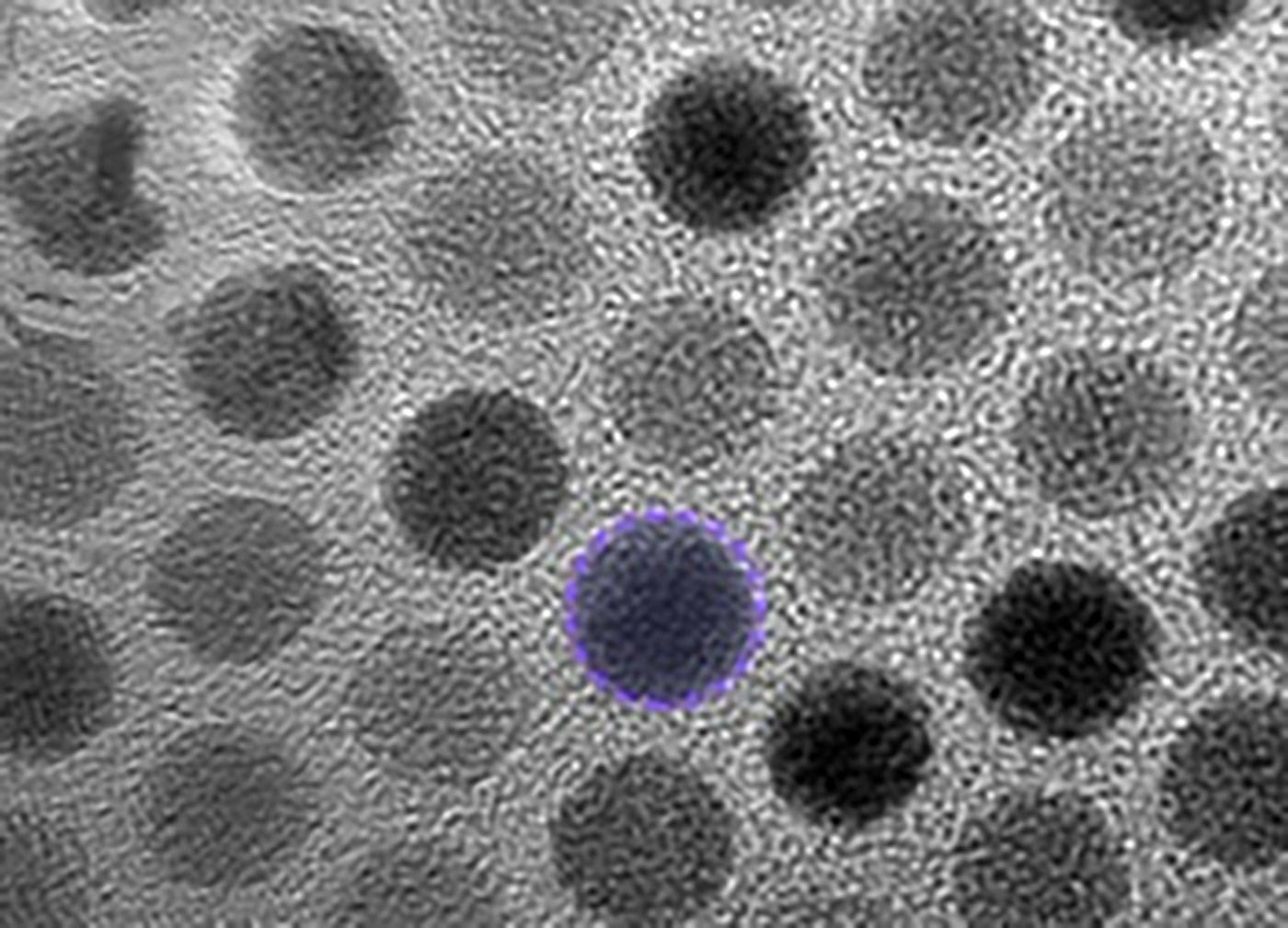
To create the material, Chen and his colleagues synthesized silver nanoparticles known as “mecons.” These particles resemble truncated octahedra, a shape that can be thought of as a diamond-like form with its corners cut off, producing a 14-sided structure.
According to Chen, the shape is particularly useful because it sits between a sphere and a cube, two forms that pack together in very different ways.
By adjusting the temperature during synthesis, the researchers produced mecons spanning a range of shapes from more rounded to more cube-like. The particles were then coated with long molecular chains that acted as sticky connectors, helping them bind together during self-assembly.
The team allowed particles of different shapes to organize themselves into nanoparticle superlattices and then examined the resulting structures.
Combining experimental observations with detailed computer simulations, the researchers found that the sticky molecular coatings played a crucial role. They enabled the particles to arrange themselves into the same transitional structures predicted by the Nishiyama-Wassermann model.
The simulations and modeling work were carried out in collaboration with researchers led by Sharon Glotzer at the University of Michigan.
“You can kind of picture them like hairy particles,” said Moore. “The hairs are flexible enough that the particles have more freedom to shift, but they also fit together nicely, which allows the particles to mesh together.”
Unexpected Quantum Optical Behavior
The newly created silver nanoparticle superlattices displayed another surprising characteristic.
When illuminated with light, the structures exhibited signatures of deep-strong light-matter coupling, a phenomenon in which electrons inside the silver nanoparticles oscillate in sync with light waves and become quantum mechanically entangled.
These types of quantum optical effects are often observed only at very low temperatures. In contrast, the newly developed material appears to exhibit this behavior at room temperature.
That capability could make the structure a valuable model for developing future materials used in quantum computing, sensing technologies, and other quantum information applications.
“Anytime you’re able to identify a new phase of matter, new applications are going to emerge,” Chen said.
Reference: “Stabilizing in-transition phases of superlattices through shape control of silver nanocrystals” by Yasutaka Nagaoka, Timothy C. Moore, Arseniy Epishin, Zhenyang Liu, Tong Cai, Na Jin, Ken Seungmin Hong, Peter Saghy, Ankai Wang, Yuzi Liu, Sooyeon Hwang, Yusong Bai, Shengli Zou, Ruipeng Li, Stephanie Reich, Sharon C. Glotzer and Ou Chen, 28 May 2026, Science.
DOI: 10.1126/science.ady6472
The research was supported by multiple grants from the National Science Foundation (DMR-1943930, CHE-2203700, EAR−2223273, CBET-2230729, CBET-2230891, 2243104, DMR 140129, 2138259, 2138286, 2138307, 2137603, 2138296) and the Department of Energy (DE-SC0012704, DOE-NNSA, DE-NA-0003975).
Never miss a breakthrough: Join the SciTechDaily newsletter.
Follow us on Google and Google News.
5 Comments
good thanks
Love what you’re leatning and sharing
That’s nice.
Another example of a recurring theme in physics: the particles were known, the energy was known, the mathematics predicted the state, yet the effect remained hidden until the correct coherent structure was created.
That observation is one reason I developed LLF (LaMarche Linear Factor). My suspicion is that many unresolved problems may not be waiting for new particles or new forces, but for a better understanding of how coherence, resonance, and organization alter the behavior of otherwise familiar systems.
Sometimes the missing ingredient is not energy. It’s structure.