
Close Menu
    Facebook X (Twitter) Instagram
    SciTechDaily
    • Biology
    • Chemistry
    • Earth
    • Health
    • Physics
    • Science
    • Space
    • Technology
    Facebook X (Twitter) Pinterest YouTube RSS
    SciTechDaily
    Home»Technology»Physicists Work on Nano Loudspeakers to Make Better MRIs, Quantum Computers
    Technology

    Physicists Work on Nano Loudspeakers to Make Better MRIs, Quantum Computers

    By National Institute of Standards and TechnologyJanuary 26, 2012No Comments3 Mins Read
    Facebook Twitter Pinterest Telegram LinkedIn WhatsApp Email Reddit
    Share
    Facebook Twitter LinkedIn Pinterest Telegram Email Reddit
    Amplify faint electrical signals using the motion of a nanomechanical membrane
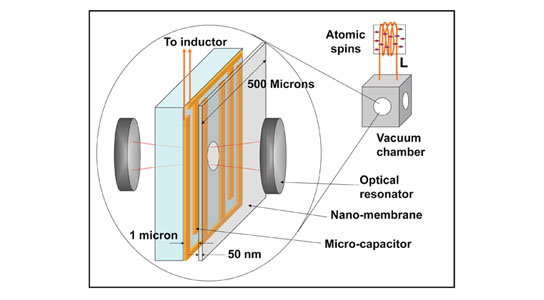
    JQI researchers think they have discovered a way to amplify faint electrical signals using the motion of a nanomechanical membrane, or loudspeaker. This schematic of the proposed device shows its use in detecting–in this example–a signal produced by the quantum-mechanical “spin” of a group of atoms. The atoms generate a faint radiofrequency signal in a coil (L) which is connected to microscale wires that form an electrical capacitor. This vibrates the ‘nanomembrane’ which in turn affects the resonant frequency of a laser optical cavity. The output is light at a frequency that is the sum of the original laser frequency plus the signal from the atoms. Credit: Taylor/NIST

    A research team of physicists is hoping to demonstrate through experiment their theory describing how to both detect weak electrical signals and cool electrical circuits using light and a nanosized loudspeaker. If proven, the team believes this technology could help make MRI medical procedures much easier and have a tremendous impact on the field of quantum information science.

    A team of physicists from the Joint Quantum Institute (JQI), the Neils Bohr Institute in Copenhagen, Denmark, and Harvard University has developed a theory describing how to both detect weak electrical signals and cool electrical circuits using light and something very like a nanosized loudspeaker. If demonstrated through experiment, the work could have a tremendous impact on detection of low-power radio signals, magnetic resonance imaging (MRI), and the developing field of quantum information science.

    The JQI is a collaborative venture of the National Institute of Standards and Technology (NIST) and the University of Maryland, College Park.

    “We envision coupling a nanomechanical membrane to an electrical circuit so that an electrical signal, even if exceedingly faint, will cause the membrane to quiver slightly as a function of the strength of that signal,” says JQI physicist Jake Taylor. “We can then bounce photons from a laser off that membrane and read the signal by measuring the modulation of the reflected light as it is shifted by the motion of the membrane. This leads to a change in the wavelength of the light.”

    Present technology for measuring the wavelength of light is highly sensitive, which makes it ideal for detecting the nanoscopic motions of the loudspeaker caused by extremely faint electrical signals.

    And the ability to detect extremely faint electrical signals may someday make MRI medical procedures much easier.

    “MRI machines are so big because they are stuffed with really powerful superconducting magnets, but if we can reduce the strength of the signals we need for a reading, we can reduce the strength, and the size, of the magnets,” Taylor says. “This may mean that one could get an MRI while sitting quietly in a room and forgo the tube.”

    The same setup could be used to generate information-carrying photons from one qubit to another, according to Taylor.

    One popular quantum information system design uses light to transfer information among qubits, entangled particles that will exploit the inherent weirdness of quantum phenomena to perform certain calculations impossible for current computers. The ‘nanospeaker’ could be used to translate low-energy signals from a quantum processor to optical photons, where they can be detected and transmitted from one qubit to another.

    All this, and the team will throw in cooling the system for free. According to their calculations, translating the mechanical motion of the little loudspeaker into photons will siphon a considerable amount of heat out of the system (from room temperature to 3 kelvin or -270 C), which in turn will reduce noise in the system and provide for better signal detection.

    Never miss a breakthrough: Join the SciTechDaily newsletter.
    Follow us on Google and Google News.

    Computers MRI Nanotechnology NIST Quantum Information Science
    Share. Facebook Twitter Pinterest LinkedIn Email Reddit

    Related Articles

    Tapping Graphene’s Hidden Potential for the Advancement of Quantum Information Science

    MIT Magnetic Wave Circuit Step Toward Highly Efficient Spintronic Computers

    New Manufacturing Method Enables Ultra-Efficient Atomic Computers That Use 100x Less Power

    Spray-on Mixture Combines Carbon Nanotubes With Ceramic

    “Silicon Nanophotonics” Integrates Optical Components With Electrical Circuits

    3D Self-Assembling Polymer Materials Could Lead to New Microchips

    Ion Crystal Set to Power Quantum Simulator

    Quantum Computers to Arrive with Single-Atom-Sized Transistors

    Using Lasers to Cool Semiconductors

    Leave A Reply Cancel Reply

    • Facebook
    • Twitter
    • Pinterest
    • YouTube

    Don't Miss a Discovery

    Subscribe for the Latest in Science & Tech!

    Trending News

    Even Occasional Binge Drinking May Triple Liver Damage Risk

    Liftoff! NASA’s Artemis II Launch Sends Astronauts Around the Moon for First Time in 50 Years

    Scientists Discover New Way To Eliminate “Zombie Cells” Driving Aging

    This New Quantum Theory Could Change Everything We Know About the Big Bang

    This One Vitamin May Help Protect Your Brain From Dementia Years Later

    Stopping Weight-Loss Drugs Like Ozempic Can Quickly Erase Heart Benefits

    A 500-Million-Year-Old Surprise Is Forcing Scientists to Rethink Spider Evolution

    Coffee and Blood Pressure: What You Need To Know Before Your Next Cup

    Follow SciTechDaily
    • Facebook
    • Twitter
    • YouTube
    • Pinterest
    • Newsletter
    • RSS
    SciTech News
    • Biology News
    • Chemistry News
    • Earth News
    • Health News
    • Physics News
    • Science News
    • Space News
    • Technology News
    Recent Posts
    • NASA’s Artemis II: Humans Just Left Earth Orbit for the First Time Since 1972
    • What Causes Chronic Pain? Scientists Identify Key Culprit in the Brain
    • Semaglutide Shows Surprising Mental Health Benefits in Massive 100,000-Person Study
    • This Little-Known Japanese Fruit Could Help Stop Lung Cancer Before It Starts
    • Scientists Uncover Giant Lava Fields From an Active Underwater Volcano
    Copyright © 1998 - 2026 SciTechDaily. All Rights Reserved.
    • Science News
    • About
    • Contact
    • Editorial Board
    • Privacy Policy
    • Terms of Use

    Type above and press Enter to search. Press Esc to cancel.