
Close Menu
    Facebook X (Twitter) Instagram
    SciTechDaily
    • Biology
    • Chemistry
    • Earth
    • Health
    • Physics
    • Science
    • Space
    • Technology
    Facebook X (Twitter) Pinterest YouTube RSS
    SciTechDaily
    Home»Technology»Spray-on Mixture Combines Carbon Nanotubes With Ceramic
    Technology

    Spray-on Mixture Combines Carbon Nanotubes With Ceramic

    By National Institute of Standards and TechnologyApril 18, 2013No Comments3 Mins Read
    Facebook Twitter Pinterest Telegram LinkedIn WhatsApp Email Reddit
    Share
    Facebook Twitter LinkedIn Pinterest Telegram Email Reddit
    Spray On Coating Combines Carbon Nanotubes with Ceramic
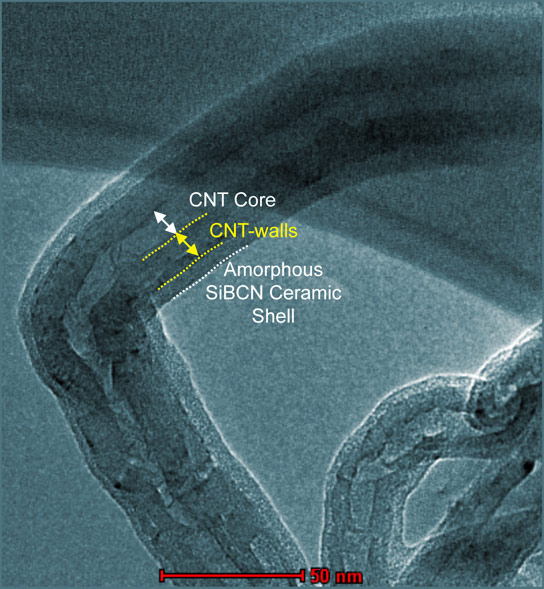
    Micrograph of one strand of a new spray-on super-nanotube composite developed by the National Institute of Standards and Technology (NIST) and Kansas State University. The multi-wall nanotube core is surrounded by a ceramic shell. The composite is a promising coating for laser power detectors. (Color added for clarity) Credit: Kansas State University

    Scientists have developed “super-nanotubes” by using a spray-on mixture that combines the optical, thermal, and electrical properties of nanotubes with the robustness of the high-temperature ceramic.

    Researchers from the National Institute of Standards and Technology (NIST) and Kansas State University have demonstrated a spray-on mixture of carbon nanotubes and ceramic that has the unprecedented ability to resist damage while absorbing laser light.

    Coatings that absorb as much of the energy of high-powered lasers as possible without breaking down are essential for optical power detectors that measure the output of such lasers, which are used, for example, in military equipment for defusing unexploded mines. The new material improves on NIST’s earlier version of a spray-on nanotube coating for optical power detectors and has already attracted industry interest.

    “It really is remarkable material,” NIST co-author John Lehman says. “It’s a way to make super-nanotubes. It has the optical, thermal and electrical properties of nanotubes with the robustness of the high-temperature ceramic.”

    The composite was developed by Kansas State. NIST researchers suggested using toluene to uniformly coat individual nanotubes with a ceramic shell. They also performed damage studies showing how well the composite tolerates exposure to laser light.

    NIST has developed and maintained optical power standards for decades. In recent years, NIST researchers have coated optical detectors with nanotubes because of their unusual combination of desirable properties, including intense black color for maximum light absorption.

    The new composite consists of multiwall carbon nanotubes and a ceramic made of silicon, boron, carbon and nitrogen. Boron boosts the temperature at which the material breaks down. The nanotubes were dispersed in toluene, to which a clear liquid polymer containing boron was added drop by drop, and the mixture was heated to 1,100 degrees C. The resulting composite was then crushed into a fine powder, dispersed in toluene, and sprayed in a thin coat on copper surfaces. Researchers baked the test specimens and then exposed them to a far-infrared laser beam of the type used to cut hard materials.

    Analysis revealed that the coating absorbed 97.5 percent of the light and tolerated 15 kilowatts of laser power per square centimeter for 10 seconds. This is about 50 percent higher damage tolerance than other research groups have reported for similar coatings—such as nanotubes alone and carbon paint—tested with the same wavelength of light, according to the paper. The nanotubes and graphene-like carbon absorb light uniformly and transmit heat well, while the oxidation-resistant ceramic boosts damage resistance. The spray-on material also adheres well to the copper surface. As an added bonus, the composite can be produced easily in large quantities.

    After light exposure, the coatings were analyzed using several different techniques. Electron microscopy revealed no major destruction such as burning or deformation. Other tests showed the coating to be adaptable, with the ceramic shell partially oxidizing into a stable layer of silicon dioxide (quartz).

    Reference: “Very High Laser-Damage Threshold of Polymer-derived Si(B)CN- Carbon Nanotube Composite Coatings” by R. Bhandavat, A. Feldman, C. Cromer, J. Lehman and G. Singh, 19 March 2013,  ACS Applied Materials & Interfaces.
    DOI: 10.1021/am302755x

    Never miss a breakthrough: Join the SciTechDaily newsletter.
    Follow us on Google and Google News.

    Kansas State University Materials Science Nanoscience Nanotechnology Nanotubes NIST
    Share. Facebook Twitter Pinterest LinkedIn Email Reddit

    Related Articles

    MIT Researchers Create Perfect Nanoscrolls from Graphene Oxide

    Carbon Nanotube Fibers Outperform Traditional Copper Cables

    Electrospinning Technique Yields Simultaneously Strong and Tough Nanofibers

    Scientists View Self-Assembling Gold Nanoparticles in Real Time

    Copper Sulfide Could Enable Faster Memory Chips and More Efficient Batteries

    Triangular Layers of Tungsten Disulfide May Have Applications in Optical Technology

    “Closed-Edge Graphene Nanoribbons”

    All-Carbon Photovoltaic Cell to Harness Infrared Light

    Carbon Nanotubes Increase the Speed of Biological Sensors

    Leave A Reply Cancel Reply

    • Facebook
    • Twitter
    • Pinterest
    • YouTube

    Don't Miss a Discovery

    Subscribe for the Latest in Science & Tech!

    Trending News

    Mezcal “Worm” in a Bottle Mystery: DNA Testing Reveals a Surprise

    New Research Reveals That Your Morning Coffee Activates an Ancient Longevity Switch

    This Is What Makes You Irresistible to Mosquitoes

    Shockingly Powerful Giant Octopuses Ruled the Seas 100 Million Years Ago

    Scientists Stunned by New Organic Molecules Found on Mars

    Rewriting Dinosaur Evolution: Scientists Unearth Remarkable 150-Million-Year-Old Stegosaur Skull

    Omega-3 Supplements Linked to Cognitive Decline in Surprising New Study

    First-of-Its-Kind Discovery: Homer’s Iliad Found Embedded in a 1,600-Year-Old Egyptian Mummy

    Follow SciTechDaily
    • Facebook
    • Twitter
    • YouTube
    • Pinterest
    • Newsletter
    • RSS
    SciTech News
    • Biology News
    • Chemistry News
    • Earth News
    • Health News
    • Physics News
    • Science News
    • Space News
    • Technology News
    Recent Posts
    • Male Birth Control Breakthrough: Scientists Find Way To Turn Sperm Production Off and Back On
    • A Common Vitamin Could Hold the Key to Treating Fatty Liver Disease
    • New Research Shows Vitamin B12 May Hold the Key to Healthy Aging
    • Scientists Map Thousands of Brain Connections With RNA Barcodes
    • This Gene Tweak Turns Strawberries Into Healthier, Tastier Superfruit
    Copyright © 1998 - 2026 SciTechDaily. All Rights Reserved.
    • Science News
    • About
    • Contact
    • Editorial Board
    • Privacy Policy
    • Terms of Use

    Type above and press Enter to search. Press Esc to cancel.