
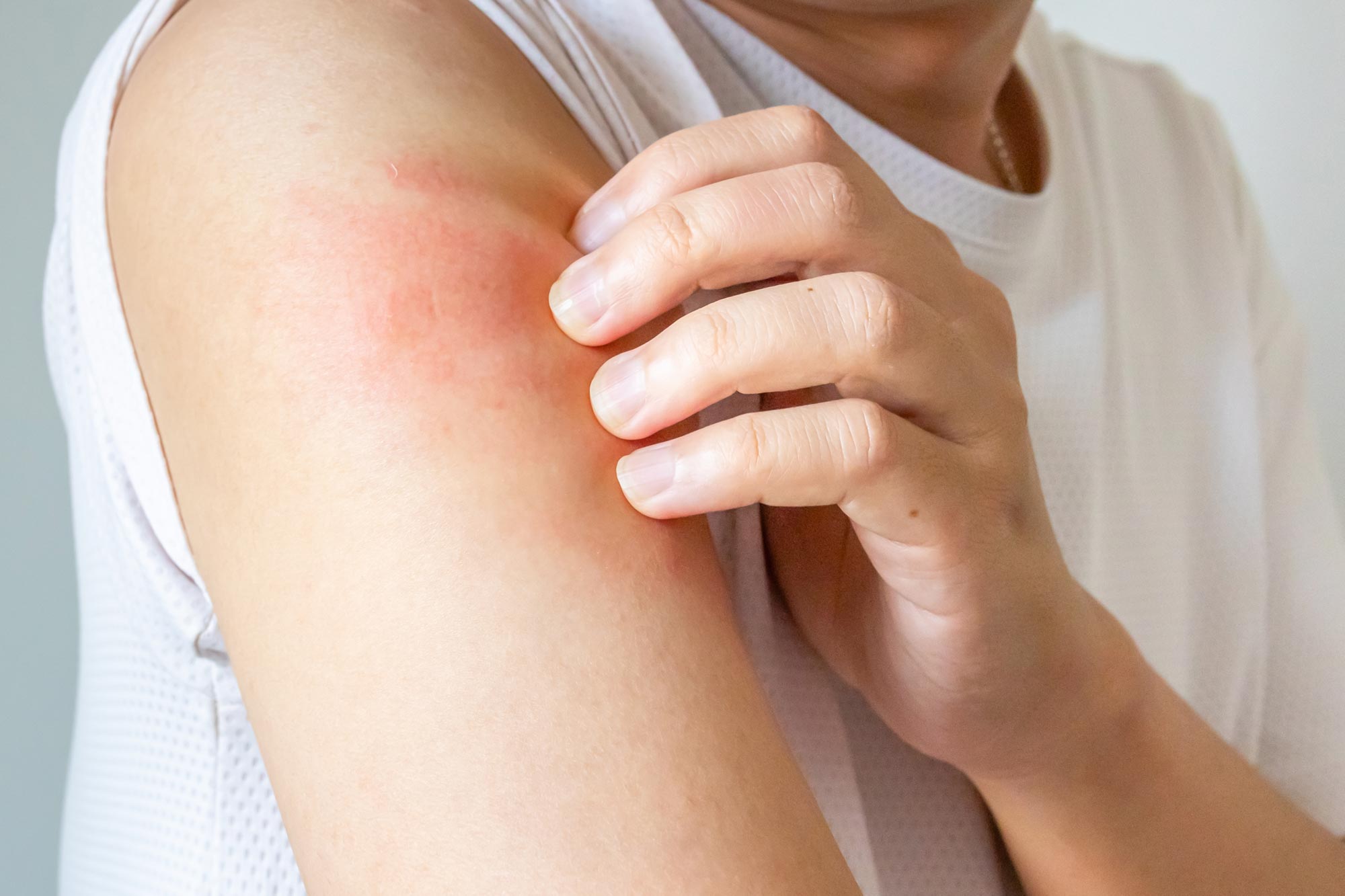
A newly identified sensory pathway links fine hairs to itch sensations, revealing an unexpected biological system that may contribute to chronic itching disorders and provide new targets for treatment.
An itch can seem simple, but scientists are finding that the sensation is far more complex than it appears. Researchers at the University of Michigan have now uncovered a previously unknown sensory pathway in mice that links tiny touch-sensitive hairs to the urge to scratch. The discovery sheds light on a form of itch that has remained largely mysterious and could eventually help researchers tackle chronic itching disorders that affect millions of people.
“Itch is one of the major symptoms in most chronic skin inflammation patients,” said Bo Duan, associate professor in the Department of Molecular, Cellular, and Developmental Biology. “What we’ve discovered is a pathway that we believe plays a very important role for both acute and chronic itch sensation.”
The study identified a previously unrecognized type of hair in mice, called vellus-like hairs, along with a specialized group of sensory neurons that detect movement of those hairs and relay itch signals to the nervous system. The findings were published in Neuron and supported in part by the National Institutes of Health.
Scientists have long understood how chemical irritants such as mosquito bites, poison ivy, and allergens can trigger itching. Mechanical itch is different. Instead of being caused by chemicals, it arises from physical stimulation of the skin or hair.
A Hidden Sensory System
The newly identified hairs resemble human vellus hairs, the fine, lightly pigmented hairs commonly known as peach fuzz. While these hairs cover much of the human body, researchers have known surprisingly little about their role in sensation.
To investigate, the team studied mice with chronic skin inflammation, a condition similar to eczema in humans. Mice with functioning sensory neurons connected to the vellus-like hairs scratched normally. However, animals lacking those neurons, or those in which the neurons had been disabled, showed a dramatic reduction in scratching behavior.
The results suggest that these neurons are a key part of a dedicated pathway that drives mechanical itch.
“We need a new pathway to target if we want to treat chronic itch,” Duan said. “And our research suggests that this population of neurons could be a target in the future. We have ongoing projects looking at this.”
Clues That Humans May Share the Same Mechanism
The researchers cannot directly test the pathway in people, but several findings suggest a similar system may exist in humans.
Humans possess the genes needed to produce these touch-sensitive neurons. The team also identified proteins in mice that help carry itch signals from hairs to the spinal cord. When the researchers exposed human neurons grown in culture to those same proteins, the cells responded.
“Our study indicates that humans may have this same kind of mechanism to transmit mechanical itch,” Duan said. “It also reveals that the body has a dedicated system for this type of sensation.”
The Simple Experiment Anyone Can Try
One of Duan’s favorite demonstrations highlights just how sensitive these tiny hairs can be.
Take a tissue and twist one corner into a fine point. Then gently brush it across the small hairs around your lips. Avoid the thicker terminal hairs and focus on the fine peach fuzz. Under the right conditions, the sensation can trigger an unmistakable itch.
“Humans and animals experience this kind of itch, but no one knew the molecular and cellular mechanisms behind it,” Duan said.
The new study helps explain why that happens. It identifies a pathway that links movement of specialized hairs to neural activity that can ultimately produce the urge to scratch.
Solving a Century-Old Mystery
The story of these hairs actually began more than 100 years ago.
Scientists had previously noted that certain vellus-like hairs in mice, particularly those found behind the ears, beneath the lips, and near the paws, appeared unusual. Yet despite those early observations, the hairs remained largely overlooked by sensory researchers.
Part of the challenge was methodological. Researchers had no established way to measure mechanical itch in mice.
“A mouse can’t say that it’s itchy,” Duan said. “But it will scratch.”
To overcome that problem, the team developed its own testing approach. Researchers gently stroked the animals’ vellus-like hairs using a small loop of thread and monitored their responses.
After identifying the neurons involved, the scientists genetically modified those cells so they could be activated by blue light. When the researchers shined blue light onto the animals’ skin, the mice scratched in much the same way they did during physical stimulation. The experiment provided strong evidence that the neurons were directly responsible for generating the itch response.
Why We Are Not Constantly Scratching
The discovery also raises an obvious question. If fine hairs are capable of triggering itch, why do humans not spend all day scratching?
The answer appears to lie deeper within the nervous system.
Although vellus hairs cover most of the body (with some notable exceptions like the palms of our hands), the spinal cord contains specialized “gating” circuits that filter incoming sensory information. These neural circuits help suppress mechanical itch signals before they reach conscious awareness.
Without those built-in filters, ordinary sensations such as clothing brushing against the skin, a breeze across the face, or a strand of hair moving out of place could become overwhelming sources of irritation.
Researchers suspect the system may have evolved as a defense mechanism. Vellus hairs are particularly concentrated around the mouth and ears in both mice and humans, locations where insects, parasites, and other small pests could pose a threat. Detecting subtle movements in those areas may have helped mammals identify unwanted intruders before they could cause harm.
Reference: “A specialized population of hair afferents dedicated to transmitting mechanical itch” by Mahar Fatima, Hankyu Lee, Hwayeon Cha, Chia Chun Hor, Feng Wang, Jingyi Liu, Jonathan Damblon, Wenwen Zhang, Katie Qu, Yumena Nagai, Abbey Dinh, Ziyan Wu, Ranveer Ajimal, Ailin Emily Xiong, Madeleine Chai, Alyssa Asmar, Wei Cai, Xiaowei Zhou, Anuraag Balaji, Haili Pan, Lorraine Horwitz, Lam C. Tsoi, Hongzhen Hu, X. Z. Shawn Xu, Yves De Koninck and Bo Duan, 4 June 2026, Neuron.
DOI: 10.1016/j.neuron.2026.05.017
Funding: National Institutes of Health
Never miss a breakthrough: Join the SciTechDaily newsletter.
Follow us on Google and Google News.